



Eastern Ecological Science Center Marine Research Highlights
June is National Ocean Month! Explore USGS ocean science and learn how environmental DNA (eDNA) helps Eastern Ecological Science Center study marine ecosystems.
Deep sea ocean waters, particularly those greater than 200 meters in depth and often found offshore near the edges of the U.S. Exclusive Economic Zone (EEZ), are still largely unexplored because they are remote and difficult to access. In collaboration with the Bureau of Ocean Energy Management (BOEM), the National Oceanic and Atmospheric Administration (NOAA), USGS colleagues, and other federal agency researchers, the Eastern Ecological Science Center (EESC), is carrying out eDNA studies in marine environments to better understand biodiversity extending from the surface all the way to the seafloor.
Role of eDNA Methods in Deep-Sea Research
eDNA methods play a crucial role in studying deep-sea habitats. DNA shed by organisms in cellular material such as skin cells, or even entire microscopic life forms like microalgae, can be collected from seawater and sediment samples. Scientists can isolate and sequence this eDNA, enabling the detection and analysis of a wide range of species, including those difficult to observe directly. Sampling water and sediment at marine expedition sites allows researchers to assess biodiversity and identify rare species often missed by traditional methods such as trawling or using cameras on remotely operated vehicles. eDNA collection is also non-invasive, minimizing disturbance to deep-sea ecosystems.
In recognition of National Ocean Month, here is a look at how EESC scientists are using eDNA to enhance understanding of marine environments.
Aleutian Islands Seafloor Mapping: Hazards, Minerals, and Deep Corals
In September 2025, EESC joined a diverse team of researchers including USGS colleagues from the Wetland and Aquatic Research Center, Pacific Coastal and Marine Science Center, St. Petersburg Coastal and Marine Science Center, and Woods Hole Coastal and Marine Science Center, on a USGS-led expedition in the Aleutian Arc off Alaska in collaboration with BOEM and NOAA. The expedition aims to deliver essential data about energy resources, underwater earthquakes and other hazards, seafloor habitats, biological resources including vital fisheries, and potential seabed minerals.
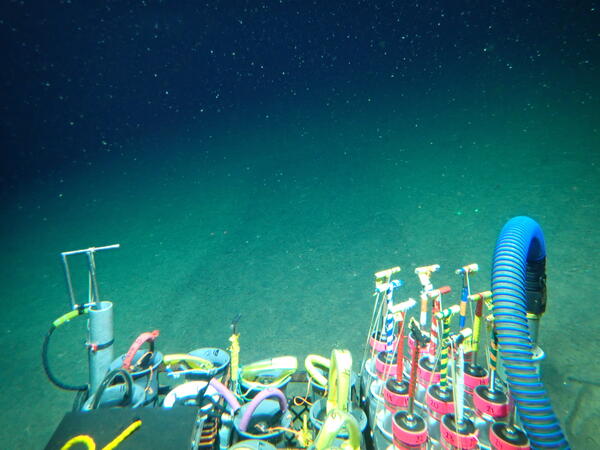
Research objectives within this expedition include using eDNA and genomic techniques to identify organisms that are difficult to spot visually, increase taxonomic accuracy, and build DNA reference libraries for lesser-known deep-sea species.
During the expedition, researchers descended to the sea floor aboard ALVIN, a deep-ocean submersible used in scientific exploration. ALVIN can transport two scientists down to 6,500 meters for up to ten hours and has played an important role in numerous ocean discoveries. While on the sea floor, eDNA samples were collected using Niskin bottles attached directly to ALVIN. Throughout the Aleutian Arc voyage, EESC scientist Aaron Aunins gathered over 200 eDNA samples throughout the water column, from the ocean floor up to the surface across multiple locations in the Aleutian Arc.
Once the trip was complete, all eDNA samples were frozen and sent to EESC’s Leetown Research Laboratory for further analysis. EESC scientists are responsible for sequencing these eDNA samples to identify corals, fishes, invertebrates and other biodiversity. They are also conducting spatial analyses to connect biological communities with geological and oceanographic features to better understand deep-sea ecosystems and food webs. DNA extraction from all samples collected during the 2025 expedition is complete, with DNA sequencing set to start in fall 2026.
Learn more about eDNA collection during the expedition here: Detecting Hydrothermal Vents and Collecting Environmental DNA: Investigating the Water Column in the Aleutian Arc | U.S. Geological Survey.
Expedition to Study Abyssal Nodules and Ecosystems in Hawaii
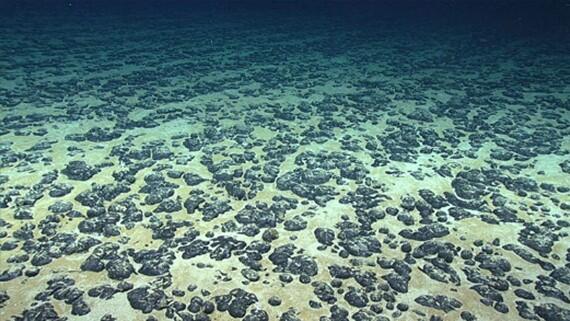
During fall 2025, USGS scientists led the Hawaiʻi Abyssal Nodules and Associated Ecosystems Expedition to examine the geology, minerals, and environment of the deep seabed near Hawaiʻi Island in the U.S. EEZ. This effort is a collaboration with BOEM and NOAA.
Using eDNA methods will be a key part of this research because they let scientists find and study different organisms living in deep-sea environments. EESC scientists will analyze water and sediment samples gathered during the expedition to extract and sequence DNA fragments shed by microbes, animals, and other creatures in the area. This will help them get a complete picture of the biodiversity, including spotting rare or hard-to-find species that might not show up with other survey methods.
Studying eDNA will help scientists figure out which biological communities are found within different kinds of sea floor and environmental settings, and whether there are special groups in places with manganese nodules or other minerals. This approach also allows researchers to link what they find in the biology with the geology and ocean features, giving them a better understanding of how ecosystems are put together and how they stretch across the deep ocean. In the end, using eDNA will fill important gaps in what we know about deep-sea life and help improve worldwide predictions about where minerals are found and what habitats exist.
Click here to watch a video about the expedition: Expedition Recap - Hawaiʻi Abyssal Nodules and Associated Ecosystems | U.S. Geological Survey
Gulf of America Coral Research
In the Gulf of America, the USGS is partnering with other federal agencies and research groups to improve coral protection and management in mesophotic and deep benthic communities. Mesophotic coral ecosystems are located in tropical and subtropical areas at depths between about 30 and 150 meters beneath the sea surface. This area is mainly made up of corals, sponges, and algae, which form the structural habitat in this zone.

In March 2026, EESC scientist Cassia Busch joined a NOAA expedition off the coast of Charleston, SC, as part of the Coral Propagation Technique Development project. This project is one of four collaborative projects working to restore mesophotic and deep benthic communities in the Gulf of America. During this expedition, several live Swiftia exserta corals (or orange fan corals), which were first collected in 2021, were returned to the seafloor. These corals have been carefully maintained for over four years at facilities in Charleston, Gainesville, and Miami, where experts monitored their growth and optimized their tank conditions. Now reintroduced to their natural habitat, scientists will observe them over the coming years to study how they grow after being returned to the seafloor. The team also surveyed the seafloor, collecting new coral samples for age and growth analyses, and taking water samples for flow cytometry and eDNA extraction. These samples will help identify which species are in the water column and provide valuable indicators of reef health, including the detection of rare organisms.
Since 2022, scientists have collected more than 4,000 samples from throughout the Gulf of America as part of this 8-year project. These samples will help them track changes in the biological community in the area over time using eDNA analysis. EESC is conducting the eDNA analysis for this project and in June 2026, they will join another Gulf expedition to collect more water samples for eDNA analysis.
Learn more about this project here: Mesophotic and Deep Benthic Communities: Coral Propagation Technique (CPT) Development Project | U.S. Geological Survey