U.S. flag

An official website of the United States government

Florence Bascom Geoscience Center

The primary mission of the Florence Bascom Geoscience Center (FBGC) is to provide detailed scientific data and assessments to support natural resource management, public safety, and national security. The FBGC specializes in:

Geologic mapping and hazards

Paleontology, stratigraphy, and environmental geology

Special geologic studies at the intersection of national security and mineral resources

Publications

Stratigraphic notes—Volume 3, 2026 Stratigraphic notes—Volume 3, 2026

This is the third volume in the U.S. Geological Survey (USGS) series of reports on stratigraphy entitled “Stratigraphic Notes,” which consists of short papers that highlight stratigraphic studies, changes in stratigraphic nomenclature, and explanations of stratigraphic names and concepts used on published geologic maps. “Stratigraphic Notes” is a long-term (multiyear), multivolume...

Correcting a systematic bias in an ocean drilling project site 882 alkenone sea surface temperature record Correcting a systematic bias in an ocean drilling project site 882 alkenone sea surface temperature record

Reconstructions of sea surface temperature (SST) in the geologic record are fundamental to our understanding of Earth's climate history and the evaluation of Earth's climate sensitivity to greenhouse gas forcing. SSTs are reconstructed with a variety of methods, including alkenone biomarker lipids produced by certain coccolithophore algae. One such alkenone SST reconstruction from the...
Authors
Joseph B. Novak, Rocio P. Caballero-Gill, Timothy D. Herbert, Harry J. Dowsett, Alfredo Martinez-Garcia

Science

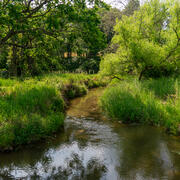
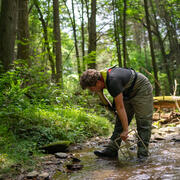
Evaluating the Effects of Stream-Restoration Practices in an Impaired Agricultural System

Stream-restoration practices are widely used throughout the Chesapeake Bay watershed to improve stream health and function, but research into their effectiveness is limited in agricultural settings. A study in Turtle Creek, Pennsylvania, suggests that stream-restoration practices can significantly reduce streambank erosion and enhance floodplain deposition, changes that can reduce in-stream...
Evaluating the Effects of Stream-Restoration Practices in an Impaired Agricultural System

Evaluating the Effects of Stream-Restoration Practices in an Impaired Agricultural System

Stream-restoration practices are widely used throughout the Chesapeake Bay watershed to improve stream health and function, but research into their effectiveness is limited in agricultural settings. A study in Turtle Creek, Pennsylvania, suggests that stream-restoration practices can significantly reduce streambank erosion and enhance floodplain deposition, changes that can reduce in-stream...
Learn More

The “sediment shadow” in Chesapeake Bay’s tidal freshwater rivers has important implications for restoration

Chesapeake Bay restoration efforts are focused on reducing nitrogen, phosphorus, and sediment loads to the estuary. A new synthesis of existing long-term records of suspended-sediment concentrations suggests that only a limited amount of watershed sediment is currently transported by rivers past the tidal freshwater zone and into saltier waters of the Chesapeake Bay.
The “sediment shadow” in Chesapeake Bay’s tidal freshwater rivers has important implications for restoration

The “sediment shadow” in Chesapeake Bay’s tidal freshwater rivers has important implications for restoration

Chesapeake Bay restoration efforts are focused on reducing nitrogen, phosphorus, and sediment loads to the estuary. A new synthesis of existing long-term records of suspended-sediment concentrations suggests that only a limited amount of watershed sediment is currently transported by rivers past the tidal freshwater zone and into saltier waters of the Chesapeake Bay.
Learn More

500 Years of Extreme Potomac Floods at Washington D.C.

Large floods on the Potomac River in Washington D.C. can be documented as early as 1784, and based on historical data and recent measurements, have occurred with increasing frequency since the mid-19th century. Human modifications to the Potomac estuary since Washington D.C. was established as the Federal capital, as well as increasingly heavy rainfall and land clearance in the watershed, likely...
500 Years of Extreme Potomac Floods at Washington D.C.

500 Years of Extreme Potomac Floods at Washington D.C.

Large floods on the Potomac River in Washington D.C. can be documented as early as 1784, and based on historical data and recent measurements, have occurred with increasing frequency since the mid-19th century. Human modifications to the Potomac estuary since Washington D.C. was established as the Federal capital, as well as increasingly heavy rainfall and land clearance in the watershed, likely...
Learn More
Was this page helpful?