



Between a Rock and a Hard Place: Experiences of the Chronic Wasting Disease Management Community
Chronic Wasting Disease (CWD) has proven to be a complex issue for wildlife managers: effective disease management may not always align with stakeholder wants. In a new study, researchers found that some wildlife managers are feeling caught between a rock and a hard place, operating under constrained decision options where they may struggle to reduce CWD prevalence and meet the public’s needs.
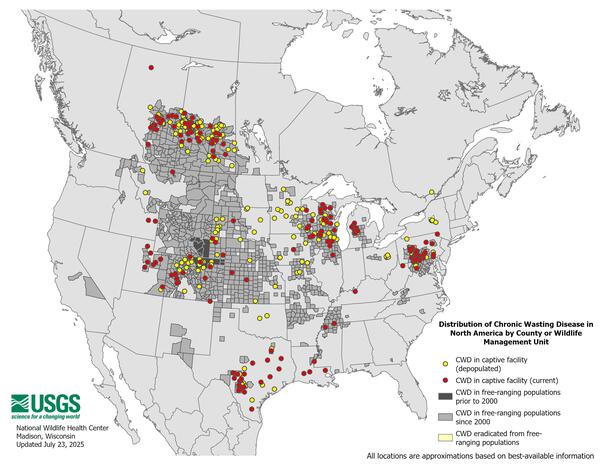
Chronic Wasting Disease (CWD), a deadly neurological disease infecting cervids (elk, deer, moose), is spreading across the country.
Now in 35 states, CWD poses a meaningful challenge for cervid populations and the associated communities that depend on them for hunting, farming, and cultural uses.
CWD is transmitted through contact with other infected animals or contaminated environments. For wildlife managers, it presents a multitude of epidemiological challenges, as it is highly transmissible, individuals can be asymptomatic but spread CWD for years undetected, and it can remain in the environment for long periods of time.
A new management challenge
Managers are also facing novel social and regulatory issues that exacerbate the management challenges of this deadly disease. Historically, cervid management strategies have aligned with the preferences of recreational hunters, with active efforts to increase participation. CWD is disrupting this alignment: effective wildlife management strategies for reducing CWD, namely reducing cervid population densities, are not resonating with hunters or some landowners.
Exploring management experiences
Exploratory, qualitative social science methods can be effective for identifying new paths to overcoming difficult management issues. In a recently published study in Society and Natural Resources, social science researchers at FORT and the US Fish and Wildlife Service evaluated the experiences of CWD managers to learn more about management strategies, challenges, and opinions. They interviewed experts from a broad range of backgrounds – including different management levels, state agencies, and Tribal nations – to ensure they were exploring a range of decision-maker perspectives.
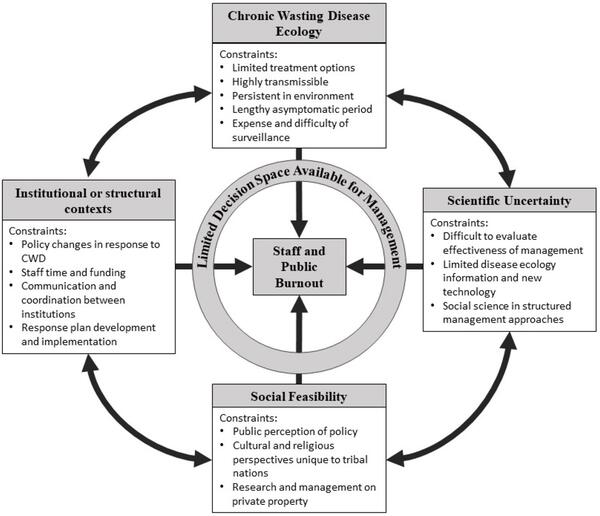
The researchers found that constraints to decision making were surprisingly similar across experts, despite differences in managed species, population sizes, locations, budgets, and staffing. In addition, they describe how these external factors were limiting the availability of decision alternatives for managers, where CWD managers were pressured to maintain the current management practices because changes risked losing trust, support, or even hunting participation. Ultimately, these pressures contributed to a common perception of burnout identified by the study participants (Figure 1).
New insights provide potential paths forward
This study presented a new conceptual model of the difficulties of CWD management, providing novel insights that can be experimentally tested to determine the importance of different challenges to the larger CWD management community. Managers can also use the model to conceptualize current and future constraints of CWD management within their own management realities.
Related

Mapping Chronic Wasting Disease Management: Identify Opportunities for Intervention

Chronic Wasting Disease
Related
Mapping Chronic Wasting Disease Management: Identify Opportunities for Intervention