



Geophysical and Geological Characterization of Mineral Deposit Localization in the Colorado Mineral Belt and Surrounding Lithosphere: Structural Geology
Geologic structures in the Colorado Mineral Belt occur over many scales and include folds, faults, fractures, veins, dikes, foliations, etc. These structures can control the strength and fluid flow properties of rock units and are commonly involved with the formation and localization of mineral deposits.
The Colorado Mineral Belt (CMB) contains many thousands of fault veins and numerous other geological structures providing information on local and regional scale motion, age, and chemistry of rock units. When representative samples and field data are collected, and chemical and age analyses are completed in our laboratories, a comprehensive picture emerges. Not only can we learn the directions of motion of blocks of Earth relative to one another, but when that motion occurred and if there are distinct mineral systems associated with different structures in different places. This information allows new understanding of how mineral hosting structures formed, and where and why they are localized in some areas but not in others. The goal of the CMB Project Structural Geology Task is to compile existing and new data and characterize the spatiotemporal structural controls on mineral deposits and tie them to other ore forming processes such as magmatism and far field plate tectonic driving forces.
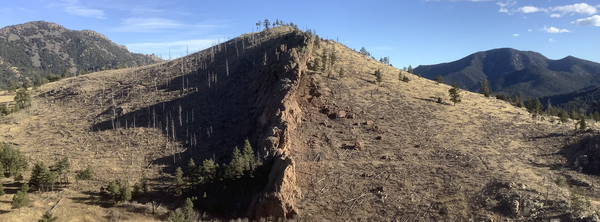
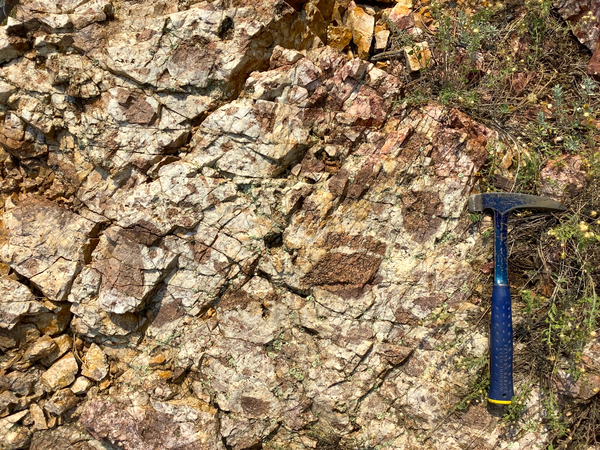
The figure below is an example of the 3rd most productive gold-quartz vein structure in the central, northeast CMB. The vein was deposited from hydrothermal fluids cutting across foliation in ~1.7 Ga gneiss. Evidence of faulting along the vein is also preserved as "slickensides", where adjacent blocks of rock moved past one another, literally scratching the rocks and recording of the direction of motion. Because the fluids moving through this "fault vein" were hot, they altered the surrounding host rocks, leaving behind clay minerals. Vein chemistry allows for the determination of mineral contents and clay minerals can be dated using advanced geochronology techniques.

This project is a task of the Geophysical and Geological Characterization of Mineral Deposit Localization in the Colorado Mineral Belt and Surrounding Lithosphere project.

Geophysical and Geological Characterization of Mineral Deposit Localization in the Colorado Mineral Belt and Surrounding Lithosphere
Geologic structures in the Colorado Mineral Belt occur over many scales and include folds, faults, fractures, veins, dikes, foliations, etc. These structures can control the strength and fluid flow properties of rock units and are commonly involved with the formation and localization of mineral deposits.
The Colorado Mineral Belt (CMB) contains many thousands of fault veins and numerous other geological structures providing information on local and regional scale motion, age, and chemistry of rock units. When representative samples and field data are collected, and chemical and age analyses are completed in our laboratories, a comprehensive picture emerges. Not only can we learn the directions of motion of blocks of Earth relative to one another, but when that motion occurred and if there are distinct mineral systems associated with different structures in different places. This information allows new understanding of how mineral hosting structures formed, and where and why they are localized in some areas but not in others. The goal of the CMB Project Structural Geology Task is to compile existing and new data and characterize the spatiotemporal structural controls on mineral deposits and tie them to other ore forming processes such as magmatism and far field plate tectonic driving forces.
The figure below is an example of the 3rd most productive gold-quartz vein structure in the central, northeast CMB. The vein was deposited from hydrothermal fluids cutting across foliation in ~1.7 Ga gneiss. Evidence of faulting along the vein is also preserved as "slickensides", where adjacent blocks of rock moved past one another, literally scratching the rocks and recording of the direction of motion. Because the fluids moving through this "fault vein" were hot, they altered the surrounding host rocks, leaving behind clay minerals. Vein chemistry allows for the determination of mineral contents and clay minerals can be dated using advanced geochronology techniques.
This project is a task of the Geophysical and Geological Characterization of Mineral Deposit Localization in the Colorado Mineral Belt and Surrounding Lithosphere project.