



USGS Great Lakes Science Center student contractor performing annual monitoring for the Phragmites Adaptive Management Framework (PAMF). Photo Credit: Taaja Tucker-Silva, USGS.
Images
Images captured by GLSC scientists while working in and around the Great Lakes.
Filter Total Items: 495
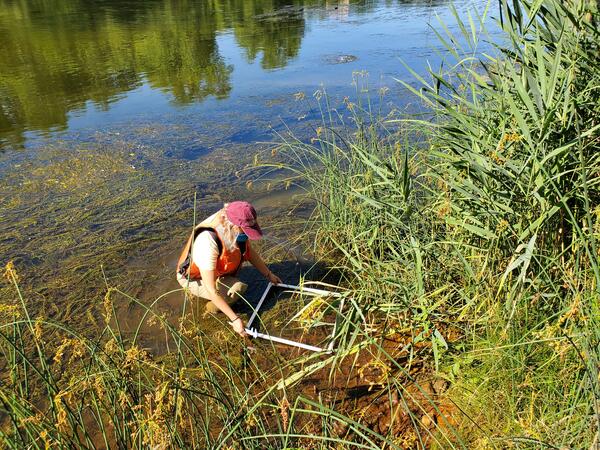
Taking Basic Density Measurements
USGS Great Lakes Science Center student contractor performing annual monitoring for the Phragmites Adaptive Management Framework (PAMF). Photo Credit: Taaja Tucker-Silva, USGS.
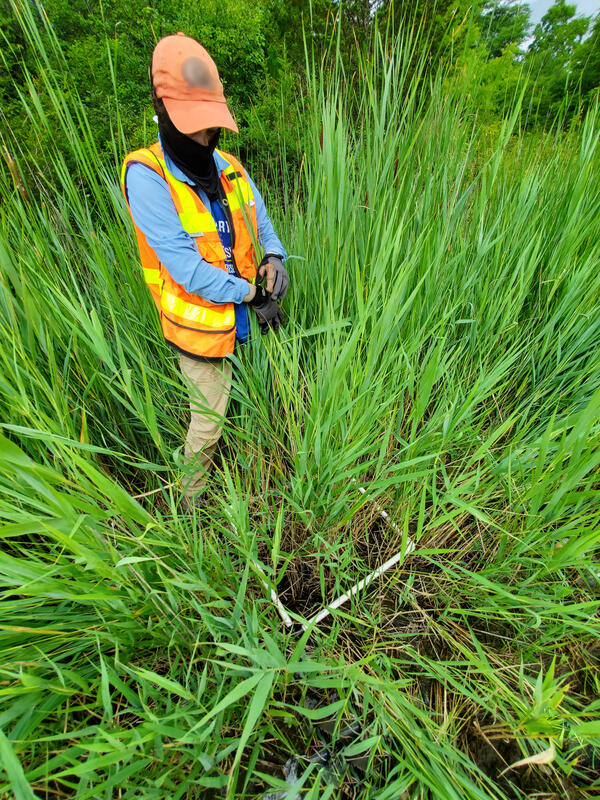
Counting Phragmites
A masked USGS Great Lakes Science Center contractor counts invasive Phragmites stems within a quadrat as part of a monitoring assistance program across Michigan, Indiana, and Ohio through the Phragmites Adaptive Management Framework.
A masked USGS Great Lakes Science Center contractor counts invasive Phragmites stems within a quadrat as part of a monitoring assistance program across Michigan, Indiana, and Ohio through the Phragmites Adaptive Management Framework.

Car Boat Comes to Dock in Lake Michigan
While tied up at a boat launch on Lake Michigan, preparing the Great Lakes Science Center’s R/V Stonecat for a day of field work, the research team was met with a surprise: A car boat coming in off the water!
While tied up at a boat launch on Lake Michigan, preparing the Great Lakes Science Center’s R/V Stonecat for a day of field work, the research team was met with a surprise: A car boat coming in off the water!
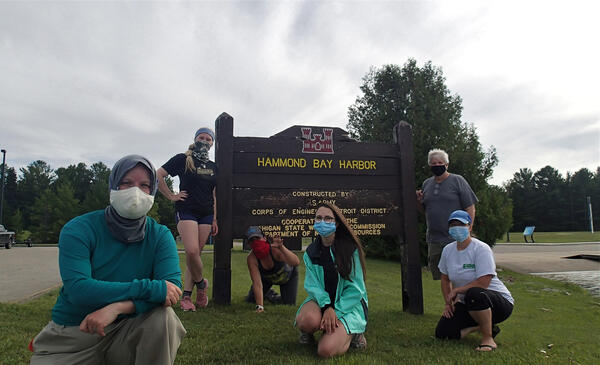
Masks and Social Distance Practice in the Field
Members of the USGS Great Lakes Science Center’s Cladophora Project team posed for a socially distanced photo before sampling in Lake Huron. The Great Lakes Integrated Cladophora Assessment Project is a Great Lakes-wide study into whether nuisance Cladophora algae could be managed by limiting phosphorus inputs.
Members of the USGS Great Lakes Science Center’s Cladophora Project team posed for a socially distanced photo before sampling in Lake Huron. The Great Lakes Integrated Cladophora Assessment Project is a Great Lakes-wide study into whether nuisance Cladophora algae could be managed by limiting phosphorus inputs.

Diver Entering Lake Huron to Monitor Cladophora
After making a splash in Lake Huron, diver and USGS Great Lakes Science Center contractor, Ashley Spoljaric (Chesterton, Indiana) will survey the area for the nuisance algae Cladophora and invasive dreissenid mussel populations as part of the Great Lakes Integrated Cladophora Assessment Project.
After making a splash in Lake Huron, diver and USGS Great Lakes Science Center contractor, Ashley Spoljaric (Chesterton, Indiana) will survey the area for the nuisance algae Cladophora and invasive dreissenid mussel populations as part of the Great Lakes Integrated Cladophora Assessment Project.

Larval Fish from Lake Michigan Under a Microscope
Larval fish collected during icthyoplankton sampling in Lake Michigan as part of the Environmental Protection Agency’s Cooperative Science and Monitoring Initiative (CSMI) that targeted Lake Michigan in 2020.
Larval fish collected during icthyoplankton sampling in Lake Michigan as part of the Environmental Protection Agency’s Cooperative Science and Monitoring Initiative (CSMI) that targeted Lake Michigan in 2020.

Counting and Measuring Invasive Dreissenid Mussels
Counting and Measuring Invasive Dreissenid MusselsUSGS contractor Victoria Conn counting and measuring invasive dreissenid mussels in a laboratory at the GLSC Lake Michigan Ecological Research Station (Chesterton, Indiana) as part of the Great Lakes Integrated Cladophora Assessment Project.
Counting and Measuring Invasive Dreissenid Mussels
Counting and Measuring Invasive Dreissenid MusselsUSGS contractor Victoria Conn counting and measuring invasive dreissenid mussels in a laboratory at the GLSC Lake Michigan Ecological Research Station (Chesterton, Indiana) as part of the Great Lakes Integrated Cladophora Assessment Project.

Tucker Trawl Net Used for Ichthyoplankton Sampling on Lake Michigan
Tucker Trawl Net Used for Ichthyoplankton Sampling on Lake MichiganThe USGS completed numerous fishery research surveys safely on the Great Lakes in 2020; masked scientists aboard the USGS Research Vessel Sturgeon rinse a Tucker trawl net during ichthyoplankton sampling on Lake Michigan.
Tucker Trawl Net Used for Ichthyoplankton Sampling on Lake Michigan
Tucker Trawl Net Used for Ichthyoplankton Sampling on Lake MichiganThe USGS completed numerous fishery research surveys safely on the Great Lakes in 2020; masked scientists aboard the USGS Research Vessel Sturgeon rinse a Tucker trawl net during ichthyoplankton sampling on Lake Michigan.
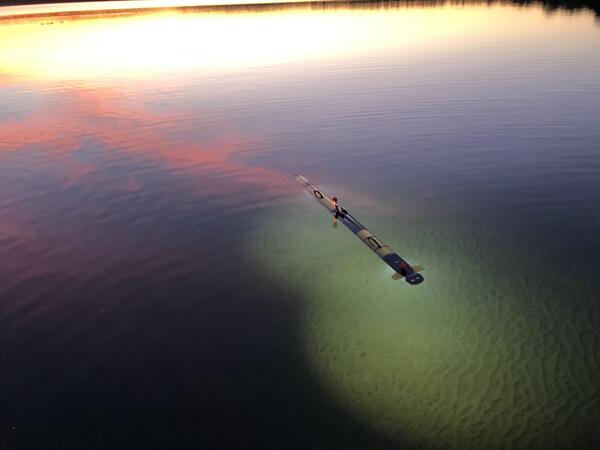
A USGS Autonomous Underwater Vehicle in Lake Michigan
A USGS Autonomous Underwater Vehicle in Lake MichiganA USGS Autonomous Underwater Vehicle illuminates the lake floor in Grand Traverse Bay, Lake Michigan, remotely sensing invasive Round Goby, invasive mussels, and nuisance algae and mapping aquatic habitats to support fisheries management in the Great Lakes.
A USGS Autonomous Underwater Vehicle in Lake Michigan
A USGS Autonomous Underwater Vehicle in Lake MichiganA USGS Autonomous Underwater Vehicle illuminates the lake floor in Grand Traverse Bay, Lake Michigan, remotely sensing invasive Round Goby, invasive mussels, and nuisance algae and mapping aquatic habitats to support fisheries management in the Great Lakes.

Cladophora Survey in Lake Erie
A USGS Great Lakes Science Center contractor uses an underwater quadrat to survey the nuisance algae Cladophora and invasive dreissenid mussel populations in Lake Erie as part of the Great Lakes Integrated Cladophora Assessment Project.
A USGS Great Lakes Science Center contractor uses an underwater quadrat to survey the nuisance algae Cladophora and invasive dreissenid mussel populations in Lake Erie as part of the Great Lakes Integrated Cladophora Assessment Project.

Smallmouth bass seen while SCUBA diving in Lake Erie
Smallmouth bass seen while SCUBA diving in Lake ErieSmallmouth bass seen while SCUBA diving in Lake Erie as part of the Great Lakes Integrated Cladophora Assessment Project.
Smallmouth bass seen while SCUBA diving in Lake Erie
Smallmouth bass seen while SCUBA diving in Lake ErieSmallmouth bass seen while SCUBA diving in Lake Erie as part of the Great Lakes Integrated Cladophora Assessment Project.

A Bloater Chub from Lake Ontario
A “bloater,” also known as a deepwater cisco, caught in Lake Ontario from the USGS Great Lakes Science Center’s research vessel Kaho—they are one of several native coregonine species recently highlighted in the winter 2021 edition of DOI Newswave. Read more at: https://ww
A “bloater,” also known as a deepwater cisco, caught in Lake Ontario from the USGS Great Lakes Science Center’s research vessel Kaho—they are one of several native coregonine species recently highlighted in the winter 2021 edition of DOI Newswave. Read more at: https://ww

SCUBA Tanks at the Ready in Lake Erie
SCUBA tanks secured as a Great Lakes Science Center small vessel motors through the water to a dive site on Lake Erie where researchers will survey for the nuisance algae, Cladophora, as part of the Great Lakes Integrated Cladophora Assessment Project.
SCUBA tanks secured as a Great Lakes Science Center small vessel motors through the water to a dive site on Lake Erie where researchers will survey for the nuisance algae, Cladophora, as part of the Great Lakes Integrated Cladophora Assessment Project.

Filtering Water with a Vacuum Pump
Filtering water with a vacuum pump to measure water quality and perform a nutrient analysis as part of the Great Lakes Integrated Cladophora Assessment Project - and - filtering COVID with a mask.
Filtering water with a vacuum pump to measure water quality and perform a nutrient analysis as part of the Great Lakes Integrated Cladophora Assessment Project - and - filtering COVID with a mask.

Dark Skies While Returning to Port in Grand Haven, Michigan
Dark Skies While Returning to Port in Grand Haven, MichiganAfter a day of deploying an autonomous underwater vehicle along the shore of Lake Michigan, the field team encountered dark skies while returning to port in Grand Haven, Michigan.
Dark Skies While Returning to Port in Grand Haven, Michigan
Dark Skies While Returning to Port in Grand Haven, MichiganAfter a day of deploying an autonomous underwater vehicle along the shore of Lake Michigan, the field team encountered dark skies while returning to port in Grand Haven, Michigan.
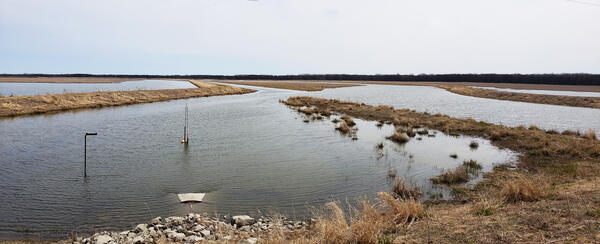
Shiawassee National Wildlife Refuge, MI in Panorama
Shiawassee National Wildlife Refuge, MI in PanoramaLandscape view of the water control structure at Maankiki Marsh Complex – Center unit: a hydrologically restored wetland unit at the Shiawassee National Wildlife Refuge.
Shiawassee National Wildlife Refuge, MI in Panorama
Shiawassee National Wildlife Refuge, MI in PanoramaLandscape view of the water control structure at Maankiki Marsh Complex – Center unit: a hydrologically restored wetland unit at the Shiawassee National Wildlife Refuge.

The Hammond Bay Biological Station Administration Building
The Hammond Bay Biological Station Administration BuildingThe USGS Hammond Bay Biological Station, a field station of the Great Lakes Science Center, located near Millersburg, Michigan.
The Hammond Bay Biological Station Administration Building
The Hammond Bay Biological Station Administration BuildingThe USGS Hammond Bay Biological Station, a field station of the Great Lakes Science Center, located near Millersburg, Michigan.

Phytoplankton under a microscope
Phytoplankton, including diatoms, viewed under a microscope. Phytoplankton occupy the lower levels of the food web.
Phytoplankton, including diatoms, viewed under a microscope. Phytoplankton occupy the lower levels of the food web.

A Native Water Flea (left) and an Invasive Water Flea (right)
A Native Water Flea (left) and an Invasive Water Flea (right)Native vs. Not: A native water flea (Leptodora kindtii; left and clear) and an invasive spiny water flea (Bythotrephes longimanus; right and purple) share space under a microscope after being collected from Lake Huron during a hydroacoustics survey.
A Native Water Flea (left) and an Invasive Water Flea (right)
A Native Water Flea (left) and an Invasive Water Flea (right)Native vs. Not: A native water flea (Leptodora kindtii; left and clear) and an invasive spiny water flea (Bythotrephes longimanus; right and purple) share space under a microscope after being collected from Lake Huron during a hydroacoustics survey.

Grass carp larvae
These images show grass carp larvae from the Maumee River. Characteristics of larval grass carp include overall length (left), skeletal muscle development (center) and presence of an eye spot that lacks pigmentation (right; pigment starting to develop on lower eye).
These images show grass carp larvae from the Maumee River. Characteristics of larval grass carp include overall length (left), skeletal muscle development (center) and presence of an eye spot that lacks pigmentation (right; pigment starting to develop on lower eye).

Aging a Fish Using a Spine
A pectoral spine cross section from invasive grass carp captured in the Great Lakes. These cross sections are used to determine the age of the fish.
A pectoral spine cross section from invasive grass carp captured in the Great Lakes. These cross sections are used to determine the age of the fish.