



Clutches of eggs in a vernal pool on Outer Island of the Apostle Islands National Lakeshore. Photo credit: Nick Yeager, USGS.
Images
Images captured by GLSC scientists while working in and around the Great Lakes.
Filter Total Items: 494
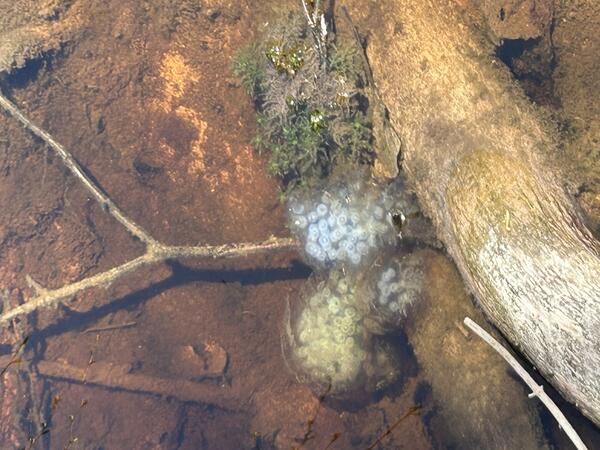
Vernal Pool Party
Clutches of eggs in a vernal pool on Outer Island of the Apostle Islands National Lakeshore. Photo credit: Nick Yeager, USGS.

Aquatic Ambience
The bottom of Lake Huron as seen by USGS divers (GLSC; Chesterton, Indiana) six meters below the surface. Photo credit: Madeleine Giordano, USGS.
The bottom of Lake Huron as seen by USGS divers (GLSC; Chesterton, Indiana) six meters below the surface. Photo credit: Madeleine Giordano, USGS.

Dive into Science!
The USGS crew of the R/V Stonecat (GLSC; Chesterton, Indiana and Ann Arbor, Michigan) all geared up for a cold day of research on Lake Huron. Photo credit: Jessica Oswald, USGS Contractor.
The USGS crew of the R/V Stonecat (GLSC; Chesterton, Indiana and Ann Arbor, Michigan) all geared up for a cold day of research on Lake Huron. Photo credit: Jessica Oswald, USGS Contractor.

Small Yet Feisty
A native Northern clearwater crayfish (Faxonius propinquus) collected in the Northern Refuge of Lake Michigan during a lake trout survey aboard the GLSC’s R/V Arcticus. Photo credit: Patty Dieter, USGS.
A native Northern clearwater crayfish (Faxonius propinquus) collected in the Northern Refuge of Lake Michigan during a lake trout survey aboard the GLSC’s R/V Arcticus. Photo credit: Patty Dieter, USGS.
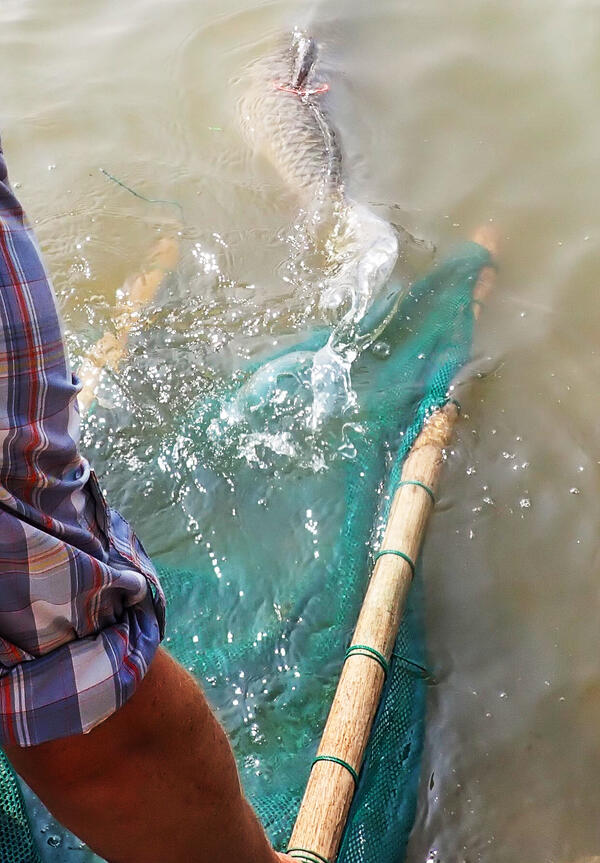
Releasing a Grass Carp with an Acoustic Tag
Tagged Grass Carp swimming away after being release post telemetry surgery into the Sandusky River, OH. Photo credit: James Roberts, USGS.
Tagged Grass Carp swimming away after being release post telemetry surgery into the Sandusky River, OH. Photo credit: James Roberts, USGS.

Crew Ready for Fish
The USGS science crew (GLSC; Ann Arbor, Michigan), vessel crew (GLSC; Cheboygan, Michigan), and a local volunteer are ready at the gillnet lifter table waiting to lift gillnets and pick out fish captured during an annual survey in Lake Michigan. Photo credit: Patty Dieter, USGS.
The USGS science crew (GLSC; Ann Arbor, Michigan), vessel crew (GLSC; Cheboygan, Michigan), and a local volunteer are ready at the gillnet lifter table waiting to lift gillnets and pick out fish captured during an annual survey in Lake Michigan. Photo credit: Patty Dieter, USGS.

Sunset Charlevoix Lighthouse
Evening sunset beaming through the Charlevoix lighthouse following a day of sampling for a spring gillnet survey on Lake Michigan. Photo credit: Patty Dieter, USGS.
Evening sunset beaming through the Charlevoix lighthouse following a day of sampling for a spring gillnet survey on Lake Michigan. Photo credit: Patty Dieter, USGS.

Reef Mapping in Progress
USGS biological science technicians (GLSC; Ann Arbor, Michigan) aboard the R/V Desmid mapping Manistique Rocky Shoal in Lake Michigan. Photo credit: Alden Tilley, USGS.
USGS biological science technicians (GLSC; Ann Arbor, Michigan) aboard the R/V Desmid mapping Manistique Rocky Shoal in Lake Michigan. Photo credit: Alden Tilley, USGS.
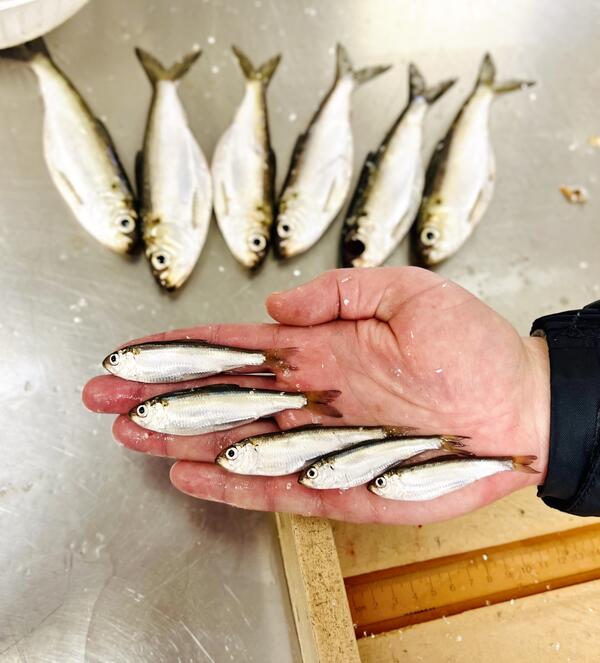
Springtime Alewife
USGS Researchers (GLSC; Ann Arbor, MI) find a few different year classes (ages) in the spring catches of alewife (Alosa pseudoharengus) during a spring prey fish assessment in northeastern Lake Michigan near Sturgeon Bay. Photo credit: Kristy Phillips, USGS.
USGS Researchers (GLSC; Ann Arbor, MI) find a few different year classes (ages) in the spring catches of alewife (Alosa pseudoharengus) during a spring prey fish assessment in northeastern Lake Michigan near Sturgeon Bay. Photo credit: Kristy Phillips, USGS.

Lake Erie Gold
The USGS research crew (GLSC; Huron, OH) aboard the R/V Muskie celebrate a large catch of adult yellow perch (Perca flavescens) to be tagged with acoustic transmitters and then released back into Lake Erie for tracking. Photo credit: Kevin Keretz, USGS.
The USGS research crew (GLSC; Huron, OH) aboard the R/V Muskie celebrate a large catch of adult yellow perch (Perca flavescens) to be tagged with acoustic transmitters and then released back into Lake Erie for tracking. Photo credit: Kevin Keretz, USGS.
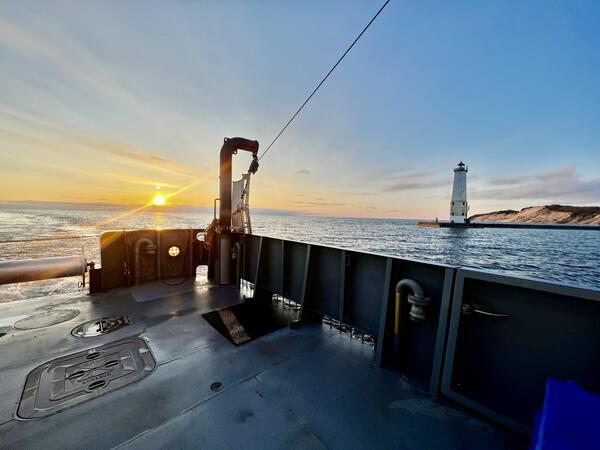
Frankfort Sunset
Sunset after a long day of processing bottom trawl catches aboard the GLSC’s R/V Arcticus. Photo credit: Kristy Phillips, USGS.
Sunset after a long day of processing bottom trawl catches aboard the GLSC’s R/V Arcticus. Photo credit: Kristy Phillips, USGS.
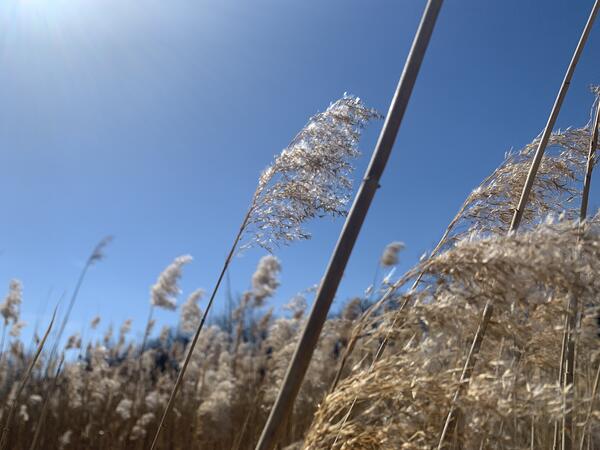
Fluffy Phragmites
A close-up of invasive Phragmites australis during the early spring; this stage results in the formation of fluffy seed heads. Photo credit: Kaira Liggett, USGS Contractor.
A close-up of invasive Phragmites australis during the early spring; this stage results in the formation of fluffy seed heads. Photo credit: Kaira Liggett, USGS Contractor.

A Day at the Jobs Fair
Research Fisheries Biologist Owen Gorman, Great Lakes Science Center, Lake Superior Biological Station attends the Northland College Job Fair on 30 March 2023. Photo Credit: Kelby Youngberg.
Research Fisheries Biologist Owen Gorman, Great Lakes Science Center, Lake Superior Biological Station attends the Northland College Job Fair on 30 March 2023. Photo Credit: Kelby Youngberg.

Tying Knots
USGS contractor Riley Ralph working on knots during the continuing education workshop. Photo Credit: USGS.
USGS contractor Riley Ralph working on knots during the continuing education workshop. Photo Credit: USGS.

Fatmucket Mussel
A gravid Fatmucket mussel (Lampsilis siliquoidea) from which glochidia (larvae) were extracted for in vitro propagation (GLSC; Chesterton, Indiana). Photo credit: Dawn Shively, USGS Contractor.
A gravid Fatmucket mussel (Lampsilis siliquoidea) from which glochidia (larvae) were extracted for in vitro propagation (GLSC; Chesterton, Indiana). Photo credit: Dawn Shively, USGS Contractor.

Diatom in the Rough
A diatom under a light microscope at 10x magnification; this single-celled alga was found while examining a benthic algal sample taken from Lake Michigan. Photo credit: Jessica Oswald, USGS Contractor.
A diatom under a light microscope at 10x magnification; this single-celled alga was found while examining a benthic algal sample taken from Lake Michigan. Photo credit: Jessica Oswald, USGS Contractor.

Swimming in a Sea of Diatoms
A nematode taken from Lake Michigan near Leland, Michigan as seen under a light microscope at 4x magnification. Photo credit: Jessica Oswald, USGS Contractor.
A nematode taken from Lake Michigan near Leland, Michigan as seen under a light microscope at 4x magnification. Photo credit: Jessica Oswald, USGS Contractor.

An Archimedes Screw as a Fish Ladder
A white sucker cascades into a collection basket after being lifted by an Archimedes’ screw (large cylindrical object on top left) during a trial in the Cheboygan River in northern Michigan in 2021. Photo credit: Scott Miehls, USGS.
A white sucker cascades into a collection basket after being lifted by an Archimedes’ screw (large cylindrical object on top left) during a trial in the Cheboygan River in northern Michigan in 2021. Photo credit: Scott Miehls, USGS.

Round Goby Catchability Experiment at Night
An experiment is conducted at the USGS Great Lakes Science Center aquatic research laboratory in Ann Arbor, Michigan, where round gobies (Neogobius melanostomus) are photographed atop varying substrates and day/night conditions. Photo credit: Nick Yeager, USGS.
An experiment is conducted at the USGS Great Lakes Science Center aquatic research laboratory in Ann Arbor, Michigan, where round gobies (Neogobius melanostomus) are photographed atop varying substrates and day/night conditions. Photo credit: Nick Yeager, USGS.

Hammond Bay Biological Station Hosts SLAP Members
SLAP initiative members at Hammond Bay Biological Station, including John Hume (Michigan State University), Trisha Searcy (GLSC), Nick Johnson (GLSC), and Ralph Lampman (Yakima Nation). Photo credit: Tyler Bruning, USGS.
SLAP initiative members at Hammond Bay Biological Station, including John Hume (Michigan State University), Trisha Searcy (GLSC), Nick Johnson (GLSC), and Ralph Lampman (Yakima Nation). Photo credit: Tyler Bruning, USGS.
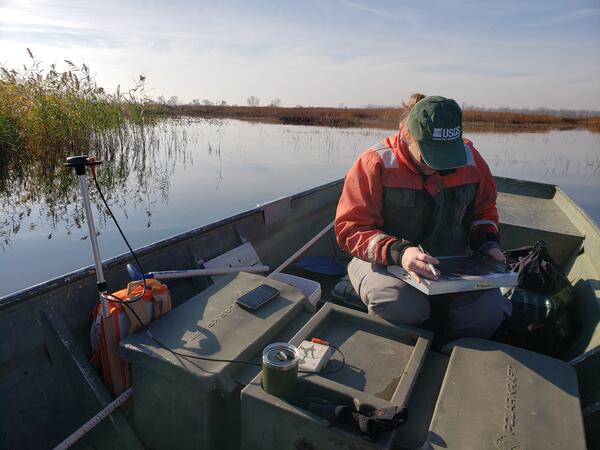
Mapping Wetland Vegetation
USGS ecologist (GLSC; Ann Arbor, Michigan) uses GPS gear to map wetland vegetation at Metzger Marsh at the Ottawa National Wildlife Refuge on the shore of Lake Erie in Ohio. Photo credit: Kurt Kowalski, USGS.
USGS ecologist (GLSC; Ann Arbor, Michigan) uses GPS gear to map wetland vegetation at Metzger Marsh at the Ottawa National Wildlife Refuge on the shore of Lake Erie in Ohio. Photo credit: Kurt Kowalski, USGS.