U.S. flag

An official website of the United States government

Publications

The Center publishes analyses critical to national security on domestic and international mineral supply chains.

Filter Total Items: 606

Mineral of the month: aluminum Mineral of the month: aluminum

Aluminum is the second most abundant metallic element in Earth’s crust after silicon. Even so, it is a comparatively new industrial metal that has been produced in commercial quantities for little more than 100 years. Aluminum is lightweight, ductile, malleable and corrosion resistant, and is a good conductor of heat and electricity. Weighing about one-third as much as steel or copper...
Authors
Patricia A. Plunkert

Mineral Commodity Summaries 2005 Mineral Commodity Summaries 2005

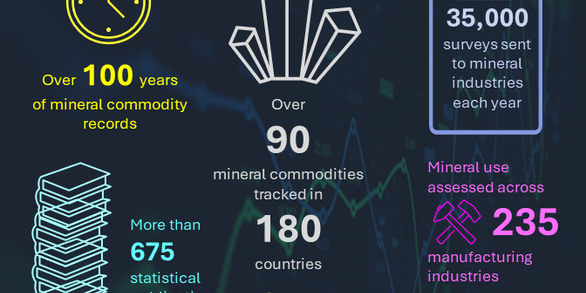
Published on an annual basis, this report is the earliest Government publication to furnish estimates covering nonfuel mineral industry data. Data sheets contain information on the domestic industry structure, Government programs, tariffs, and 5-year salient statistics for over 90 individual minerals and materials.
Authors
Water Resources Division U.S. Geological Survey

Mineral of the month: cadmium Mineral of the month: cadmium

Cadmium, which was once used almost exclusively for pigments, now has many diverse applications. Cadmium’s low melting point, excellent electrical conductivity and resistance to corrosion make it valuable for many products including batteries, electroplated coatings, stabilizers for plastics, solar cells and nonferrous alloys. Today’s cadmium is primarily used in rechargeable batteries...
Authors
Edward Klimasauskas

Mineral of the month: boron Mineral of the month: boron

What does boron have to do with baseball, apple pie, motherhood and Chevrolet? Boron minerals and chemicals are used in the tanning of leather baseballs and gloves; in micro-fertilizer to grow apples and in the glass and enamels of bakewares to cook apple pie; in boron detergents for soaking baby clothes and diapers; and in fiberglass parts for the Chevrolet Corvette.
Authors
Phyllis A. Lyday

Mineral resource of the month: clays Mineral resource of the month: clays

Clays represent one of the largest mineral commodities in the world in terms of mineral and rock production and use. Many people, however, do not recognize that clays are used in an amazingly wide variety of applications. Use continues to increase worldwide as populations and their associated needs increase. Robert Virta, clay and shale commodity specialist for the U.S. Geological Survey...
Authors
Robert Virta

Mineral of the month: titanium Mineral of the month: titanium

From paint to airplanes, titanium is important in a number of applications. Commercial production comes from titanium-bearing ilmenite, rutile and leucoxene (altered ilmenite). These minerals are used to produce titanium dioxide pigment, as well as an assortment of metal and chemical products.
Authors
Joseph Gambogi

Mineral of the month: gypsum Mineral of the month: gypsum

The earliest known use of gypsum as a building material was in Anatolia (in what is now Turkey) around 6000 B.C. It has been found on the interiors of the great pyramids in Egypt, which were erected in about 3700 B.C. Now an average new American home contains more than 7 metric tons of gypsum in the form of more than 6,000 square feet of wallboard.
Authors
Alan Founie

Mineral resource of the month: lead Mineral resource of the month: lead

The United States is a major producer and consumer of refined lead, representing almost one quarter of total world production and consumption. Two mines in Alaska and six in Missouri accounted for 97 percent of domestic lead production in 2002. The United States also imports enough refined lead to satisfy almost 20 percent of domestic consumption. Other major producers or consumers of...
Authors
Gerald R. Smith

Industrial diamond Industrial diamond

Part of the 2003 industrial minerals review. Supply and demand data for industrial diamond are provided. Topics discussed are consumption, prices, imports and exports, government stockpiles, and the outlook for 2004.
Authors
D.W. Olson

Fire clay Fire clay

Seven companies mined fire clay in four states during 2003. From 1984 to 1992, production declined to 383 kt (422,000 st) from a high of 1.04 Mt (1.14 million st) as markets for clay-based refractories declined. Since 1992, production levels have been erratic, ranging from 383 kt (422,000 st) in 1992 and 2001 to 583 kt (642,000 st) in 1995. Production in 2003, based on preliminary data...
Authors
R.L. Virta

Mineral resource of the month: tantalum Mineral resource of the month: tantalum

Tantalum is a metal that is critical to the United States because of its defense-related applications in aircraft, missiles and radio communications. It is ductile, easily fabricated, highly resistant to corrosion by acids, a good conductor of heat and electricity, and has a high melting point. Tantalum’s first commercial usage was as filament material in incandescent electric lamps in...
Authors
Larry D. Cunningham

Mineral resource of the month: molybdenum Mineral resource of the month: molybdenum

Molybdenum is a metallic element that is most frequently used in alloy and stainless steels, which together represent the single largest market for molybdenum. Molybdenum has also proven invaluable in carbon steel, cast iron and superalloys. Its alloying versatility is unmatched because its addition enhances material performance under high-stress conditions in expanded temperature ranges...
Authors
Michael J. Magyar
Was this page helpful?