U.S. flag

An official website of the United States government

Publications

The Center publishes analyses critical to national security on domestic and international mineral supply chains.

Filter Total Items: 605

Mineral of the month: garnet Mineral of the month: garnet

Garnet is the general name given to a group of complex silicate minerals, all with isometric crystal structure, similar properties and chemical compositions. Garnet occurs in every color of the spectrum except blue, but it is most commonly red, purple, brown and green. Garnet necklaces dating from the Bronze Age have been found in graves and also among the ornaments adorning the oldest...
Authors
Donald Olson

Mineral resources and consumption in the twenty-first century Mineral resources and consumption in the twenty-first century

Modern societies are highly dependent upon energy and mineral resources to produce and deliver the material goods and even the services of everyday life. Although societies' dependence upon fossil fuels is evident and understood by much of the population, few people are as well informed about their dependence upon a wide variety of nonfuel minerals. This ignorance may result from two...
Authors
W. David Menzie, Donald A. Singer, DeYoung

Mineral resource of the month: boron Mineral resource of the month: boron

What does boron have to do with baseball, apple pie, motherhood and Chevrolet? Boron minerals and chemicals are used in the tanning of leather baseballs and gloves; in micro-fertilizer to grow apples and in the glass and enamels of bakewares to cook apple pie; in boron detergents for soaking baby clothes and diapers; and in fiberglass parts for the Chevrolet Corvette.
Authors
Phyllis A. Lyday

Mineral of the month: chromium Mineral of the month: chromium

Chromium is one of the most indispensable industrial metals and it plays an essential but hidden role in daily life. Chromium is used in many consumer and building products, and it contributes to a clean, efficient and healthy environment.
Authors
John F. Papp

Mineral of the month: aggregates Mineral of the month: aggregates

Natural aggregates, consisting of crushed stone, and sand and gravel, are a major contributor to economic health, and have an amazing variety of uses. Aggregates are among the most abundant mineral resources and are major basic raw materials used by construction, agriculture and other industries that employ complex chemical and metallurgical processes.
Authors
Valentin V. Tepordei

Mineral of the month: manganese Mineral of the month: manganese

Manganese is one of the most important ferrous metals and one of the few for which the United States is totally dependent on imports. It is a black, brittle element predominantly used in metallurgical applications as an alloying addition, particularly in steel and cast iron production, which together provide the largest market for manganese (about 83 percent). It is also used as an alloy...
Authors
Lisa A. Corathers

Mineral of the month: magnesium Mineral of the month: magnesium

Magnesium, often confused with last month’s mineral of the month manganese, is valued primarily because of its light weight and high strength-to-weight ratio. Magnesium is the eighth most abundant element and constitutes about 2 percent of the Earth’s crust. It is the third most plentiful element dissolved in seawater, with a concentration averaging 0.13 percent. Magnesium is found in...
Authors
Deborah A. Kramer

Mineral Commodity Summaries 2005 Mineral Commodity Summaries 2005

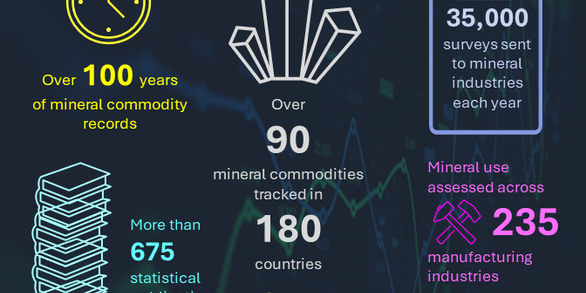
Published on an annual basis, this report is the earliest Government publication to furnish estimates covering nonfuel mineral industry data. Data sheets contain information on the domestic industry structure, Government programs, tariffs, and 5-year salient statistics for over 90 individual minerals and materials.
Authors
Water Resources Division U.S. Geological Survey

Mineral of the month: aluminum Mineral of the month: aluminum

Aluminum is the second most abundant metallic element in Earth’s crust after silicon. Even so, it is a comparatively new industrial metal that has been produced in commercial quantities for little more than 100 years. Aluminum is lightweight, ductile, malleable and corrosion resistant, and is a good conductor of heat and electricity. Weighing about one-third as much as steel or copper...
Authors
Patricia A. Plunkert

Mineral of the month: rhenium Mineral of the month: rhenium

Rhenium, an exotic, heat-resistant metal, has grown in importance since its discovery nearly 80 years ago. First isolated by a team of German chemists studying a platinum ore, the mineral was named for the Rhine River. From then until the 1960s, only 2 metric tons of rhenium were produced worldwide. In 2004, worldwide production was 40 metric tons.
Authors
Michael J. Magyar

Exploration Exploration

The worldwide budget for nonferrous, nonfuel mineral exploration was expected to increase by 58 percent in 2004 from the 2003 budget, according to Metals Economics Group (MEG) of Halifax, Nova Scotia. The increase comes two years after a five-year period of declining spending for mineral exploration (1998 to 2002). Figures suggest a subsequent 27 percent increase in budgeted expenditures...
Authors
D.R. Wilburn

Mineral of the month: potash Mineral of the month: potash

In 1807, Sir Humphrey Davy discovered a metal during the electrolysis of potassium hydroxide; he named the metal potassium because it came from potash recovered from wood ashes. The four types of potash are the water-soluble compounds potassium chloride, potassium sulfate, potassium-magnesium sulfate and potassium nitrate. The early uses of potash were in glass and soap manufacturing, as...
Authors
James P. Searls
Was this page helpful?