



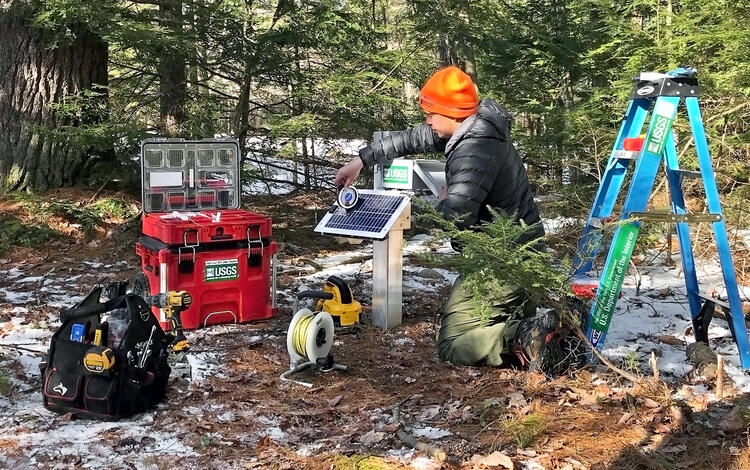
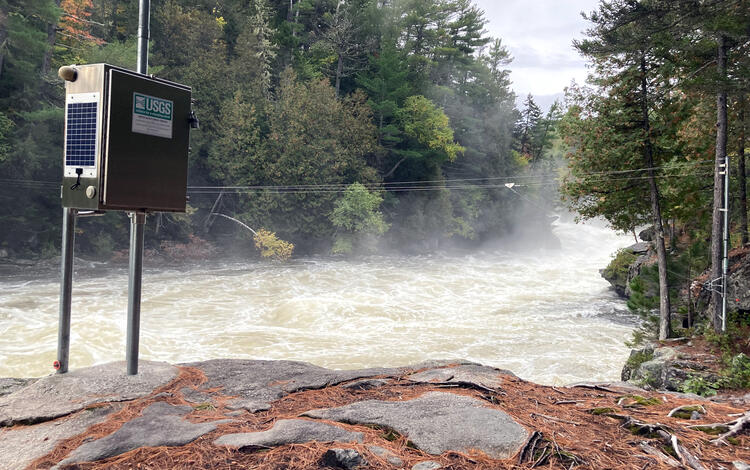
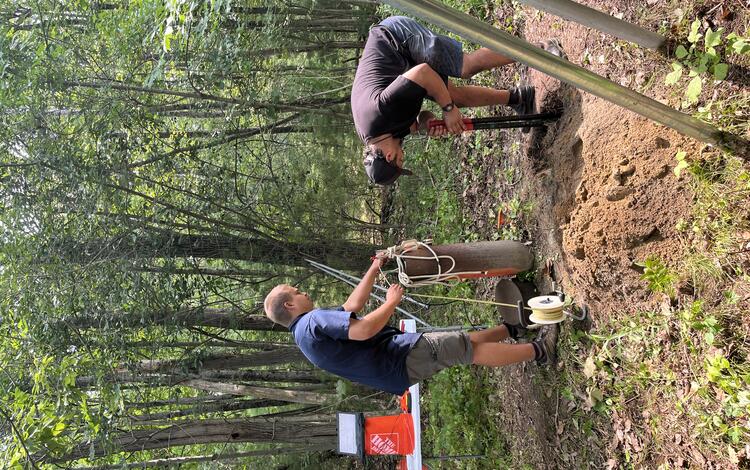
The Hydrologic Monitoring Branch (HMB) provides water data for all six New England states through an expansive network of monitoring locations. The HMB is responsible for a wide range of hydrologic monitoring activities, including collecting and analyzing streamflow, groundwater and coastal water levels, precipitation, and continuous water-quality information, such as water temperature and specific conductance. Currently, the HMB gathers data from about 450 stream locations, 10 lakes and reservoirs, three coastal sites, 200 groundwater wells, 30 crest-stage gages, and 60 precipitation gages. The HMB comprises approximately 50 employees based in four offices.
The real-time data provided by HMB play a critical role in water resource management and are used to:
Determine water management and allocation for agricultural, industrial, and municipal uses
Predict floods, assess flood risk, and plan flood control measures
Enhance public safety by improving community preparedness and response to water-related emergencies
Inform the design and construction of water-related infrastructure, such as dams, bridges, and water treatment facilities
Protect the environment by ensuring both water quality and quantity are sustainable to support ecosystems and public health
Facilitate education and scientific collaboration on hydrologic processes and water management as an open resource for researchers, students, and the public

Contacts
Hydrologic Monitoring Branch Chief: Brian Loving, Supervisory Hydrologist
Monitoring Operations Section Chief: Nicholas Stasulis, Supervisory Physical Scientist
Connecticut and Rhode Island Monitoring Section Chief: Christopher Bruet, Supervisory Hydrologic Technician
Maine Monitoring Section Chief: Jason Cyr, Supervisory Hydrologic Technician
Massachusetts Monitoring Section Chief: Jason Pollender, Supervisory Hydrologic Technician
New Hampshire and Vermont Monitoring Section Chief: Nicholas Stasulis, Supervisory Physical Scientist


The Hydrologic Monitoring Branch (HMB) provides water data for all six New England states through an expansive network of monitoring locations. The HMB is responsible for a wide range of hydrologic monitoring activities, including collecting and analyzing streamflow, groundwater and coastal water levels, precipitation, and continuous water-quality information, such as water temperature and specific conductance. Currently, the HMB gathers data from about 450 stream locations, 10 lakes and reservoirs, three coastal sites, 200 groundwater wells, 30 crest-stage gages, and 60 precipitation gages. The HMB comprises approximately 50 employees based in four offices.
The real-time data provided by HMB play a critical role in water resource management and are used to:
Determine water management and allocation for agricultural, industrial, and municipal uses
Predict floods, assess flood risk, and plan flood control measures
Enhance public safety by improving community preparedness and response to water-related emergencies
Inform the design and construction of water-related infrastructure, such as dams, bridges, and water treatment facilities
Protect the environment by ensuring both water quality and quantity are sustainable to support ecosystems and public health
Facilitate education and scientific collaboration on hydrologic processes and water management as an open resource for researchers, students, and the public
Contacts
Hydrologic Monitoring Branch Chief: Brian Loving, Supervisory Hydrologist
Monitoring Operations Section Chief: Nicholas Stasulis, Supervisory Physical Scientist
Connecticut and Rhode Island Monitoring Section Chief: Christopher Bruet, Supervisory Hydrologic Technician
Maine Monitoring Section Chief: Jason Cyr, Supervisory Hydrologic Technician
Massachusetts Monitoring Section Chief: Jason Pollender, Supervisory Hydrologic Technician
New Hampshire and Vermont Monitoring Section Chief: Nicholas Stasulis, Supervisory Physical Scientist