



The National Wildlife Disease Database: Partner with Us to Protect Wildlife, Agriculture, Pet, and Human Health
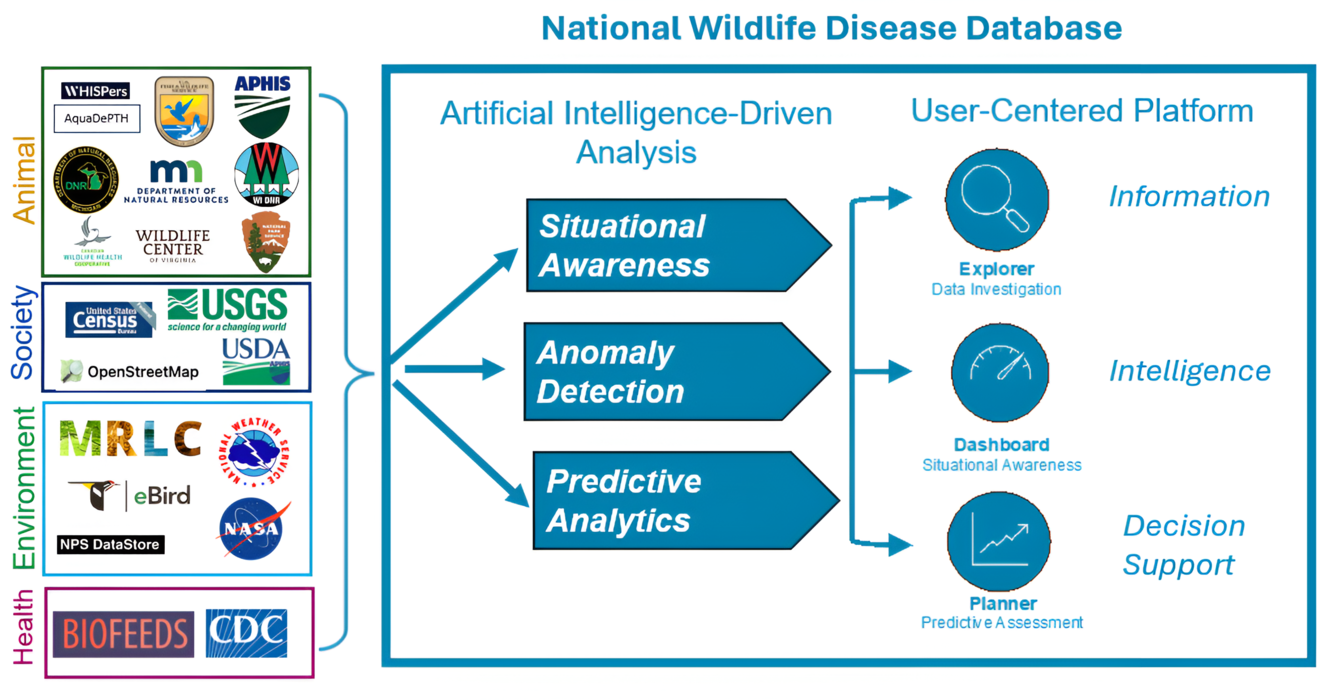
The National Wildlife Disease Database (NWDD) system applies advanced analytics to integrated data from government agencies, wildlife rehabilitators, and open sources, to identify unusual disease events, assess impacts, and map disease occurrences nationwide. Natural resource managers, agricultural communities, veterinary professionals, and human health practitioners rely on this data to investigate wildlife diseases while managing risks to health and resources.
To learn more about NWDD participation and be part of the conversation, contact NWDD@pnnl.gov.
Why Should Agencies and Stakeholders Participate?
No single agency holds all the data necessary to fully evaluate the impacts of wildlife diseases. Although wildlife regularly cross jurisdictions, wildlife data collected by state, federal, and tribal entities is generally limited to their jurisdictional boundaries and often only accessible to the originating agency. Integrating and analyzing multisource data for trends and anomalies across jurisdictions yields a more complete picture of where and when diseases occur, provides early warnings of health threats, and supports data-driven decisions.
Data of interest for the NWDD includes reports of sick or dead wildlife (e.g., location, species, date, clinical signs, and cause of death if known) from natural resource agencies, public reporting, and wildlife rehabilitation records; disease specific positive and negative surveillance results (such as highly pathogenic avian influenza); diagnostic laboratory reports; and species range information. Visibility of detailed data in NWDD is controlled by the contributing agency.
Contact NWDD@pnnl.gov for more details.
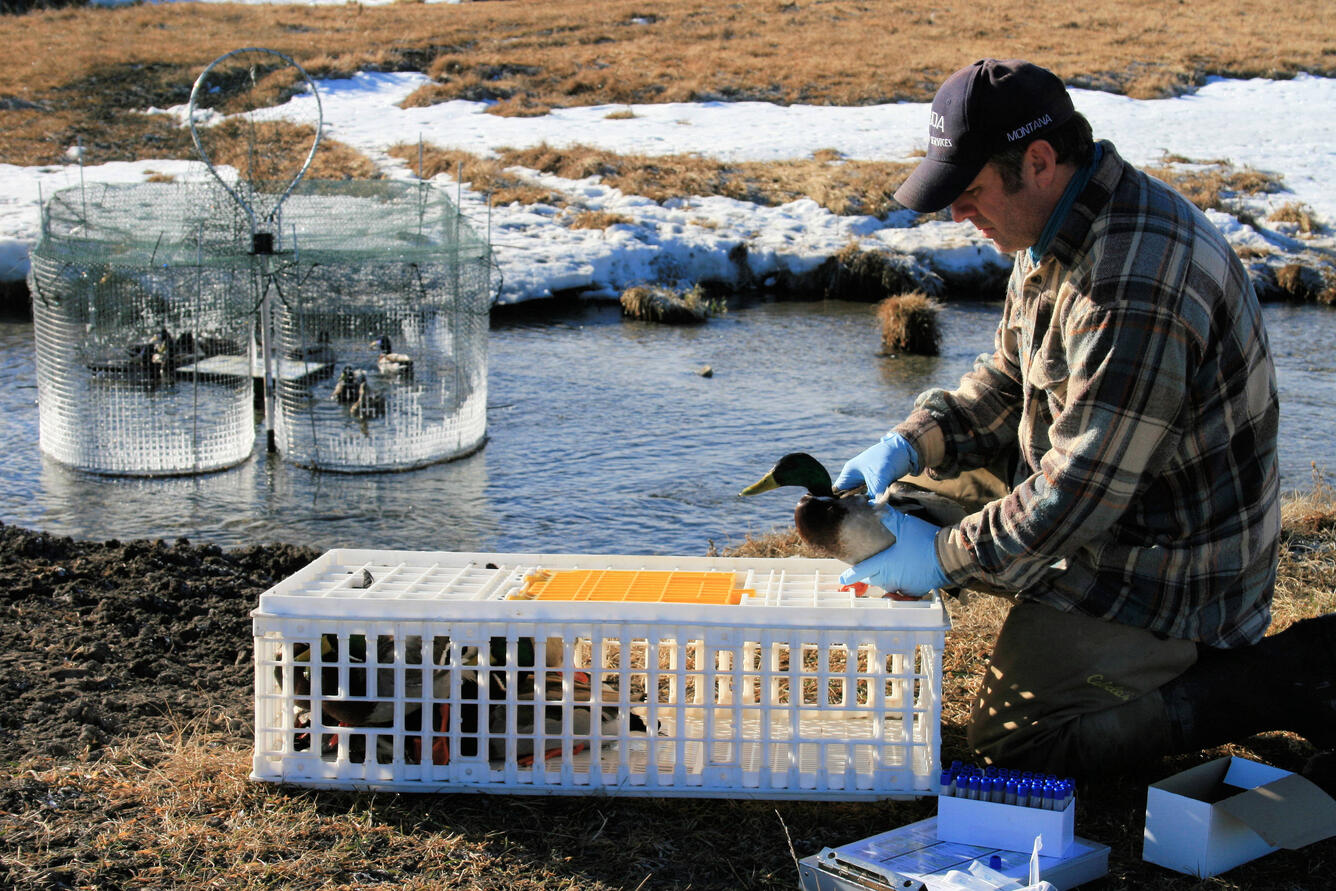
U.S. Department of Agriculture Wildlife Services disease biologist samples a mallard for highly pathogenic avian influenza in 2017.
Built on Trust and Collaboration
Access to quality data from many sources improves analysis for detection, monitoring, predictions, risk assessment, and disease management. Successful sharing depends on trust – respecting contributors’ needs, data ownership, and ensuring shared benefits. Ongoing collaborations among agencies, developers, and the NWDD Steering Committee ensures transparency and contractual agreements detailing how data can be accessed and used. Data access is provider controlled and detailed information is not visible to the public or other agencies.
As a data contributor, there is no need for duplicate data entry; data can be shared with the NWDD in the same format that your agency currently uses to collect data e.g., PDF, Microsoft Excel spreadsheet, Microsoft Access or other databases. NWDD uses advanced tools to standardize information across data sets, unifying terms for species, date, location, clinical signs, disease, and etiology. Agencies can visualize and map all their data together and download a single combined dataset for further use. These features will save agencies time and money while increasing data usability.
As a registered data user, aggregated data is displayed with data layers from a variety of sources for better situational awareness, context, and understanding of potential health threats across the landscape.
As a contributing organization, to ensure privacy and accountability, organizations will define parameters for data sharing through explicit data use agreements. Within NWDD, data contributors control access to their data by other NWDD users.
Driving Force behind NWDD Development
Congressional Mandate: Congress funded a “national wildlife disease database” to facilitate an efficient, multi-agency threat detection approach for national security, human and agricultural health, economic resiliency, and outdoor recreation. The Government Accountability Office (GAO) report on Zoonotic Diseases (GAO-23-105238) stipulated that federal agencies resolve data sharing concerns for improved wildlife disease data access. The NWDD aligns with a Department of the Interior mission-essential function to detect and analyze wildlife disease occurrence across the nation.
Steering Committee Leading the Effort: A multi-agency, senior executive NWDD Steering Committee representing Association of Fish and Wildlife Agencies, U.S. Fish and Wildlife Service, National Park Service, Native American Fish and Wildlife Society, U.S. Department of Agriculture (Animal and Plant Health Inspection Services, Wildlife Services), U.S. Geological Survey, and National Oceanic and Atmospheric Administration guides project development and fosters interagency data sharing and collaboration.
Development Team: The USGS National Wildlife Health Center contracted with the Pacific Northwest National Laboratory, a Department of Energy Office of Science Laboratory and leader in operational artificial intelligence, to build the NWDD. A team of data scientists, engineers, and subject matter experts is collaborating with prospective end-users to integrate wildlife health data with existing data streams, such as weather, species range maps, and open-source reports, to develop a robust, user-friendly platform (alpha prototype in late 2025; beta release in late 2026).
Multi-partner Participation: The NWDD is being built for natural resource management agencies as the key participants, data providers, and information consumers. A broad coalition of state, federal, and tribal agencies and non-government organizations are contributing data and/or subject matter expertise to the design and development of the NWDD.
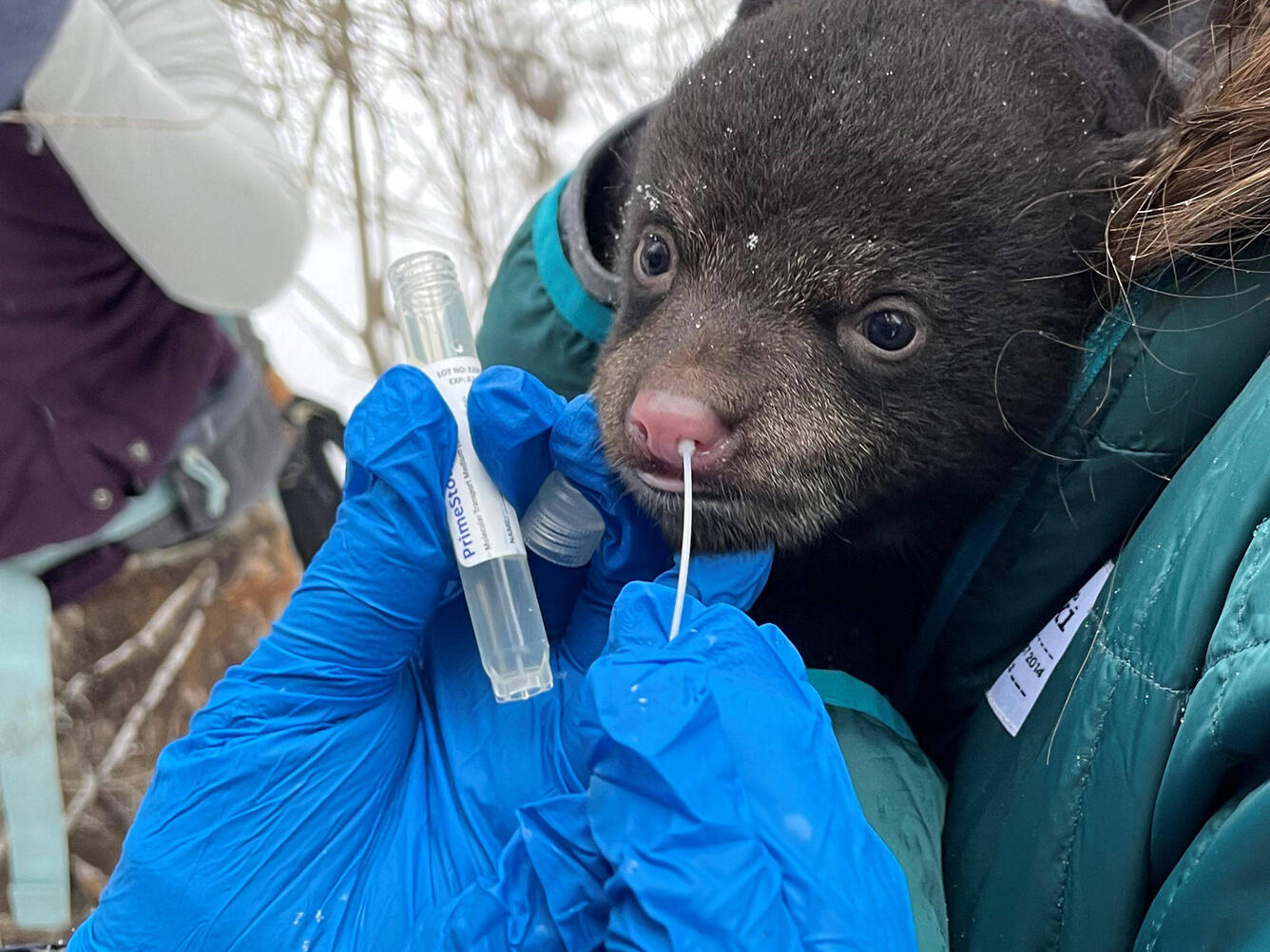
A U.S. Department of Agriculture Wildlife Services disease biologist samples a black bear cub for SARS-CoV-2 surveillance in Wisconsin in 2023.
Partner Page
The National Wildlife Disease Database (NWDD) development team thanks the multiple agencies and organizations that are participating in this effort.
The National Wildlife Disease Database (NWDD) system applies advanced analytics to integrated data from government agencies, wildlife rehabilitators, and open sources, to identify unusual disease events, assess impacts, and map disease occurrences nationwide. Natural resource managers, agricultural communities, veterinary professionals, and human health practitioners rely on this data to investigate wildlife diseases while managing risks to health and resources.
To learn more about NWDD participation and be part of the conversation, contact NWDD@pnnl.gov.
Why Should Agencies and Stakeholders Participate?
No single agency holds all the data necessary to fully evaluate the impacts of wildlife diseases. Although wildlife regularly cross jurisdictions, wildlife data collected by state, federal, and tribal entities is generally limited to their jurisdictional boundaries and often only accessible to the originating agency. Integrating and analyzing multisource data for trends and anomalies across jurisdictions yields a more complete picture of where and when diseases occur, provides early warnings of health threats, and supports data-driven decisions.
Data of interest for the NWDD includes reports of sick or dead wildlife (e.g., location, species, date, clinical signs, and cause of death if known) from natural resource agencies, public reporting, and wildlife rehabilitation records; disease specific positive and negative surveillance results (such as highly pathogenic avian influenza); diagnostic laboratory reports; and species range information. Visibility of detailed data in NWDD is controlled by the contributing agency.
Contact NWDD@pnnl.gov for more details.
U.S. Department of Agriculture Wildlife Services disease biologist samples a mallard for highly pathogenic avian influenza in 2017.
Built on Trust and Collaboration
Access to quality data from many sources improves analysis for detection, monitoring, predictions, risk assessment, and disease management. Successful sharing depends on trust – respecting contributors’ needs, data ownership, and ensuring shared benefits. Ongoing collaborations among agencies, developers, and the NWDD Steering Committee ensures transparency and contractual agreements detailing how data can be accessed and used. Data access is provider controlled and detailed information is not visible to the public or other agencies.
As a data contributor, there is no need for duplicate data entry; data can be shared with the NWDD in the same format that your agency currently uses to collect data e.g., PDF, Microsoft Excel spreadsheet, Microsoft Access or other databases. NWDD uses advanced tools to standardize information across data sets, unifying terms for species, date, location, clinical signs, disease, and etiology. Agencies can visualize and map all their data together and download a single combined dataset for further use. These features will save agencies time and money while increasing data usability.
As a registered data user, aggregated data is displayed with data layers from a variety of sources for better situational awareness, context, and understanding of potential health threats across the landscape.
As a contributing organization, to ensure privacy and accountability, organizations will define parameters for data sharing through explicit data use agreements. Within NWDD, data contributors control access to their data by other NWDD users.
Driving Force behind NWDD Development
Congressional Mandate: Congress funded a “national wildlife disease database” to facilitate an efficient, multi-agency threat detection approach for national security, human and agricultural health, economic resiliency, and outdoor recreation. The Government Accountability Office (GAO) report on Zoonotic Diseases (GAO-23-105238) stipulated that federal agencies resolve data sharing concerns for improved wildlife disease data access. The NWDD aligns with a Department of the Interior mission-essential function to detect and analyze wildlife disease occurrence across the nation.
Steering Committee Leading the Effort: A multi-agency, senior executive NWDD Steering Committee representing Association of Fish and Wildlife Agencies, U.S. Fish and Wildlife Service, National Park Service, Native American Fish and Wildlife Society, U.S. Department of Agriculture (Animal and Plant Health Inspection Services, Wildlife Services), U.S. Geological Survey, and National Oceanic and Atmospheric Administration guides project development and fosters interagency data sharing and collaboration.
Development Team: The USGS National Wildlife Health Center contracted with the Pacific Northwest National Laboratory, a Department of Energy Office of Science Laboratory and leader in operational artificial intelligence, to build the NWDD. A team of data scientists, engineers, and subject matter experts is collaborating with prospective end-users to integrate wildlife health data with existing data streams, such as weather, species range maps, and open-source reports, to develop a robust, user-friendly platform (alpha prototype in late 2025; beta release in late 2026).
Multi-partner Participation: The NWDD is being built for natural resource management agencies as the key participants, data providers, and information consumers. A broad coalition of state, federal, and tribal agencies and non-government organizations are contributing data and/or subject matter expertise to the design and development of the NWDD.
A U.S. Department of Agriculture Wildlife Services disease biologist samples a black bear cub for SARS-CoV-2 surveillance in Wisconsin in 2023.
Partner Page
The National Wildlife Disease Database (NWDD) development team thanks the multiple agencies and organizations that are participating in this effort.