



Responding to New World Screwworm in the U.S.
The USGS National Wildlife Health Center (NWHC) is supporting the Department of the Interior’s (DOI) preparedness planning and response for New World screwworm (NWS), an invasive parasitic fly detected in the U.S. in June 2026 after its northward spread from Central America.
What is New World Screwworm
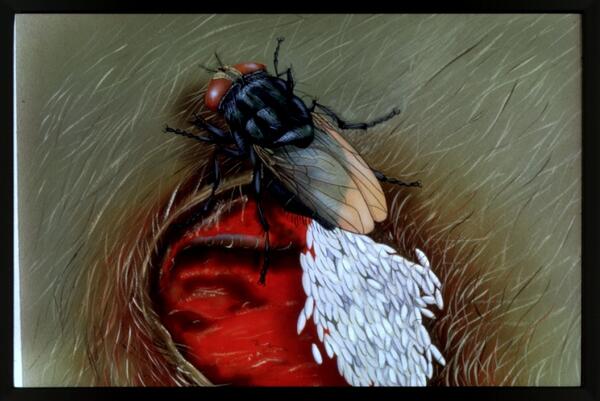
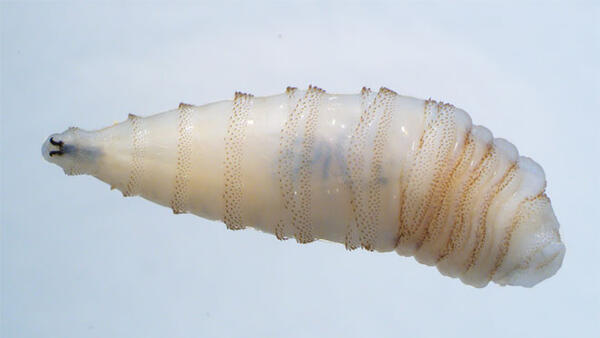
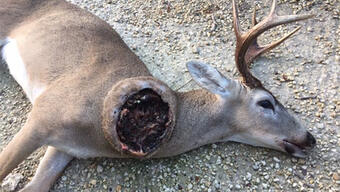
New World screwworm is a parasitic fly (Cochliomyia hominivorax) that lays its eggs in the wounds of living warm-blooded animals. Within 12-24 hours the eggs hatch into larvae (maggots) which burrow into the wound to feed, creating a larger wound and leading to illness and death if left untreated. The flies primarily affect livestock but can also infest people, pets and wildlife.
New World screwworm was once native to the southern U.S. and Central America but was eradicated in the U.S. in 1966 by the targeted release of sterilized male flies (sterile insect technique). Females only mate once in their lifetime, so mating with sterilized male flies results in unfertilized eggs which reduces the population over time.
Starting in 2023, NWS began to move north from Panama through Central America. In June 2026, NWS was detected in southern Texas. Notably, isolated detections do not indicate that the parasite is established in a location because it may be possible to control isolated events through quarantine and sterile insect technique. However, NWS has the potential to significantly impact agriculture and vulnerable wildlife species if it re-establishes in the U.S. The U.S. Fish and Wildlife Service National Wildlife Refuge System is urging DOI personnel in southern states, particularly those that border Mexico, to be on high alert for NWS in wildlife.
What is NWHC doing for NWS
Early detection and rapid response are critical to controlling the spread of this parasite. To help prepare for the possibility that NWS becomes established again in the U.S., NWHC is developing several tools to guide decision-making: a rapid risk assessment, a comprehensive risk model, a planning tool related to white-tailed deer vulnerabilities, an assessment of management considerations on National Wildlife Refuges, and annotated bibliographies of existing research.
The rapid risk assessment, expected by December 2026, is being led by NWHC in partnership with Texas Parks and Wildlife Department, the USGS National Climate Adaptation Science Center (NCASC), and Northern Rocky Mountain Science Center (NOROCK). It will focus on the exposure risk NWS poses to wildlife in Texas, mapping out which areas are most at risk based on factors such as cattle and deer populations and how well the local climate supports NWS survival. The assessment will also identify priority information gaps to guide future research. The results will help inform wildlife and game management decisions in Texas and support broader efforts to protect wildlife and recreational hunting. Results will also be used to develop seasonal NWS risk forecasts for 2027.
The comprehensive risk model is being developed by NWHC together with several USGS science centers (Fort Collins, Eastern Ecological, Northern Rocky Mountain, and the Montana Cooperative Research Unit), NCASC, USFWS, and collaborators from Colorado State University, University of Georgia, and Michigan State University. This model, using a systems-based approach similar to that previously applied to chronic wasting disease, will examine how biological, ecological, and human factors interact to influence the spread and potential effects of NWS. The model will help wildlife managers and other decision makers understand potential risks and evaluate approaches to reduce them.
NWHC, in partnership with NCASC, is also developing a Texas-based planning tool to identify when and where white-tailed deer may be most vulnerable to NWS. The tool combines expected rut and fawning periods with weather conditions that may support screwworm activity to identify periods and locations of elevated risk.
Social science work, conducted by NWHC in collaboration with USFWS, will identify areas where NWS management preferences may differ between private landowners and managers of nearby National Wildlife Refuges. The project will produce a spatial assessment and prioritized list of locations where differing preferences could complicate coordinated management. USFWS and partner agencies can use this information to focus local communication and engagement efforts, incorporate community values into planning, and reduce potential conflict around NWS response and management actions.
An annotated bibliography, published in April 2026, summarizes scientific reports of NWS in wildlife and serves as a plain-language reference for wildlife professionals, land managers, and policymakers. While this document does not replace the need to conduct additional research, it is intended to provide a consolidated summary of existing information needed to inform wildlife NWS surveillance, management, and response decisions. A second annotated bibliography, focused on climate and habitat suitability for the NWS fly, is expected to be complete by fall 2026. This product will summarize the literature on the environmental preferences and limits for adult and pupal NWS stages to inform risk planning and modeling.
The NWHC is also coordinating closely with our partners in the US Department of Agriculture on data, modeling, and laboratory working groups. Through our diagnostic program, we are screening all morbidity and mortality submissions for suspect NWS larvae or wounds and have established internal biosafety and other protocols to safely accept suspect NWS cases, should surge capacity be needed by USDA and state partners.
The NWHC is available for consultation to help wildlife partners navigate this emerging threat in wildlife. If you have a question regarding NWS in wildlife, please contact our Epidemiology Team at NWHC-epi@usgs.gov.
For additional information about NWS myiasis (the disease caused by NWS), see:
Animal disease: New World Screwworm (USDA)
The USGS National Wildlife Health Center (NWHC) is supporting the Department of the Interior’s (DOI) preparedness planning and response for New World screwworm (NWS), an invasive parasitic fly detected in the U.S. in June 2026 after its northward spread from Central America.
What is New World Screwworm
New World screwworm is a parasitic fly (Cochliomyia hominivorax) that lays its eggs in the wounds of living warm-blooded animals. Within 12-24 hours the eggs hatch into larvae (maggots) which burrow into the wound to feed, creating a larger wound and leading to illness and death if left untreated. The flies primarily affect livestock but can also infest people, pets and wildlife.
New World screwworm was once native to the southern U.S. and Central America but was eradicated in the U.S. in 1966 by the targeted release of sterilized male flies (sterile insect technique). Females only mate once in their lifetime, so mating with sterilized male flies results in unfertilized eggs which reduces the population over time.
Starting in 2023, NWS began to move north from Panama through Central America. In June 2026, NWS was detected in southern Texas. Notably, isolated detections do not indicate that the parasite is established in a location because it may be possible to control isolated events through quarantine and sterile insect technique. However, NWS has the potential to significantly impact agriculture and vulnerable wildlife species if it re-establishes in the U.S. The U.S. Fish and Wildlife Service National Wildlife Refuge System is urging DOI personnel in southern states, particularly those that border Mexico, to be on high alert for NWS in wildlife.
What is NWHC doing for NWS
Early detection and rapid response are critical to controlling the spread of this parasite. To help prepare for the possibility that NWS becomes established again in the U.S., NWHC is developing several tools to guide decision-making: a rapid risk assessment, a comprehensive risk model, a planning tool related to white-tailed deer vulnerabilities, an assessment of management considerations on National Wildlife Refuges, and annotated bibliographies of existing research.
The rapid risk assessment, expected by December 2026, is being led by NWHC in partnership with Texas Parks and Wildlife Department, the USGS National Climate Adaptation Science Center (NCASC), and Northern Rocky Mountain Science Center (NOROCK). It will focus on the exposure risk NWS poses to wildlife in Texas, mapping out which areas are most at risk based on factors such as cattle and deer populations and how well the local climate supports NWS survival. The assessment will also identify priority information gaps to guide future research. The results will help inform wildlife and game management decisions in Texas and support broader efforts to protect wildlife and recreational hunting. Results will also be used to develop seasonal NWS risk forecasts for 2027.
The comprehensive risk model is being developed by NWHC together with several USGS science centers (Fort Collins, Eastern Ecological, Northern Rocky Mountain, and the Montana Cooperative Research Unit), NCASC, USFWS, and collaborators from Colorado State University, University of Georgia, and Michigan State University. This model, using a systems-based approach similar to that previously applied to chronic wasting disease, will examine how biological, ecological, and human factors interact to influence the spread and potential effects of NWS. The model will help wildlife managers and other decision makers understand potential risks and evaluate approaches to reduce them.
NWHC, in partnership with NCASC, is also developing a Texas-based planning tool to identify when and where white-tailed deer may be most vulnerable to NWS. The tool combines expected rut and fawning periods with weather conditions that may support screwworm activity to identify periods and locations of elevated risk.
Social science work, conducted by NWHC in collaboration with USFWS, will identify areas where NWS management preferences may differ between private landowners and managers of nearby National Wildlife Refuges. The project will produce a spatial assessment and prioritized list of locations where differing preferences could complicate coordinated management. USFWS and partner agencies can use this information to focus local communication and engagement efforts, incorporate community values into planning, and reduce potential conflict around NWS response and management actions.
An annotated bibliography, published in April 2026, summarizes scientific reports of NWS in wildlife and serves as a plain-language reference for wildlife professionals, land managers, and policymakers. While this document does not replace the need to conduct additional research, it is intended to provide a consolidated summary of existing information needed to inform wildlife NWS surveillance, management, and response decisions. A second annotated bibliography, focused on climate and habitat suitability for the NWS fly, is expected to be complete by fall 2026. This product will summarize the literature on the environmental preferences and limits for adult and pupal NWS stages to inform risk planning and modeling.
The NWHC is also coordinating closely with our partners in the US Department of Agriculture on data, modeling, and laboratory working groups. Through our diagnostic program, we are screening all morbidity and mortality submissions for suspect NWS larvae or wounds and have established internal biosafety and other protocols to safely accept suspect NWS cases, should surge capacity be needed by USDA and state partners.
The NWHC is available for consultation to help wildlife partners navigate this emerging threat in wildlife. If you have a question regarding NWS in wildlife, please contact our Epidemiology Team at NWHC-epi@usgs.gov.
For additional information about NWS myiasis (the disease caused by NWS), see:
Animal disease: New World Screwworm (USDA)