



White-nose syndrome: Uncovering fungal mechanisms and unique bat adaptations
White-nose syndrome (WNS) has killed millions of hibernating bats across North America, causing severe population declines and even local extinctions. Caused by the cold-loving fungus Pseudogymnoascus destructans, this disease behaves unlike typical wildlife pathogens, making it especially hard to control. Researchers at the USGS National Wildlife Health Center, with partners at the University of Wisconsin–Madison, are working to uncover how the fungus causes disease and why some bat species are more vulnerable—knowledge essential for predicting outbreaks and protecting bats more effectively.

What is the issue
White-nose syndrome (WNS) is a devastating disease that has killed millions of hibernating bats across North America. Many bat populations have suffered severe declines, and some species have disappeared entirely from parts of their range. WNS is caused by the fungus Pseudogymnoascus destructans, which thrives in the cold, damp conditions of bat hibernacula. Because this fungus behaves so differently from other wildlife pathogens, it has proven especially difficult to control.
What's at stake
Even after more than a decade of research, key questions remain unanswered. We still don't fully understand how this fungus causes disease or why some bat species are far more vulnerable than others. Answering these questions is essential for predicting outbreaks and developing more effective ways to protect bats.
What is our approach
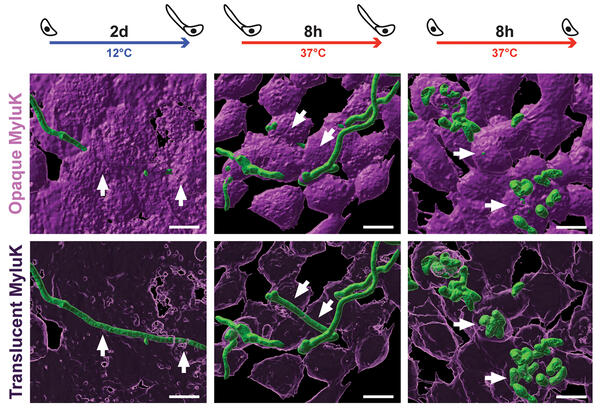
Building on earlier research (Isidoro-Ayza et al., Science, 2024), scientists at the U.S. Geological Survey's National Wildlife Health Center, together with partners at the Klein Lab and Ayuso Lab at the University of Wisconsin–Madison, have developed a unique cell culture model of hibernating bat skin. This model lets us study how the fungus interacts with bat cells under conditions that mimic hibernation, making it possible to investigate disease processes that were previously out of reach.
What are the benefits
This research opens new doors for preventing and managing WNS. By pinpointing the specific ways the fungus causes disease, we can design more targeted treatments instead of relying on broad-spectrum antifungal approaches. These discoveries could lead to better strategies for reducing the fungus's impact, bolstering bats' natural defenses, and strengthening models that predict how the disease spreads.
Our work is also revealing how hibernating bats adapt to survive harsh winter conditions. Understanding how bats maintain healthy skin through months of hibernation deepens our knowledge of their biology — and could even inform new research into tissue repair and regeneration.
Recent accomplishments
Our research has already identified weaknesses in Pseudogymnoascus destructans that could be exploited for new disease management strategies. We've also uncovered aspects of bat skin immunology that may help explain why certain species are more susceptible to WNS. Together, these findings are advancing our understanding of both the fungus and its bat hosts, with implications that may extend beyond WNS research alone.
Next steps
Future research will focus on identifying additional features of the fungus and its bat hosts that influence disease outcomes. We will also continue exploring the unique adaptations that allow hibernating bats to endure harsh winter conditions. These efforts could lead to improved disease management strategies while offering new insights into bat biology and tissue repair.
White-nose syndrome (WNS) has killed millions of hibernating bats across North America, causing severe population declines and even local extinctions. Caused by the cold-loving fungus Pseudogymnoascus destructans, this disease behaves unlike typical wildlife pathogens, making it especially hard to control. Researchers at the USGS National Wildlife Health Center, with partners at the University of Wisconsin–Madison, are working to uncover how the fungus causes disease and why some bat species are more vulnerable—knowledge essential for predicting outbreaks and protecting bats more effectively.
What is the issue
White-nose syndrome (WNS) is a devastating disease that has killed millions of hibernating bats across North America. Many bat populations have suffered severe declines, and some species have disappeared entirely from parts of their range. WNS is caused by the fungus Pseudogymnoascus destructans, which thrives in the cold, damp conditions of bat hibernacula. Because this fungus behaves so differently from other wildlife pathogens, it has proven especially difficult to control.
What's at stake
Even after more than a decade of research, key questions remain unanswered. We still don't fully understand how this fungus causes disease or why some bat species are far more vulnerable than others. Answering these questions is essential for predicting outbreaks and developing more effective ways to protect bats.
What is our approach
Building on earlier research (Isidoro-Ayza et al., Science, 2024), scientists at the U.S. Geological Survey's National Wildlife Health Center, together with partners at the Klein Lab and Ayuso Lab at the University of Wisconsin–Madison, have developed a unique cell culture model of hibernating bat skin. This model lets us study how the fungus interacts with bat cells under conditions that mimic hibernation, making it possible to investigate disease processes that were previously out of reach.
What are the benefits
This research opens new doors for preventing and managing WNS. By pinpointing the specific ways the fungus causes disease, we can design more targeted treatments instead of relying on broad-spectrum antifungal approaches. These discoveries could lead to better strategies for reducing the fungus's impact, bolstering bats' natural defenses, and strengthening models that predict how the disease spreads.
Our work is also revealing how hibernating bats adapt to survive harsh winter conditions. Understanding how bats maintain healthy skin through months of hibernation deepens our knowledge of their biology — and could even inform new research into tissue repair and regeneration.
Recent accomplishments
Our research has already identified weaknesses in Pseudogymnoascus destructans that could be exploited for new disease management strategies. We've also uncovered aspects of bat skin immunology that may help explain why certain species are more susceptible to WNS. Together, these findings are advancing our understanding of both the fungus and its bat hosts, with implications that may extend beyond WNS research alone.
Next steps
Future research will focus on identifying additional features of the fungus and its bat hosts that influence disease outcomes. We will also continue exploring the unique adaptations that allow hibernating bats to endure harsh winter conditions. These efforts could lead to improved disease management strategies while offering new insights into bat biology and tissue repair.