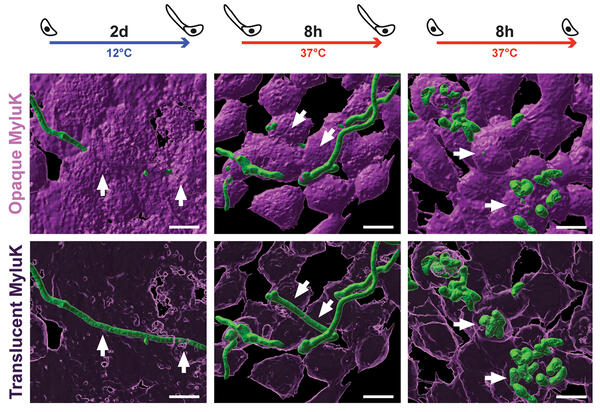
These images show the hyphae and spores of the fungus that causes white-nose syndrome (in green) invading the lab grown skin cells of little brown bats. (Isidoro-Ayza, 2024, Science)
Marcos Isidoro-Ayza
Marcos Isidoro-Ayza is a Wildlife Pathologist and Researcher at the National Wildlife Health Center.
He is a DVM, PhD in Comparative Biomedical Sciences, and a Diplomate of the European College of Veterinary Pathologists (ECVP).
Marcos' research focuses on wildlife pathology, infectious diseases, comparative immunology and epithelial biology, and tissue repair, with particular expertise in white-nose syndrome of bats.
Science and Products
Pathology and bacteriology of 178 tadpoles with histologically confirmed Severe Perkinsea Infections: Data Pathology and bacteriology of 178 tadpoles with histologically confirmed Severe Perkinsea Infections: Data
Natural infections with Pigeon Paramyxovirus-1: Pathologic changes in Eurasian collared-doves (Streptopelia decaocto) and rock pigeons (Columba livia) in the USA: Data Natural infections with Pigeon Paramyxovirus-1: Pathologic changes in Eurasian collared-doves (Streptopelia decaocto) and rock pigeons (Columba livia) in the USA: Data
The skin I live in: Pathogenesis of white-nose syndrome of bats The skin I live in: Pathogenesis of white-nose syndrome of bats
Evidence of vertical transmission of the snake fungal pathogen Ophidiomyces ophiodiicola Evidence of vertical transmission of the snake fungal pathogen Ophidiomyces ophiodiicola
Interactive effects of food supplementation and snake fungal disease on pregnant Pygmy Rattlesnakes and their offspring Interactive effects of food supplementation and snake fungal disease on pregnant Pygmy Rattlesnakes and their offspring
Virally-vectored vaccine candidates against white-nose syndrome induce anti-fungal immune response in little brown bats (Myotis lucifugus) Virally-vectored vaccine candidates against white-nose syndrome induce anti-fungal immune response in little brown bats (Myotis lucifugus)
Pathology and case definition of Severe Perkinsea Infections of frogs Pathology and case definition of Severe Perkinsea Infections of frogs
Mortality of little brown bats (Myotis lucifugus carissima) naturally exposed to microcystin-LR Mortality of little brown bats (Myotis lucifugus carissima) naturally exposed to microcystin-LR
Mortality trends in northern sea otters (Enhydra lutris kenyoni) collected from the coasts of Washington and Oregon (2002–15) Mortality trends in northern sea otters (Enhydra lutris kenyoni) collected from the coasts of Washington and Oregon (2002–15)
Pathogenic lineage of Perkinsea associated with mass mortality of frogs across the United States Pathogenic lineage of Perkinsea associated with mass mortality of frogs across the United States
Natural infections with pigeon paramyxovirus serotype 1: Pathologic changes in Eurasian collared-doves (Streptopelia decaocto) and rock pigeons (Columba livia) in the United States Natural infections with pigeon paramyxovirus serotype 1: Pathologic changes in Eurasian collared-doves (Streptopelia decaocto) and rock pigeons (Columba livia) in the United States
These images show the hyphae and spores of the fungus that causes white-nose syndrome (in green) invading the lab grown skin cells of little brown bats. (Isidoro-Ayza, 2024, Science)
Science and Products
Pathology and bacteriology of 178 tadpoles with histologically confirmed Severe Perkinsea Infections: Data Pathology and bacteriology of 178 tadpoles with histologically confirmed Severe Perkinsea Infections: Data
Natural infections with Pigeon Paramyxovirus-1: Pathologic changes in Eurasian collared-doves (Streptopelia decaocto) and rock pigeons (Columba livia) in the USA: Data Natural infections with Pigeon Paramyxovirus-1: Pathologic changes in Eurasian collared-doves (Streptopelia decaocto) and rock pigeons (Columba livia) in the USA: Data
The skin I live in: Pathogenesis of white-nose syndrome of bats The skin I live in: Pathogenesis of white-nose syndrome of bats
Evidence of vertical transmission of the snake fungal pathogen Ophidiomyces ophiodiicola Evidence of vertical transmission of the snake fungal pathogen Ophidiomyces ophiodiicola
Interactive effects of food supplementation and snake fungal disease on pregnant Pygmy Rattlesnakes and their offspring Interactive effects of food supplementation and snake fungal disease on pregnant Pygmy Rattlesnakes and their offspring
Virally-vectored vaccine candidates against white-nose syndrome induce anti-fungal immune response in little brown bats (Myotis lucifugus) Virally-vectored vaccine candidates against white-nose syndrome induce anti-fungal immune response in little brown bats (Myotis lucifugus)
Pathology and case definition of Severe Perkinsea Infections of frogs Pathology and case definition of Severe Perkinsea Infections of frogs
Mortality of little brown bats (Myotis lucifugus carissima) naturally exposed to microcystin-LR Mortality of little brown bats (Myotis lucifugus carissima) naturally exposed to microcystin-LR
Mortality trends in northern sea otters (Enhydra lutris kenyoni) collected from the coasts of Washington and Oregon (2002–15) Mortality trends in northern sea otters (Enhydra lutris kenyoni) collected from the coasts of Washington and Oregon (2002–15)
Pathogenic lineage of Perkinsea associated with mass mortality of frogs across the United States Pathogenic lineage of Perkinsea associated with mass mortality of frogs across the United States
Natural infections with pigeon paramyxovirus serotype 1: Pathologic changes in Eurasian collared-doves (Streptopelia decaocto) and rock pigeons (Columba livia) in the United States Natural infections with pigeon paramyxovirus serotype 1: Pathologic changes in Eurasian collared-doves (Streptopelia decaocto) and rock pigeons (Columba livia) in the United States
These images show the hyphae and spores of the fungus that causes white-nose syndrome (in green) invading the lab grown skin cells of little brown bats. (Isidoro-Ayza, 2024, Science)