



Publications
Scientific reports, journal articles, and information products produced by USGS Pacific Coastal and Marine Science Center scientists.
USGS Pubs Warehouse
USGS Pubs Warehouse

Browse the USGS Publications Warehouse to broaden your search with enhanced filtering.
Sound Waves Newsletter
Sound Waves Newsletter
Browse issues of the Sound Waves newsletter, featuring coastal and marine research news from across the USGS.
Filter Total Items: 1426
Atmospheric circulation drivers of extreme high water level events at Foggy Island Bay, Alaska Atmospheric circulation drivers of extreme high water level events at Foggy Island Bay, Alaska
The northern coast of Alaska is experiencing significant climatic change enhancing hazards from reduced sea ice and increased coastal erosion. This same region is home to offshore oil/gas activities. Foggy Island Bay is one region along the Beaufort Sea coast with planned offshore oil/gas development that will need to account for the changing climate. High water levels impact...
Authors
Peter A. Bieniek, Li H. Erikson, Jeremy L. Kasper
An integrated approach for physical, economic, and demographic evaluation of coastal flood hazard adaptation in Santa Monica Bay, California An integrated approach for physical, economic, and demographic evaluation of coastal flood hazard adaptation in Santa Monica Bay, California
The increased risk of coastal flooding associated with climate-change driven sea level rise threatens to displace communities and cause substantial damage to infrastructure. Site-specific adaptation planning is necessary to mitigate the negative impacts of flooding on coastal residents and the built environment. Cost-benefit analyses used to evaluate coastal adaption strategies have...
Authors
Klaus Schroder, Michele A. Hummel, Kevin A. Befus, Patrick L. Barnard
Seismic evidence for magmatic underplating along the Kodiak-Bowie Seamount Chain, Gulf of Alaska Seismic evidence for magmatic underplating along the Kodiak-Bowie Seamount Chain, Gulf of Alaska
Oceanic crust formed at mid-ocean ridges may be later modified by off-ridge magmatism forming seamounts, guyots, and islands. We investigate processes associated with seamount formation in the Gulf of Alaska Seamount Province using two coincident seismic reflection/wide-angle profiles. A north-south profile crosses the Kodiak-Bowie Seamount Chain and Aja fracture zone (FZ), and an...
Authors
Gail L. Christeson, Sean P.S. Gulick, Maureen A. L. Walton, Ginger Barth
Affinity of the benthic foraminifer Cassidulinoides parkeriana (Brady) for whale-falls: Evidence from off western Vancouver Island, British Columbia, Canada Affinity of the benthic foraminifer Cassidulinoides parkeriana (Brady) for whale-falls: Evidence from off western Vancouver Island, British Columbia, Canada
A partial skeleton of a blue or fin whale, estimated to have been 16.5 m in length and thought to have been lying on the seafloor for less than 10 years, was observed at a depth of 1288 m off western Vancouver Island, British Columbia, Canada (48.68° N, 126.84° W). Four push cores were taken at the site, three (15-26 cm in length) directly under caudal vertebrae and one 18 cm long...
Authors
Mary McGann, Charles K. Paull
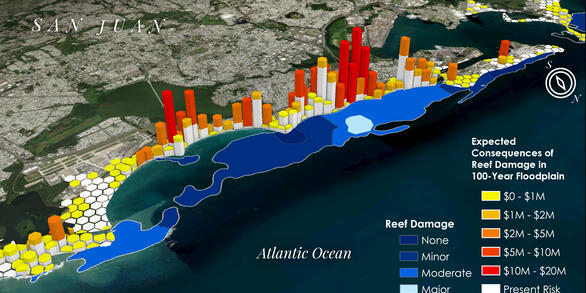
Coral reef restoration for risk reduction (CR4): A guide to project design and proposal development Coral reef restoration for risk reduction (CR4): A guide to project design and proposal development
The Federal Emergency Management Agency (FEMA), U.S. Geological Survey (USGS), U.S. Army Corps of Engineers (USACE), National Oceanic and Atmospheric Administration (NOAA), and University of California Santa Cruz (UCSC) are working through the U.S. Coral Reef Task Force to provide guidance on the development of coral reef restoration proposals for federal hazard mitigation funding.
Authors
Austen Stovall, Michael W. Beck, Curt D. Storlazzi, Juliette Hayes, Janan Reilly, Jennifer Koss, Doug Bausch
Warming-driven erosion and sediment transport in cold regions Warming-driven erosion and sediment transport in cold regions
Rapid atmospheric warming since the mid-twentieth century has increased temperature-dependent erosion and sediment-transport processes in cold environments, affecting food, energy and water security. In this Review, we summarize landscape changes in cold environments and provide a global inventory of increases in erosion and sediment yield driven by cryosphere degradation. Anthropogenic...
Authors
Tinghu Zhang, Dongfeng Li, Amy E. East, Desmond E. Walling, Stuart N. Lane, Irina Overeem, Achim A. Beylich, Michele N Koppes, Xixi Lu
A characterization of the deep-sea coral and sponge community along the California, Oregon, and Washington coasts using a remotely operated vehicle on the EXPRESS 2019 expedition A characterization of the deep-sea coral and sponge community along the California, Oregon, and Washington coasts using a remotely operated vehicle on the EXPRESS 2019 expedition
NOAA’s Deep-Sea Coral Research Technology Program (DSCRTP) began a 4-year funding initiative for the U.S. West Coast in 2018. The goals of the West Coast Deep-Sea Coral Initiative were to: 1) gather baseline information on DSCS in areas subject to fishing regulation changes prior to the implementation of Amendment 28; 2) improve our understanding of known DSCS bycatch “hot spots”; and 3)...
Authors
Tom Laidig, Diana Watters, Nancy G. Prouty, Meredith Everett, Lizzie Duncan, Liz Clarke, Chris Caldow, Jill R. Bourque, Jennifer McClain Counts, Amanda Demopoulos
On the use of high-resolution and deep-learning seismic catalogs for short-term earthquake forecasts: Potential benefits and current limitations On the use of high-resolution and deep-learning seismic catalogs for short-term earthquake forecasts: Potential benefits and current limitations
Enhanced earthquake catalogs provide detailed images of evolving seismic sequences. Currently, these data sets take some time to be released but will soon become available in real time. Here, we explore whether and how enhanced seismic catalogs feeding into established short-term earthquake forecasting protocols may result in higher predictive skill. We consider three enhanced catalogs...
Authors
Simone Mancini, Margarita Segou, Maximillan J. Werner, Thomas E. Parsons, Gregory C. Beroza, Lauro Chiaraluce
Using active source seismology to image the Palos Verdes Fault damage zone as a function of distance, depth, and geology Using active source seismology to image the Palos Verdes Fault damage zone as a function of distance, depth, and geology
Fault damage zones provide a window into the non-elastic processes of an earthquake. Geological and seismic tomography methods have been unable to measure damage zones at depth with sufficient spatial sampling to evaluate the relative influence of depth, distance, and lithological variations. Here, we identify and analyze the damage zone of the Palos Verdes Fault offshore southern...
Authors
Travis Alongi, Emily Brodsky, Jared W. Kluesner, Daniel S. Brothers
Multi-factor biotopes as a method for detailed site characterization in diverse benthic megafaunal communities and habitats in deep-water off Morro Bay, California Multi-factor biotopes as a method for detailed site characterization in diverse benthic megafaunal communities and habitats in deep-water off Morro Bay, California
Here we describe the methods and results for biological characterization of the benthos on a previously unexplored area of central California, USA seafloor. We conducted 40 remotely operated vehicle dives from 371 to 1173 m water depth. Seafloor habitats and megafauna (fish and invertebrates) were documented from 46.8 km of seafloor video footage. Our expanded development and analysis of...
Authors
Linda A. Kuhnz, Lisa Gilbane, Guy R. Cochrane, Charles K. Paull
Estimation of site terms in ground-motion models for California using horizontal-to-vertical spectral ratios from microtremor Estimation of site terms in ground-motion models for California using horizontal-to-vertical spectral ratios from microtremor
The horizontal‐to‐vertical spectral ratios from microtremor (mHVSR) data obtained at 196 seismic stations in California are used to evaluate three alternative microtremor‐based proxies for site amplification for use in ground‐motion models (GMMs): the site fundamental period (f0), the period‐dependent amplitude of the mHVSR(T), and the normalized amplitude of the mHVSR(T). The...
Authors
Camilo Pinilla Ramos, Norman A. Abrahamson, Robert Kayen
Planetary-scale change to the biosphere signalled by global species translocations can be used to identify the Anthropocene Planetary-scale change to the biosphere signalled by global species translocations can be used to identify the Anthropocene
We examine three distinctive biostratigraphic signatures associated with: hunting and gathering, landscape domestication, and globalisation. All three signatures have significant fossil records of regional importance that can be correlated inter-regionally and help describe the developing pattern of human expansion and appropriation of resources. While none have individual first or last
Authors
Mark Williams, Reinhold Leinfelder, Anthony D. Barnosky, Martin J Head, Francine M G McCarthy, Cearreta. Alejandro, Stephen J Himson, Rachael Holmes, Colin N. Waters, Jan Zalasiewicz, Simon Turner, Mary McGann, Elizabeth A. Hadly, M. Allison Stegner, Paul Michael Pilkington, Jerome Kaiser, Juan Carlos Berrio, Ian P. Wilkinson, Jens Zinke, Kristine L. DeLong