



Biocrusts with moss species. Photo taken by SBSC in Utah, during surveys, 2017, courtesy of Erika Geiger.
Images
Below are images associated with SBSC's science and staff. Images appear according to the year they were taken. To search, type a keyword or select a year from the dropdown menu. Or, click through the pages using the arrows at the bottom of the page.
Filter Total Items: 683

Biocrusts with mosses, Utah
Biocrusts with moss species. Photo taken by SBSC in Utah, during surveys, 2017, courtesy of Erika Geiger.

An extremely rare Mojave River western pond turtle
An extremely rare Mojave River western pond turtleAn extremely rare Mojave River western pond turtle was recently observed by USGS scientists and staff from The Living Desert Zoo and Gardens in the Mojave Desert. Turtles of this population have rarely been seen since the late 1990s.
An extremely rare Mojave River western pond turtle
An extremely rare Mojave River western pond turtleAn extremely rare Mojave River western pond turtle was recently observed by USGS scientists and staff from The Living Desert Zoo and Gardens in the Mojave Desert. Turtles of this population have rarely been seen since the late 1990s.

USGS researcher collects data on saguaro blooming patterns for phenology study
USGS researcher collects data on saguaro blooming patterns for phenology studySouthwest Biological Science center research ecologist Daniel Winkler photographs the top of a saguaro using the "world's largest selfie stick" to collect phenology data for a study that examined saguaro flowering patterns.
USGS researcher collects data on saguaro blooming patterns for phenology study
USGS researcher collects data on saguaro blooming patterns for phenology studySouthwest Biological Science center research ecologist Daniel Winkler photographs the top of a saguaro using the "world's largest selfie stick" to collect phenology data for a study that examined saguaro flowering patterns.

Sampling invertebrates on the Colorado River downstream of Davis Dam with a Hess sampler
Sampling invertebrates on the Colorado River downstream of Davis Dam with a Hess samplerSampling invertebrates on “Casino Row” at Laughlin, Nevada, just downstream of Davis Dam on the Colorado River, September 7, 2015.
Sampling invertebrates on the Colorado River downstream of Davis Dam with a Hess sampler
Sampling invertebrates on the Colorado River downstream of Davis Dam with a Hess samplerSampling invertebrates on “Casino Row” at Laughlin, Nevada, just downstream of Davis Dam on the Colorado River, September 7, 2015.

Biocrusts in healthy grassland data collection
Person taking data in a healthy dryland grassland with dark biocrusts between bunchgrasses and cacti in Utah.
Person taking data in a healthy dryland grassland with dark biocrusts between bunchgrasses and cacti in Utah.
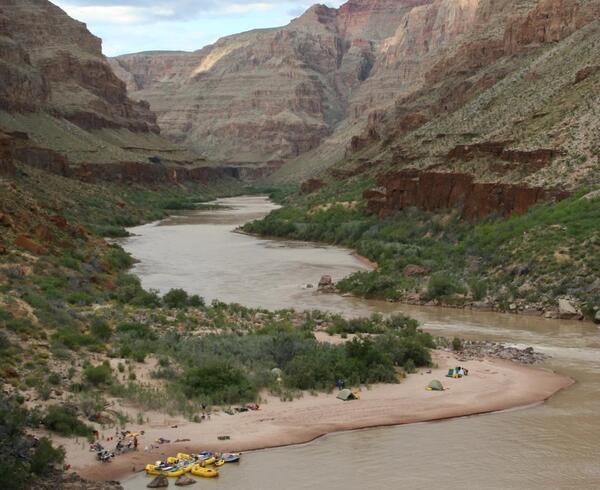
Sandbar on the Colorado River
A river trip on the Colorado River in the Grand Canyon camping on a sandbar beach. Photo by Scott VanderKooi, USGS. Public domain.
A river trip on the Colorado River in the Grand Canyon camping on a sandbar beach. Photo by Scott VanderKooi, USGS. Public domain.

Sticky trap for aquatic insects on the bank of Little Colorado River
Sticky trap for aquatic insects on the bank of Little Colorado RiverSticky trap for emergent aquatic insects (close-up) showing captured insects. Photo by Eric Kortenhoeven, USGS.
Sticky trap for aquatic insects on the bank of Little Colorado River
Sticky trap for aquatic insects on the bank of Little Colorado RiverSticky trap for emergent aquatic insects (close-up) showing captured insects. Photo by Eric Kortenhoeven, USGS.

Colorado River sticky trap for emergent aquatic insects
Colorado River sticky trap for emergent aquatic insectsSticky trap for insects Located on the banks of the Colorado River, at the confluence of the Little Colorado River and the Colorado River in AZ.
Colorado River sticky trap for emergent aquatic insects
Colorado River sticky trap for emergent aquatic insectsSticky trap for insects Located on the banks of the Colorado River, at the confluence of the Little Colorado River and the Colorado River in AZ.

A nurse tree cohort of Saguaro cacti in the Sonoran Desert, AZ
A nurse tree cohort of Saguaro cacti in the Sonoran Desert, AZSimilar aged saguaros can often be found in groups where nurse trees once stood. Nurse debris remains in place for years after the nurse died. Photo courtesy of Daniel Winkler, USGS SBSC.
A nurse tree cohort of Saguaro cacti in the Sonoran Desert, AZ
A nurse tree cohort of Saguaro cacti in the Sonoran Desert, AZSimilar aged saguaros can often be found in groups where nurse trees once stood. Nurse debris remains in place for years after the nurse died. Photo courtesy of Daniel Winkler, USGS SBSC.

View from Canyonlands Research Center
View from Canyonlands Research Center.

USGS scientist Jayne Belnap examines instruments to measure biocrust
USGS scientist Jayne Belnap examines instruments to measure biocrustUSGS scientist Jayne Belnap examines instrumentation to measure photosynthetic rates of biocrusts.
USGS scientist Jayne Belnap examines instruments to measure biocrust
USGS scientist Jayne Belnap examines instruments to measure biocrustUSGS scientist Jayne Belnap examines instrumentation to measure photosynthetic rates of biocrusts.

Footprint damage to biocrusts
Many human activities can be unintentionally harmful to biological crusts. The biocrusts are no match for the compressional stress caused by footprints of livestock or people or tracks from vehicles.
Many human activities can be unintentionally harmful to biological crusts. The biocrusts are no match for the compressional stress caused by footprints of livestock or people or tracks from vehicles.

Dark-colored mature biocrust
On the Colorado Plateau, mature biocrusts are bumpy and dark-colored due to the presence of lichens, mosses, and high densities of cyanobacteria and other organisms. These organisms perform critical functions, such as fertilizing soils and increasing soil stability, therefore reducing dust.
On the Colorado Plateau, mature biocrusts are bumpy and dark-colored due to the presence of lichens, mosses, and high densities of cyanobacteria and other organisms. These organisms perform critical functions, such as fertilizing soils and increasing soil stability, therefore reducing dust.

Biocrust
On the Colorado Plateau, mature biocrusts are bumpy and dark-colored due to the presence of lichens, mosses, and high densities of cyanobacteria and other organisms. Disturbed biocrusts are lighter in color, looking more like the underlying sand than undisturbed ones, and are less capable of stabilizing soils or providing soil fertility.
On the Colorado Plateau, mature biocrusts are bumpy and dark-colored due to the presence of lichens, mosses, and high densities of cyanobacteria and other organisms. Disturbed biocrusts are lighter in color, looking more like the underlying sand than undisturbed ones, and are less capable of stabilizing soils or providing soil fertility.

Biocrusts provide soil stability and prevent erosion
Biocrusts provide soil stability and prevent erosionBiocrusts provide soil stability and prevent erosion. Soil is the foundation where plants live; if soil is not stable, native plants can have difficulty growing.
Biocrusts provide soil stability and prevent erosion
Biocrusts provide soil stability and prevent erosionBiocrusts provide soil stability and prevent erosion. Soil is the foundation where plants live; if soil is not stable, native plants can have difficulty growing.

Biocrust outdoor testing plots
USGS scientists created outdoor testing plots where large squares of biocrusts were exposed to different warming and precipitation factors over time.
USGS scientists created outdoor testing plots where large squares of biocrusts were exposed to different warming and precipitation factors over time.

USGS scientist Sasha Reed studys outdoor biocrust testing sites
USGS scientist Sasha Reed studys outdoor biocrust testing sitesUSGS scientist Sasha Reed studies sites where different climate conditions are being mimicked to determine effect on biocrusts.
USGS scientist Sasha Reed studys outdoor biocrust testing sites
USGS scientist Sasha Reed studys outdoor biocrust testing sitesUSGS scientist Sasha Reed studies sites where different climate conditions are being mimicked to determine effect on biocrusts.

Biocrust outdoor testing plots
USGS scientists created outdoor testing plots where large squares of biocrusts were exposed to different warming and precipitation factors over time.
USGS scientists created outdoor testing plots where large squares of biocrusts were exposed to different warming and precipitation factors over time.

Biocrust outdoor testing plots.
USGS scientists created outdoor testing plots where large squares of biocrusts were exposed to different warming and precipitation factors over time.
USGS scientists created outdoor testing plots where large squares of biocrusts were exposed to different warming and precipitation factors over time.

New tamarisk leaves re-grow after tamarisk leaf beetle defoliation
New tamarisk leaves re-grow after tamarisk leaf beetle defoliationTamarisk leaves regrow following defoliation by the biological control agent, tamarisk leaf beetle (Diorhabda spp.).
New tamarisk leaves re-grow after tamarisk leaf beetle defoliation
New tamarisk leaves re-grow after tamarisk leaf beetle defoliationTamarisk leaves regrow following defoliation by the biological control agent, tamarisk leaf beetle (Diorhabda spp.).

Defoliated nonnative tamarisk with native cottonwood trees
Defoliated nonnative tamarisk with native cottonwood treesNonnative tamarisk can form mixed stands with native trees, such as cottonwoods, and other nonnative trees, such as Russian olive.
Defoliated nonnative tamarisk with native cottonwood trees
Defoliated nonnative tamarisk with native cottonwood treesNonnative tamarisk can form mixed stands with native trees, such as cottonwoods, and other nonnative trees, such as Russian olive.