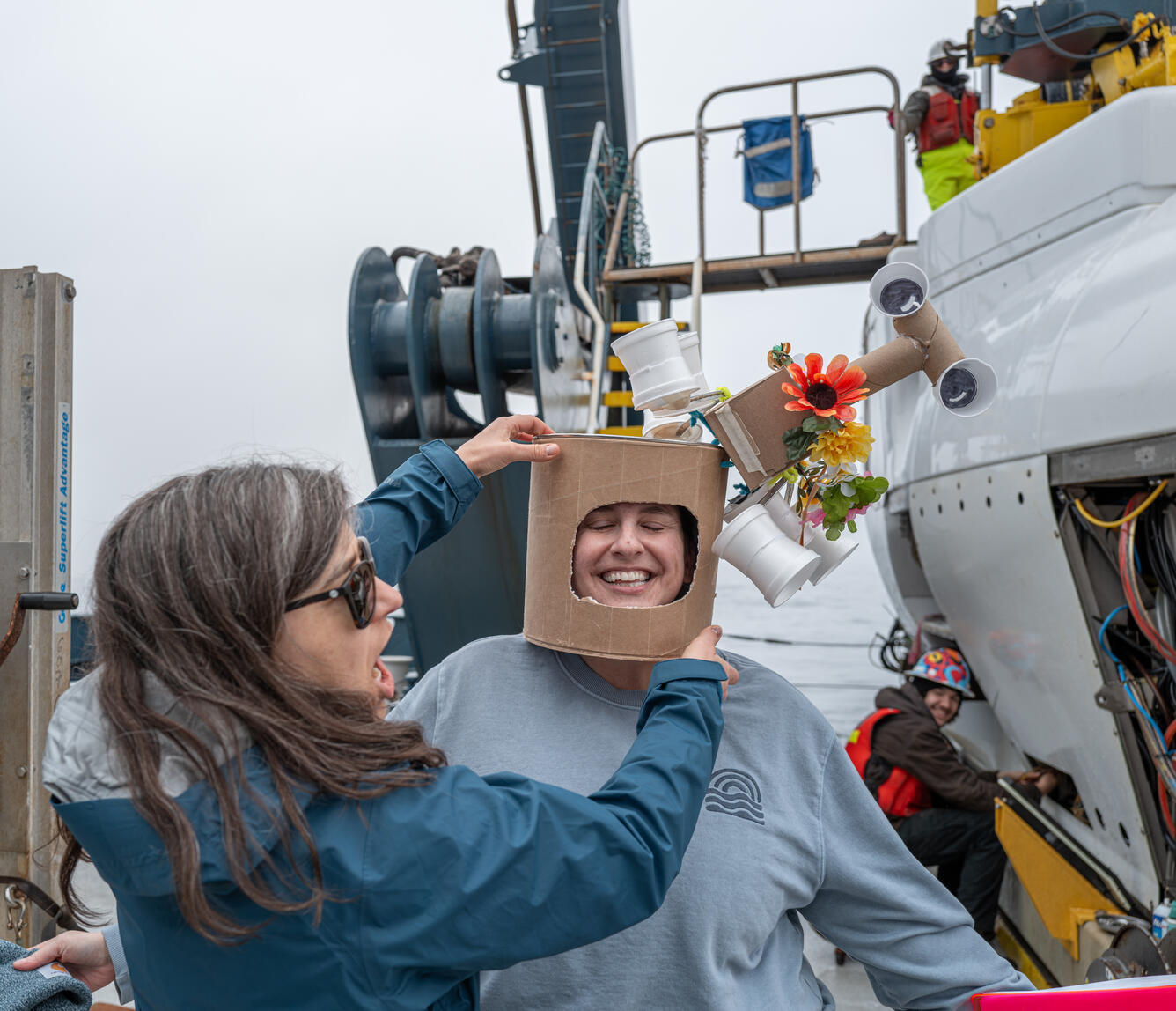
Life in the Sphere: Exploring the Aleutian Arc
A USGS-led expedition in the Aleutian Arc off Alaska will provide critical information on energy resources, underwater earthquakes and other hazards, seafloor habitats, and biological resources, including key fisheries, as well as potential seabed minerals. To do this, the science team is using the human-occupied vehicle known as Alvin to reach the seafloor.
“OBSERVERS!” It is 8 am, and two individuals step forward from a crowd of researchers on the rear deck of the Office of Naval Research's Research Vessel Atlantis. They climb a set of stairs built into the side of a hydraulic A-frame, remove their shoes, and lower themselves into the open hatch atop the deep-sea submersible, the U.S. Navy's human occupied vehicle (HOV) Alvin, operated by the Woods Hole Oceanographic Institution.
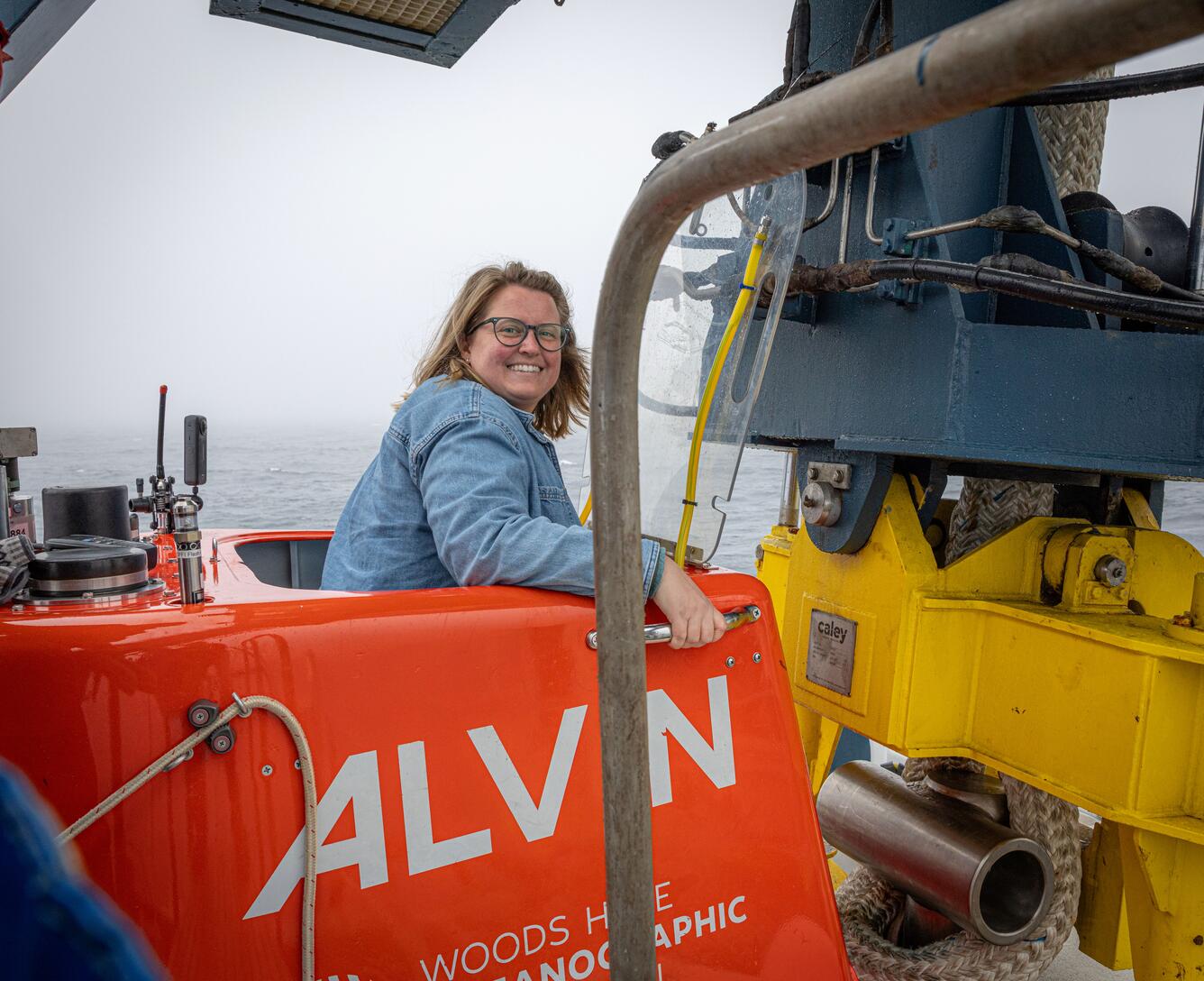
Over the next half hour, the hatch is sealed, and the submersible is lifted off the deck and lowered into the water. Two swimmers dive down for final safety checks before Alvin descends into the depths of the ocean. To conserve battery, the submersible’s lights are off during the 30-to-60-minute descent to the seafloor. In the darkness of the deep ocean, divers in the submersible are often treated to a brilliant show of bioluminescence, bright flashes of light breaking the darkness outside the sub’s windows.
We are currently sailing off the Aleutian Islands in Alaska, mapping and exploring the habitats found along the deep ocean floor. The region promises unique geology as well as a huge diversity of animals such as sponges, corals, fish, and crab. Using Alvin allows us to explore new places, untethered to the ship, and personally visit the seafloor to make detailed observations with a stronger sense of context, which can be lost when only using cameras. While the rest of the research team wait on the ship, the two scientists chosen to dive in the sphere have a busy day ahead of them.
The titanium sphere of the HOV Alvin holds three people, generally a pilot and two science observers. These three individuals will juggle various responsibilities and work to meet a list of research objectives put forth by the science party. The observers guide the dive, instructing the pilot to transit between pre-determined way points, stopping to sample along the way. On our expedition, tasks include collecting sediment cores, gathering rocks, collecting various target animals, capturing volumes of water, and recording hours of video footage. The catch? No one knows exactly what they will find in these unexplored regions of the Aleutians.
The inside of the sphere is illuminated with red light to reduce glare on the viewports. The pilot sits on a small stool, hunched over the controls and watches out the front viewport. The two science observers recline on oddly shaped benches and hold tablets that let them control the cameras and take digital notes. They each also have a clipboard with papers detailing the objectives of the dive, maps of the dive area, picture references of target animals, and diagrams to help track where collected samples are stored.
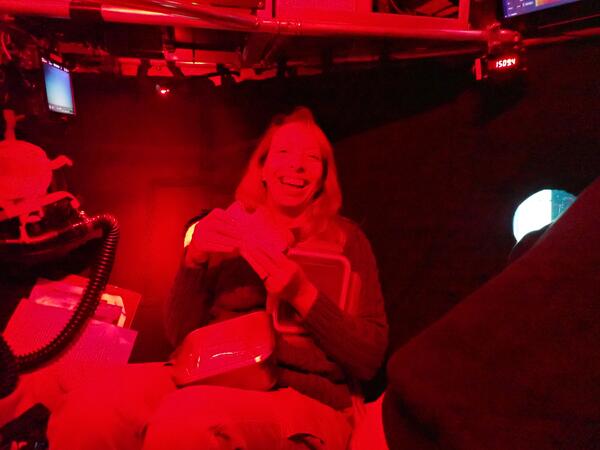
As Alvin descends and the water temperatures drop, the scientists unpack extra clothes from pillowcases placed aboard the submersible before their dive. Lunch – consisting of peanut butter and jelly sandwiches, apples, and candy bars – are stored alongside a wall of oxygen canisters and computers. Thermoses with water and coffee are tucked near the floor. The observers and the pilot will spend upwards of eight hours in the sphere, exploring the seafloor and collecting samples. Upon their return to the ship, they will be greeted by cheers and, for first-time divers, a uniquely designed hat. Once the all-clear is given, samples will be offloaded from Alvin’s basket and processing will begin.