PubTalk 1/2018 — ShakeAlert: Path to West Coast EQ Early Warning
PubTalk 1/2018 — ShakeAlert: Path to West Coast EQ Early WarningTitle: ShakeAlert: The Path to West Coast Earthquake Early Warning ... how a few seconds can save lives and property


Official websites use .gov
A .gov website belongs to an official government organization in the United States.

Secure .gov websites use HTTPS
A lock () or https:// means you’ve safely connected to the .gov website. Share sensitive information only on official, secure websites.

USGS earthquake information mechanisms are all triggered by the same system, so they all receive the information at the same time. The time it takes for the system to receive the information primarily depends on the size and location of the earthquake:
An earthquake in California is processed and posted to the system in 2.5 minutes (on average). This is because our seismic network is very extensive in California, where there are many earthquakes and many people.
An earthquake in the U.S. outside of California (where seismic networks are not as dense), is typically posted within 8 minutes.
An earthquake outside the United States, where the seismic network is sparse in some areas, takes 20 minutes (on average) to process and post. Our webpages with realtime information are cached for 60 seconds, so there might be an additional delay of up to 60 seconds for the webpage to be updated.
From the time each system receives the information to the time you receive the information is the same for all systems, usually within a few seconds (unless there are network problems), except for the Earthquake Notification System (ENS) and the earthquake feeds, which can vary.
Since ENS has many thousands of accounts, all customized to receive different notifications, the time between ENS receiving the information and you receiving your notification can vary quite a bit. A large earthquake that generates many notifications might take up to 45 minutes to reach the last account on the list. A small earthquake that generates fewer notifications will take only a matter of several minutes to reach all accounts. The time it takes for the notifications to be sent depends on the capacity of the machines that send the email.
Social media outlets, such as Twitter, might be able to broadcast the occurrence of an earthquake faster than the USGS can using our standard mechanisms, but they cannot provide any quantitative data such as location and magnitude.
For the various Feeds, we cache different feeds for different lengths of time, so it depends on the feed you access. We try to balance data volume, how often the data in the feeds change, and server load so:
The Earthquake Map/List/Search interface uses GeoJSON feeds.
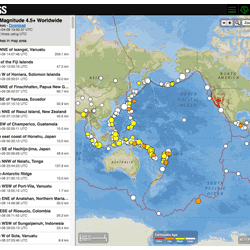
The Earthquake Hazards Program Latest Earthquakes Map displays earthquakes in near-realtime and up to the past 30 days of earthquakes. The interface includes three panels: a list of earthquakes, a map, and a settings/options panel. You can pan and zoom the map to view specific areas. Click on an event on the list or map for additional information and a link to the event page with all the details...

Report an earthquake experience or related observation through the Did You Feel It? citizen science webpage. The best way to do this is to click on the earthquake that you think you felt on one of the lists on the Earthquakes webpage, and then select the "Tell Us!" link. If you don't see the earthquake you think you felt, use the green "Report an Unknown Event" button on our Did You Feel It? page...

The USGS Latest Earthquakes map and lists show events that have been located by the USGS and contributing agencies within the last 30 days. They should NOT be considered complete lists of all events in the U.S. and adjacent areas and especially should NOT be considered complete lists of all magnitude 4.5 and greater events that occur around the globe. In most cases, we locate and report an...

The USGS and networks contributing to the Advance National Seismic System (ANSS) take great effort to provide accurate and timely earthquake information. Occasionally our systems produce erroneous information that is released to the public via our web pages or Earthquake Notification System. These mistakes are generally promptly identified by seismologists, removed from our web pages, and “delete”...

Seismologists evaluate the hypocenter location and the focal mechanism of an earthquake to decide if the earthquake occurs on a named fault. Research shows that many earthquakes occur on small, un-named faults located near well-known faults. For example, most of the aftershocks of the 1989 M6.9 Loma Prieta earthquake occurred on small, subsidiary faults within a few hundred meters of the mainshock...

Please go to the USGS Earthquake Notification Services (ENS) to sign up for free emails or text messages to your phone. Use the default settings or customize ENS to fit your needs. Also check out the many different Earthquake Feeds. ENS is NOT an earthquake early warning system. Messages issued by ENS will almost always arrive after you would feel any shaking. Learn more: How do I sign up for...

The USGS often updates an earthquake's magnitude in the hours and sometimes days following the event. Updates occur as more data become available for analysis and more time-intensive analysis is performed. Additional updates are possible as part of the standard procedure of assembling a final earthquake catalog. There are physical and operational constraints on how quickly seismic data are...

Ten kilometers is a "fixed depth." Sometimes data are too poor to compute a reliable depth for an earthquake. In such cases, the depth is assigned to be 10 km. Why that number? In many areas around the world, reliable depths tend to average 10 km or close to it. For example, if we made a histogram of the reliable depths in such an area, we'd expect to see a peak around 10 km. So if we don't know...

The USGS Earthquake Hazards Program has helicorders (seismogram displays) available for several areas in the United States and the World. Our research partner IRIS (Incorporated Research Institutions for Seismology) has two applications, the Station Monitor and the Global Seismogram Viewer, for viewing seismograms. IRIS also supplies software that allows users to collect and view seismic data from...

Magnitude estimates for a given earthquake can vary between reporting agencies due to differences in methodology, data availability, and inherent uncertainties in seismic data. Individual agencies use magnitude estimation procedures designed to meet the agency's specific needs and monitoring capabilities. Even for well-recorded events, differences in magnitude of 0.2 or 0.3 units are common and...

UTC stands for Coordinated Universal Time, and for this purpose is the same as GMT (Greenwich Mean Time). Since the USGS and other seismic network agencies record earthquakes around the globe in all the various time zones, using a single standard time reference is best for record-keeping and exchange of data. The individual event pages with details about each earthquake use UTC for the reference...

Title: ShakeAlert: The Path to West Coast Earthquake Early Warning ... how a few seconds can save lives and property
Title: ShakeAlert: The Path to West Coast Earthquake Early Warning ... how a few seconds can save lives and property

With funding from the American Recovery and Reinvestment Act of 2009, The USGS Hawaiian Volcano Observatory recently upgraded its seismic monitoring network. Here, HVO staff, assisted by an HVO volunteer, installs the solar panel and antenna for one of the upgraded seismic stations on Kīlauea.
With funding from the American Recovery and Reinvestment Act of 2009, The USGS Hawaiian Volcano Observatory recently upgraded its seismic monitoring network. Here, HVO staff, assisted by an HVO volunteer, installs the solar panel and antenna for one of the upgraded seismic stations on Kīlauea.
The Earthquake Hazards Program Latest Earthquakes Map displays earthquakes in near-realtime and up to the past 30 days of earthquakes. The interface includes three panels: a list of earthquakes, a map, and a settings/options panel. You can pan and zoom the map to view specific areas. Click on an event on the list or map for additional information and a link to the event page with all the details...
Report an earthquake experience or related observation through the Did You Feel It? citizen science webpage. The best way to do this is to click on the earthquake that you think you felt on one of the lists on the Earthquakes webpage, and then select the "Tell Us!" link. If you don't see the earthquake you think you felt, use the green "Report an Unknown Event" button on our Did You Feel It? page...
The USGS Latest Earthquakes map and lists show events that have been located by the USGS and contributing agencies within the last 30 days. They should NOT be considered complete lists of all events in the U.S. and adjacent areas and especially should NOT be considered complete lists of all magnitude 4.5 and greater events that occur around the globe. In most cases, we locate and report an...
The USGS and networks contributing to the Advance National Seismic System (ANSS) take great effort to provide accurate and timely earthquake information. Occasionally our systems produce erroneous information that is released to the public via our web pages or Earthquake Notification System. These mistakes are generally promptly identified by seismologists, removed from our web pages, and “delete”...
Seismologists evaluate the hypocenter location and the focal mechanism of an earthquake to decide if the earthquake occurs on a named fault. Research shows that many earthquakes occur on small, un-named faults located near well-known faults. For example, most of the aftershocks of the 1989 M6.9 Loma Prieta earthquake occurred on small, subsidiary faults within a few hundred meters of the mainshock...
Please go to the USGS Earthquake Notification Services (ENS) to sign up for free emails or text messages to your phone. Use the default settings or customize ENS to fit your needs. Also check out the many different Earthquake Feeds. ENS is NOT an earthquake early warning system. Messages issued by ENS will almost always arrive after you would feel any shaking. Learn more: How do I sign up for...
The USGS often updates an earthquake's magnitude in the hours and sometimes days following the event. Updates occur as more data become available for analysis and more time-intensive analysis is performed. Additional updates are possible as part of the standard procedure of assembling a final earthquake catalog. There are physical and operational constraints on how quickly seismic data are...
Ten kilometers is a "fixed depth." Sometimes data are too poor to compute a reliable depth for an earthquake. In such cases, the depth is assigned to be 10 km. Why that number? In many areas around the world, reliable depths tend to average 10 km or close to it. For example, if we made a histogram of the reliable depths in such an area, we'd expect to see a peak around 10 km. So if we don't know...
The USGS Earthquake Hazards Program has helicorders (seismogram displays) available for several areas in the United States and the World. Our research partner IRIS (Incorporated Research Institutions for Seismology) has two applications, the Station Monitor and the Global Seismogram Viewer, for viewing seismograms. IRIS also supplies software that allows users to collect and view seismic data from...
Magnitude estimates for a given earthquake can vary between reporting agencies due to differences in methodology, data availability, and inherent uncertainties in seismic data. Individual agencies use magnitude estimation procedures designed to meet the agency's specific needs and monitoring capabilities. Even for well-recorded events, differences in magnitude of 0.2 or 0.3 units are common and...
UTC stands for Coordinated Universal Time, and for this purpose is the same as GMT (Greenwich Mean Time). Since the USGS and other seismic network agencies record earthquakes around the globe in all the various time zones, using a single standard time reference is best for record-keeping and exchange of data. The individual event pages with details about each earthquake use UTC for the reference...
Title: ShakeAlert: The Path to West Coast Earthquake Early Warning ... how a few seconds can save lives and property
Title: ShakeAlert: The Path to West Coast Earthquake Early Warning ... how a few seconds can save lives and property
With funding from the American Recovery and Reinvestment Act of 2009, The USGS Hawaiian Volcano Observatory recently upgraded its seismic monitoring network. Here, HVO staff, assisted by an HVO volunteer, installs the solar panel and antenna for one of the upgraded seismic stations on Kīlauea.
With funding from the American Recovery and Reinvestment Act of 2009, The USGS Hawaiian Volcano Observatory recently upgraded its seismic monitoring network. Here, HVO staff, assisted by an HVO volunteer, installs the solar panel and antenna for one of the upgraded seismic stations on Kīlauea.