



What is the probability that an earthquake is a foreshock to a larger earthquake?
Around the world, the likelihood that an earthquake will be followed by a larger earthquake nearby and within a week is about 5%.
When an earthquake occurs, it can trigger other earthquakes nearby in what seismologists call an earthquake sequence. In most sequences, these later earthquakes will be smaller than the first one. The first, largest earthquake is called the mainshock and the later, smaller earthquakes are called aftershocks.
Occasionally, a new earthquake will be larger than any of the earlier events. When that happens, we call the new, largest earthquake the mainshock and we call all the earlier earthquakes in the sequence foreshocks. Observations show that the chance of an earthquake being followed by a larger one nearby and within a week is about 5%.
That 5% foreshock probability varies with the activity level of an aftershock sequence. Some earthquakes will have more or fewer aftershocks than average making them more or less likely to be followed by a larger earthquake, respectively. The USGS releases aftershock forecasts for all mainshocks with magnitude greater than 5 in the U.S. and its territories. These forecasts provide more accurate estimates of aftershock and foreshock probabilities.
Learn more:
Related

What is the USGS doing to mitigate and respond to earthquake hazards? What is the USGS doing to mitigate and respond to earthquake hazards?
The U.S. Geological Survey performs the following functions related to earthquake hazard mitigation: Receives, analyzes, maintains, and distributes data on earthquake activity worldwide. Satellites link our National Earthquake Information Center in Golden, Colorado to a network of seismograph stations. These stations, located throughout the world, are maintained by the U.S. Geological Survey...
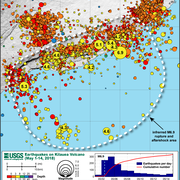
Foreshocks, aftershocks - what's the difference? Foreshocks, aftershocks - what's the difference?
"Foreshock" and "aftershock" are relative terms. Foreshocks are earthquakes that precede larger earthquakes in the same location. An earthquake cannot be identified as a foreshock until after a larger earthquake in the same area occurs. Aftershocks are smaller earthquakes that occur in the same general area during the days to years following a larger event or "mainshock." They occur within 1-2...
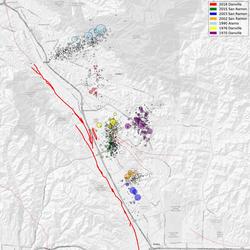
What is the difference between aftershocks and swarms? What is the difference between aftershocks and swarms?
Aftershocks are a sequence of earthquakes that happen after a larger mainshock on a fault. Aftershocks occur near the fault zone where the mainshock rupture occurred and are part of the "readjustment process” after the main slip on the fault. Aftershocks become less frequent with time, although they can continue for days, weeks, months, or even years for a very large mainshock. A swarm, on the...
Related
What is the USGS doing to mitigate and respond to earthquake hazards? What is the USGS doing to mitigate and respond to earthquake hazards?
The U.S. Geological Survey performs the following functions related to earthquake hazard mitigation: Receives, analyzes, maintains, and distributes data on earthquake activity worldwide. Satellites link our National Earthquake Information Center in Golden, Colorado to a network of seismograph stations. These stations, located throughout the world, are maintained by the U.S. Geological Survey...
Foreshocks, aftershocks - what's the difference? Foreshocks, aftershocks - what's the difference?
"Foreshock" and "aftershock" are relative terms. Foreshocks are earthquakes that precede larger earthquakes in the same location. An earthquake cannot be identified as a foreshock until after a larger earthquake in the same area occurs. Aftershocks are smaller earthquakes that occur in the same general area during the days to years following a larger event or "mainshock." They occur within 1-2...
What is the difference between aftershocks and swarms? What is the difference between aftershocks and swarms?
Aftershocks are a sequence of earthquakes that happen after a larger mainshock on a fault. Aftershocks occur near the fault zone where the mainshock rupture occurred and are part of the "readjustment process” after the main slip on the fault. Aftershocks become less frequent with time, although they can continue for days, weeks, months, or even years for a very large mainshock. A swarm, on the...