



FORT Updates: From Plains to Peaks - Vol. 4 | Issue 4
Hot off the Press
Recent publications, events, and other news from the Fort Collins Science Center.
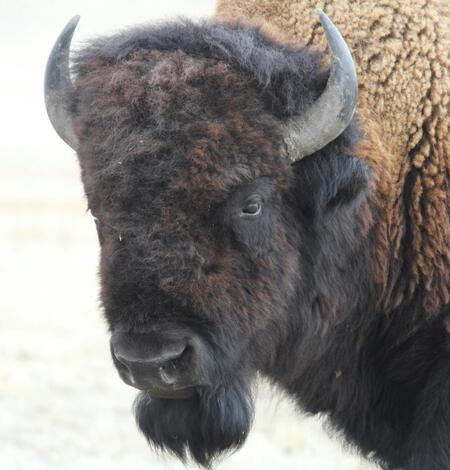
Towards Continental Conservation: A Metapopulation Strategy to Support Collaborative Bison Restoration and Management
Join us for a bison-centric Friday's Findings in honor of National Bison Day (November 7)! Tune in to learn how USGS scientists are helping to inform bison restoration and management.

USGS Study Outlines Scope and Severity of Bat Fatalities at US Wind Energy Facilities
A new USGS study reveals that an estimated 18.7 million bats have been killed at U.S. onshore wind energy facilities since 1981, far more than previously understood. By analyzing data from hundreds of wind projects, researchers identified the species most vulnerable to turbine collisions and uncovered patterns that could help reduce future bat fatalities.
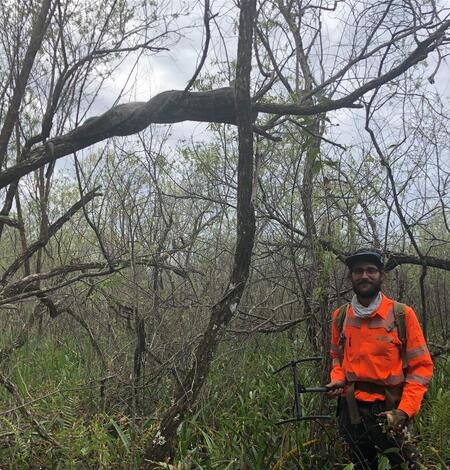
Branching out: New study reveals when invasive pythons take to the trees
Effective management of invasive species often depends on not only understanding where the species lives, but how it behaves. In Big Cypress National Preserve, USGS scientists are uncovering new insights into the behavior of one of Florida’s most prolific invasive snakes – the Burmese python. A new study provides important context for understanding and managing this formidable snake.

Range-wide population trend analysis for greater sage-grouse (Centrocercus urophasianus)—Updated 1960–2025
Greater sage-grouse (Centrocercus urophasianus; hereafter sage-grouse) are at the center of State and national land-use policies largely because of their unique life-history traits as an ecological indicator for the health of sagebrush ecosystems. This updated population analysis provides State and Federal land and wildlife managers with the best available science to help guide...
Quantifying free-roaming horse body condition: A methodological investigation using game cameras and observer bias corrections
Large populations of free-roaming horses (Equus caballus) inhabit the western United States, Australia, and other arid and semi-arid rangelands globally. In the United States, horse body condition has been the impetus for gathering and removing horses under an emergency designation and has been noted as a common chronic mortality-causing condition. The Henneke body condition scoring (BCS...
Mountain lion prey-selection in a community comprised of native and introduced ungulate species
Species introductions are a hallmark of human influence on ecosystems worldwide. In communities where native and introduced fauna coexist, predators may select prey based on availability or vulnerability. Free-roaming feral horses (Equus caballus) are a recent addition to North America and have become widespread, abundant, and in some areas serve as major prey for mountain lions (Puma...
Subscribe to our newsletter to get all the FORT Science Updates!
Science Spotlights
New or ongoing research projects at the Fort Collins Science Center.
-

Actionable science for managing public lands
Our team of biologists, ecologists, and social scientists focuses on coproducing actionable science products to support natural resource planning and management. Broadly, our research involves working to better understand and bridge the research-management gap through a variety of mechanisms, including coproduction and relationship-building, science synthesis and summary, and identification of...
-
Science for management of America’s iconic wild horses and burros
Wild horses and burros are iconic wildlife of the western USA as well as a complicated management issue on tribal, state, and federal lands. Due to their history as domesticated animals, these wild equids – also called “free-roaming” or “feral” equids – can reproduce quickly, and have few natural predators, allowing their populations to grow rapidly if not managed. When populations are too large...
-

Research to support conservation of America’s national mammal, the bison
Once numbering in the tens of millions, plains bison ( Bison bison bison) were nearly driven to extinction with only a few hundred individuals remaining by the late 19th century. Plains bison have since recovered to approximately 20,000 animals managed in conservation herds throughout North America, yet substantial challenges to their recovery remain. The Department of the Interior (DOI) stewards...
Learn More
Find our science and connect with our researchers.
Publications
FORT scientists have produced more than 2000 peer reviewed publications that are registered in the USGS Publications Warehouse, along with many others prior to their work at the USGS or in conjunction with other government agencies.

Data
Our interdisciplinary, integrated science teams develop various data sets in support of the USGS mission areas. This information then aids natural resource managers in decision making and support of the complex issues they face in today's world. The data and tools listed here are official USGS data releases.

Connect
The majority of our staff call Fort Collins, Colorado their home, but work all over the United States. FORT research and support staff work from one of four duty stations: in Colorado, at the Fort Collins Science Center or Denver Federal Center; in New Mexico, at the New Mexico Landscapes Field Station; or in Florida, at the USGS Everglades Research Offices.