



Early detection and rapid response tools for invasive tegu lizards
Scientists at USGS have shown that much of the US is suitable for invasion by tegu lizards, and suitability will likely increase in the future. While tegus can be removed via trapping, it is difficult to monitor every geographic area where tegus could invade. Thus, methods for quickly detecting and removing tegus in new areas are the best way to prevent spread and minimize damage from these invasive lizards.
USGS scientists are currently developing an adaptable Early Detection Rapid Response framework to help limit the spread of tegus. They are conducting research on new technologies, such as terrestrial environmental DNA (eDNA) sampling and artificial intelligence (AI), for early detection of invasive tegu lizards. Terrestrial eDNA sampling will allow managers to detect if tegus are present without seeing a tegu, while AI image detection algorithms will allow managers to use camera traps to survey and efficiently identify tegus in the images.
These new technologies will reduce the resources needed to monitor for tegus in currently uninvaded areas. USGS scientists are also testing ways to improve removal methods for tegus by trialing different baiting strategies for trapping tegus.

Tegus are a group of lizards native to South America and popular in the pet trade. There are three species in particular that are common in the pet trade: the black and white tegu, red tegu, and gold tegu. Tegu sightings in Florida began in 2006, and since then, populations have established in at least two Florida counties and one county in Georgia. There have also been multiple sightings of tegus in several other states across the southern US, Texas, and as far west as California. Studies using environmental data from their native range suggest that much of the US is suitable for tegus, and that suitability is likely to increase in the future (Jarnevich and others 2018).
Tegus are omnivorous, and have been documented eating plants, invertebrates, vertebrates (including hatchlings of the threatened gopher tortoise), and eggs of various species in Florida (Offner and others 2021). Their broad diet and predilection for eggs makes them a threat to native ecosystems and small-scale poultry farms.
Trapping tegus is an effective means of removal (Haro and others 2021), and every year hundreds of tegus are removed along the border of Everglades National Park (ENP), as the park managers fight to keep tegus out of the heart of ENP and bordering Big Cypress National Preserve (BCNP). However, both ENP and BCNP cover vast areas of South Florida, and it is impossible to consistently monitor the entirety of the two park units. While opportunistic sightings of tegus within BCNP have successfully led to removal (Sandfoss and others 2025), wide-spread monitoring for tegus in new areas has yet to be implemented.
USGS FORT scientists are working to develop a framework for Early Detection and Rapid Response (EDRR) that can be used not only by the park service, but for local, state, and federal partners, as well as Tribal Nations. As part of the framework, researchers are testing a suite of tools for more systematic EDRR efforts. These tools have the potential to both increase the probability of detecting a tegu if it is in the area, and to increase removal success when traps are deployed. The tools are being designed to be widely applicable across different landscapes, and thus could be implemented by a variety of partner agencies as the need arises.
Terrestrial environmental DNA (eDNA)
The concept of eDNA stems from our knowledge that pieces of DNA from organisms can remain in the environment to be detected. Thus, testing certain environments for the DNA of organisms can be a way to quickly understand if a species is present without seeing them.
Until recently, samples for eDNA were primarily taken from aquatic environments, because technology existed to filter DNA from samples of water. However, recent advances have expanded the opportunities for extracting DNA from terrestrial substrates such as vegetation, soil, and air.
Scientists at USGS FORT are working to understand whether tegus ‘shed’ enough DNA in the environment to be picked up by new eDNA sampling strategies, and to develop a targeted assay for tegus (a unique sequence of tegu DNA) to test environmental samples against. They are experimenting with two different ways to collect tegu DNA from vegetation using common household items like a paint roller or a paper towel.
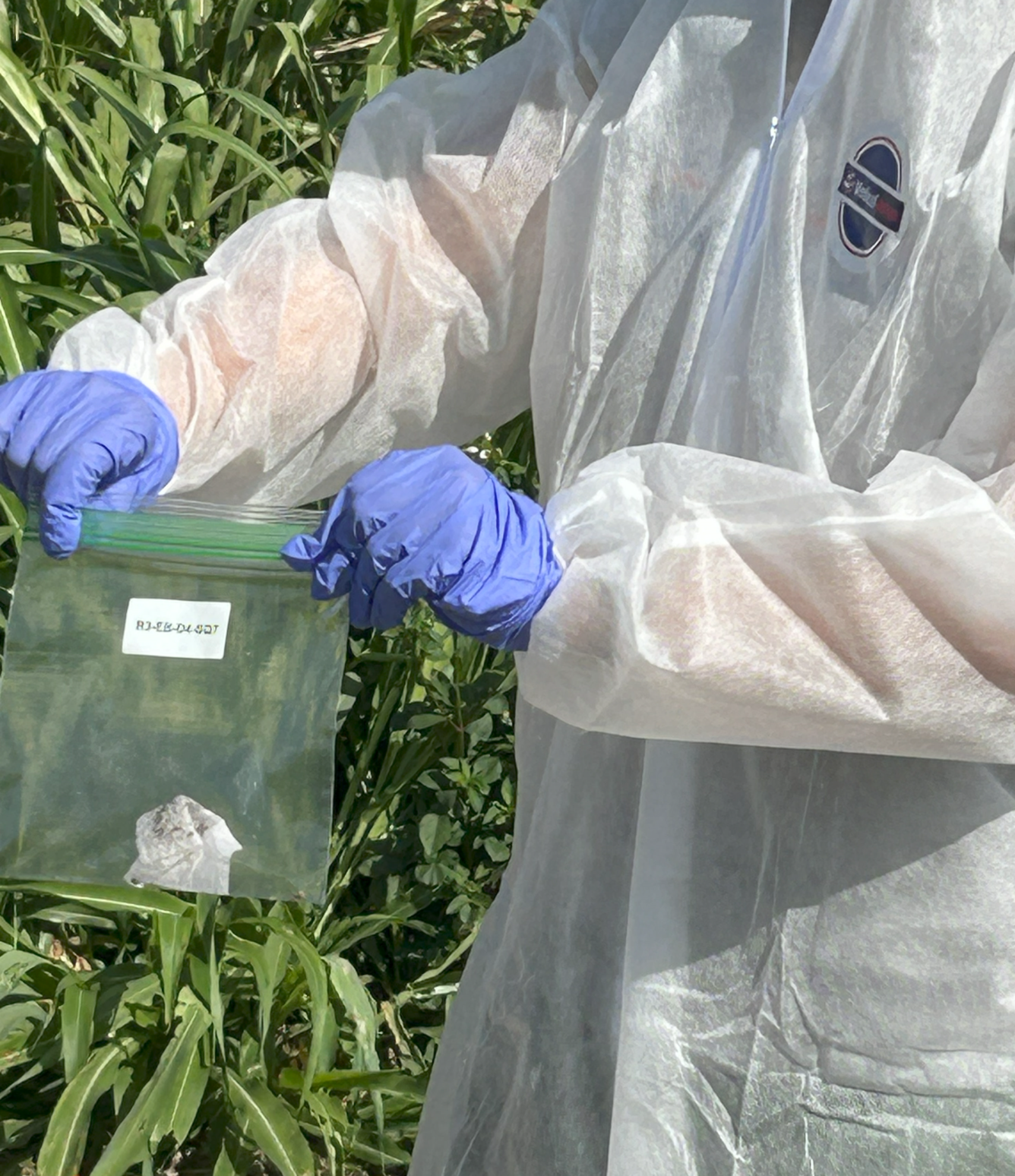
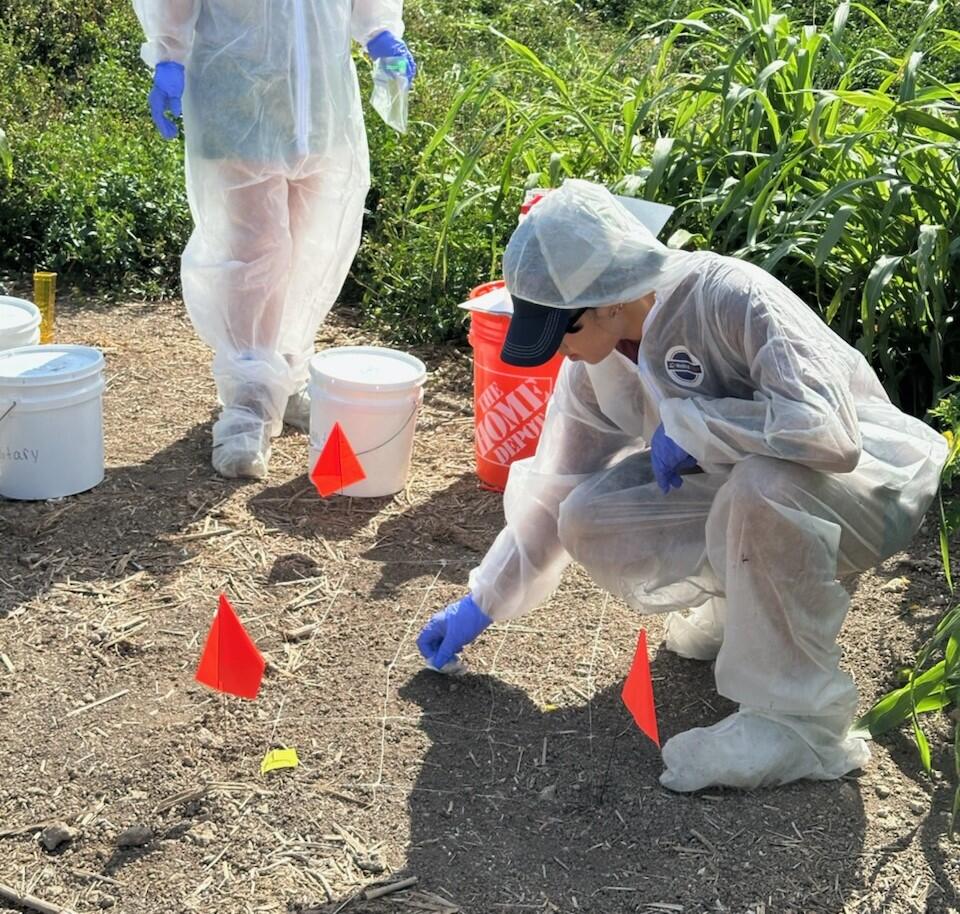
Additionally, USGS FORT researchers are currently conducting an experiment to understand how tegu eDNA decays in the environment. Scientists have set up an experiment consisting of plots divided into grid cells that have a known quantity of tegu DNA applied to them. These plots were deployed in a variety of conditions and are being sampled over time to determine how long tegu eDNA can be detected a) on different vegetation substrates, b) in areas fully exposed to the sun (where DNA is likely to degrade faster) and in c) areas that are partially shaded by trees or other vegetation.
Artificial Intelligence
Image detection algorithms that are developed using artificial intelligence, such as neural networks, are an emerging tool in wildlife surveillance. While these algorithms have been developed for many species, there is a taxonomic bias favoring detection of mammals and birds. Many algorithms are notoriously bad at identifying reptiles. However, USGS FORT has partnered with the developer of Microsoft’s publicly available image detection algorithm, Megadetector, to improve its ability to detect tegus. Researchers provided >2,000,000 images from five years of tegu surveillance to train the model to detect tegus.
Now, USGS researchers are applying the tegu-specific Megadetector to an independently collected dataset of images to understand detection rates and develop thresholds for the number of cameras and the length of time cameras should be deployed to detect a tegu if it is present in an area of interest.
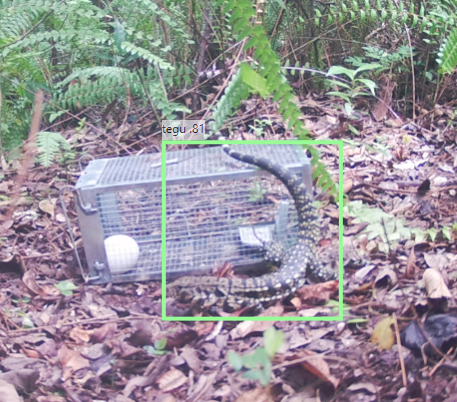
Additionally, USGS FORT researchers are developing an automated pipeline for image analysis. They are testing the use of cellular- and satellite-enabled devices that can be attached to trail cameras. The devices can also house the AI algorithm for detecting tegus. Thus, when the camera is triggered and one or more images is taken, the device will automatically run the images through the AI algorithm and send information over the cellular or satellite network if a tegu is observed.
Putting the real-time automated pipeline together- from camera deployment to image detection to an alert system when a tegu is detected- is still a work in progress, but researchers hope that this will serve as a tool to help monitor new areas for the arrival of tegus and guide managers as to where to focus trapping efforts, while greatly reducing the resources needed for surveillance.

Improving tegu trapping
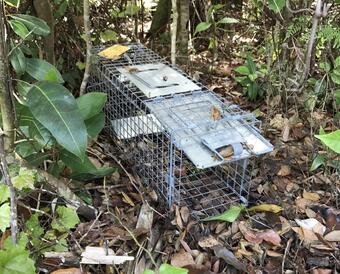
While using baited traps to remove tegus is relatively effective compared to removal of other invasive reptiles, understanding how to maximize capture rates is critical in a rapid response scenario. To test the effectiveness of various bait methods, USGS FORT researchers teamed up with National Park Service biologists who trap tegus annually from March through October along the park border to prevent tegus from invading and establishing within the park. Traditionally, traps are baited with a single egg. In 2023 and 2024, USGS FORT and NPS scientists tested whether decoy eggs or multiple real eggs produced similar or increased capture rates. The analysis of these data are underway, and the results will have real-world management implications for NPS and other state and local partners who are working to remove tegus.
Scientists at USGS have shown that much of the US is suitable for invasion by tegu lizards, and suitability will likely increase in the future. While tegus can be removed via trapping, it is difficult to monitor every geographic area where tegus could invade. Thus, methods for quickly detecting and removing tegus in new areas are the best way to prevent spread and minimize damage from these invasive lizards.
USGS scientists are currently developing an adaptable Early Detection Rapid Response framework to help limit the spread of tegus. They are conducting research on new technologies, such as terrestrial environmental DNA (eDNA) sampling and artificial intelligence (AI), for early detection of invasive tegu lizards. Terrestrial eDNA sampling will allow managers to detect if tegus are present without seeing a tegu, while AI image detection algorithms will allow managers to use camera traps to survey and efficiently identify tegus in the images.
These new technologies will reduce the resources needed to monitor for tegus in currently uninvaded areas. USGS scientists are also testing ways to improve removal methods for tegus by trialing different baiting strategies for trapping tegus.
Tegus are a group of lizards native to South America and popular in the pet trade. There are three species in particular that are common in the pet trade: the black and white tegu, red tegu, and gold tegu. Tegu sightings in Florida began in 2006, and since then, populations have established in at least two Florida counties and one county in Georgia. There have also been multiple sightings of tegus in several other states across the southern US, Texas, and as far west as California. Studies using environmental data from their native range suggest that much of the US is suitable for tegus, and that suitability is likely to increase in the future (Jarnevich and others 2018).
Tegus are omnivorous, and have been documented eating plants, invertebrates, vertebrates (including hatchlings of the threatened gopher tortoise), and eggs of various species in Florida (Offner and others 2021). Their broad diet and predilection for eggs makes them a threat to native ecosystems and small-scale poultry farms.
Trapping tegus is an effective means of removal (Haro and others 2021), and every year hundreds of tegus are removed along the border of Everglades National Park (ENP), as the park managers fight to keep tegus out of the heart of ENP and bordering Big Cypress National Preserve (BCNP). However, both ENP and BCNP cover vast areas of South Florida, and it is impossible to consistently monitor the entirety of the two park units. While opportunistic sightings of tegus within BCNP have successfully led to removal (Sandfoss and others 2025), wide-spread monitoring for tegus in new areas has yet to be implemented.
USGS FORT scientists are working to develop a framework for Early Detection and Rapid Response (EDRR) that can be used not only by the park service, but for local, state, and federal partners, as well as Tribal Nations. As part of the framework, researchers are testing a suite of tools for more systematic EDRR efforts. These tools have the potential to both increase the probability of detecting a tegu if it is in the area, and to increase removal success when traps are deployed. The tools are being designed to be widely applicable across different landscapes, and thus could be implemented by a variety of partner agencies as the need arises.
Terrestrial environmental DNA (eDNA)
The concept of eDNA stems from our knowledge that pieces of DNA from organisms can remain in the environment to be detected. Thus, testing certain environments for the DNA of organisms can be a way to quickly understand if a species is present without seeing them.
Until recently, samples for eDNA were primarily taken from aquatic environments, because technology existed to filter DNA from samples of water. However, recent advances have expanded the opportunities for extracting DNA from terrestrial substrates such as vegetation, soil, and air.
Scientists at USGS FORT are working to understand whether tegus ‘shed’ enough DNA in the environment to be picked up by new eDNA sampling strategies, and to develop a targeted assay for tegus (a unique sequence of tegu DNA) to test environmental samples against. They are experimenting with two different ways to collect tegu DNA from vegetation using common household items like a paint roller or a paper towel.
Additionally, USGS FORT researchers are currently conducting an experiment to understand how tegu eDNA decays in the environment. Scientists have set up an experiment consisting of plots divided into grid cells that have a known quantity of tegu DNA applied to them. These plots were deployed in a variety of conditions and are being sampled over time to determine how long tegu eDNA can be detected a) on different vegetation substrates, b) in areas fully exposed to the sun (where DNA is likely to degrade faster) and in c) areas that are partially shaded by trees or other vegetation.
Artificial Intelligence
Image detection algorithms that are developed using artificial intelligence, such as neural networks, are an emerging tool in wildlife surveillance. While these algorithms have been developed for many species, there is a taxonomic bias favoring detection of mammals and birds. Many algorithms are notoriously bad at identifying reptiles. However, USGS FORT has partnered with the developer of Microsoft’s publicly available image detection algorithm, Megadetector, to improve its ability to detect tegus. Researchers provided >2,000,000 images from five years of tegu surveillance to train the model to detect tegus.
Now, USGS researchers are applying the tegu-specific Megadetector to an independently collected dataset of images to understand detection rates and develop thresholds for the number of cameras and the length of time cameras should be deployed to detect a tegu if it is present in an area of interest.
Additionally, USGS FORT researchers are developing an automated pipeline for image analysis. They are testing the use of cellular- and satellite-enabled devices that can be attached to trail cameras. The devices can also house the AI algorithm for detecting tegus. Thus, when the camera is triggered and one or more images is taken, the device will automatically run the images through the AI algorithm and send information over the cellular or satellite network if a tegu is observed.
Putting the real-time automated pipeline together- from camera deployment to image detection to an alert system when a tegu is detected- is still a work in progress, but researchers hope that this will serve as a tool to help monitor new areas for the arrival of tegus and guide managers as to where to focus trapping efforts, while greatly reducing the resources needed for surveillance.
Improving tegu trapping
While using baited traps to remove tegus is relatively effective compared to removal of other invasive reptiles, understanding how to maximize capture rates is critical in a rapid response scenario. To test the effectiveness of various bait methods, USGS FORT researchers teamed up with National Park Service biologists who trap tegus annually from March through October along the park border to prevent tegus from invading and establishing within the park. Traditionally, traps are baited with a single egg. In 2023 and 2024, USGS FORT and NPS scientists tested whether decoy eggs or multiple real eggs produced similar or increased capture rates. The analysis of these data are underway, and the results will have real-world management implications for NPS and other state and local partners who are working to remove tegus.