



A robust geological framework of the eastern Snake River Plain (ESRP) is essential for understanding the hydraulic and geologic properties of the ESRP aquifer, a vital source of drinking and irrigation water in southeastern Idaho. The development of an ESRP geologic framework model at the Idaho National Laboratory Project Office (INLPO) is informed by multiple datasets, including paleomagnetic inclincation and age-dating data, supplemented by geophysical, geochemical, and petrologic studies. Over 100,000 feet of lithologic drill core stored at the INLPO Lithologic Core Storage Library provide abundant material for sampling. This drill core contributes valuable detail and context for the ESRP geologic framework by archiving subsurface sedimentary and lava flow layers. Physical and chemical studies of igneous and sedimentary layers further support seismic and volcanic hazards assessments, INL facilities design and construction, volcanic evolution, and groundwater flow models.
Paleomagnetic Studies
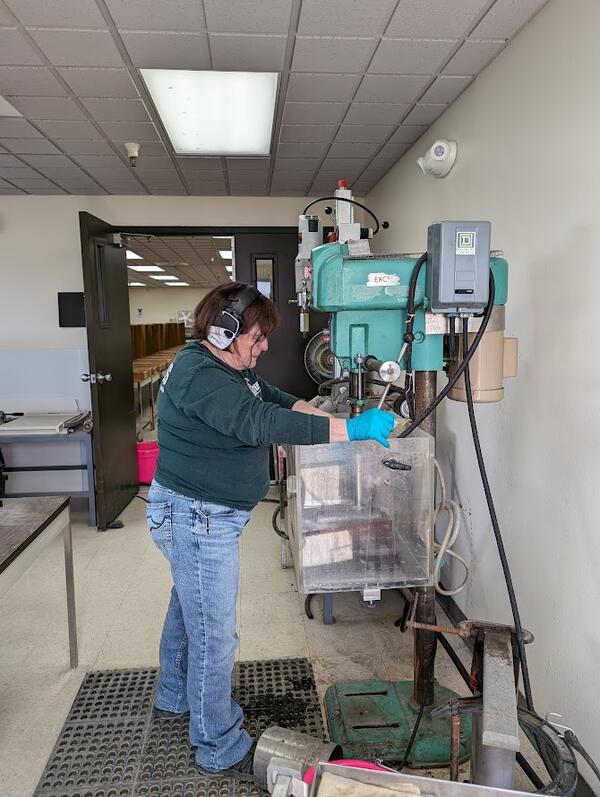
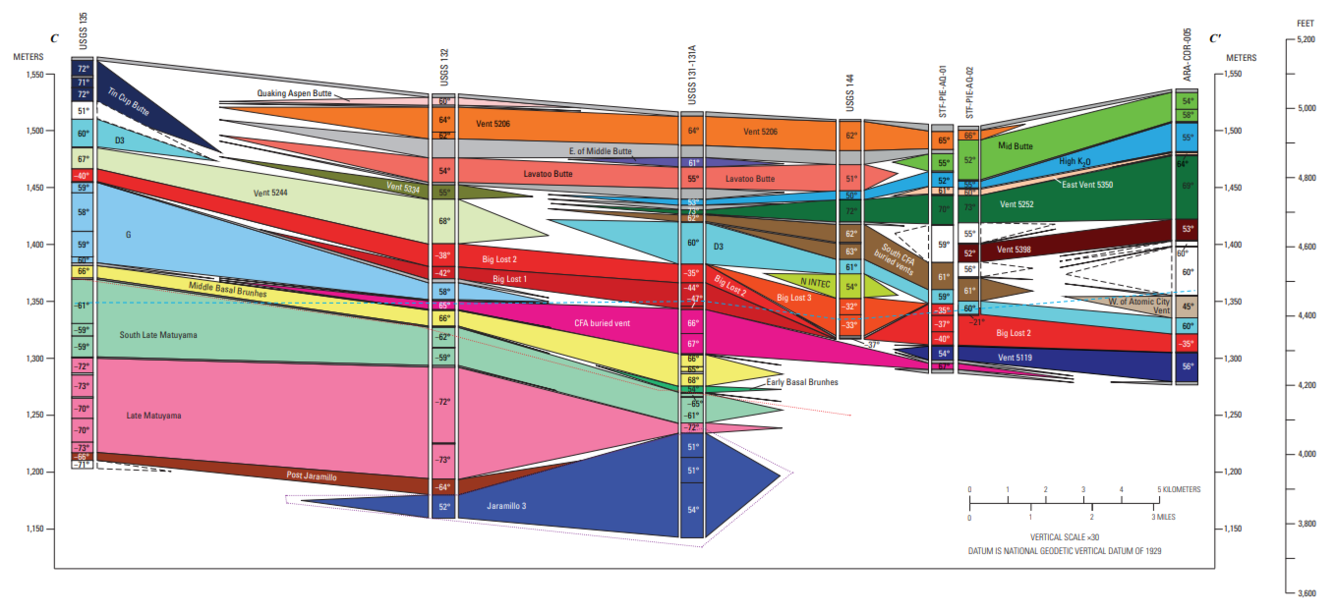
In collaboration with the Rock and Paleomagnetics Laboratory, paleomagnetic inclination and polarity studies have been conducted on thousands of subcore samples sourced from over 50 coreholes located at and near the Idaho National Laboratory. These studies are used to paleomagnetically characterize and correlate successive stratigraphic intervals of buried basalt flows in each corehole to similar depth intervals in adjacent coreholes (Champion and others, 2011; Champion and others, 2013; Hodges and others, 2016; Hodges and others, 2025). Paleomagnetic results from over 80 surface paleomagnetic sites, within and near the INL, are utilized to correlate these buried lava flows to basaltic shield volcanoes still exposed on the surface of the eastern Snake River Plain. Additional data, such as petrology, geophysical logs, and geochemistry, can be used in conjunction with paleomagnetic inclination and age-dates to confirm or reject correlations.
Age-Dating
Age-dating studies have been conducted on over 20 samples from more than 15 coreholes located at and near the Idaho National Laboratory using various methods, including radiocarbon, potassium-argon (K-Ar), and argon-argon (⁴⁰Ar/³⁹Ar; Hodges and others, 2015). These age constraints help define the subsurface stratigraphy by allowing discrimination between basalt flows that are similar in paleomagnetic inclination and chemistry but differ in age or emplacement timing. Improved age control will enhance researchers' understanding of the recurrence interval of basalt eruptions.
A robust geological framework of the eastern Snake River Plain (ESRP) is essential for understanding the hydraulic and geologic properties of the ESRP aquifer, a vital source of drinking and irrigation water in southeastern Idaho. The development of an ESRP geologic framework model at the Idaho National Laboratory Project Office (INLPO) is informed by multiple datasets, including paleomagnetic inclincation and age-dating data, supplemented by geophysical, geochemical, and petrologic studies. Over 100,000 feet of lithologic drill core stored at the INLPO Lithologic Core Storage Library provide abundant material for sampling. This drill core contributes valuable detail and context for the ESRP geologic framework by archiving subsurface sedimentary and lava flow layers. Physical and chemical studies of igneous and sedimentary layers further support seismic and volcanic hazards assessments, INL facilities design and construction, volcanic evolution, and groundwater flow models.
Paleomagnetic Studies
In collaboration with the Rock and Paleomagnetics Laboratory, paleomagnetic inclination and polarity studies have been conducted on thousands of subcore samples sourced from over 50 coreholes located at and near the Idaho National Laboratory. These studies are used to paleomagnetically characterize and correlate successive stratigraphic intervals of buried basalt flows in each corehole to similar depth intervals in adjacent coreholes (Champion and others, 2011; Champion and others, 2013; Hodges and others, 2016; Hodges and others, 2025). Paleomagnetic results from over 80 surface paleomagnetic sites, within and near the INL, are utilized to correlate these buried lava flows to basaltic shield volcanoes still exposed on the surface of the eastern Snake River Plain. Additional data, such as petrology, geophysical logs, and geochemistry, can be used in conjunction with paleomagnetic inclination and age-dates to confirm or reject correlations.
Age-Dating
Age-dating studies have been conducted on over 20 samples from more than 15 coreholes located at and near the Idaho National Laboratory using various methods, including radiocarbon, potassium-argon (K-Ar), and argon-argon (⁴⁰Ar/³⁹Ar; Hodges and others, 2015). These age constraints help define the subsurface stratigraphy by allowing discrimination between basalt flows that are similar in paleomagnetic inclination and chemistry but differ in age or emplacement timing. Improved age control will enhance researchers' understanding of the recurrence interval of basalt eruptions.