



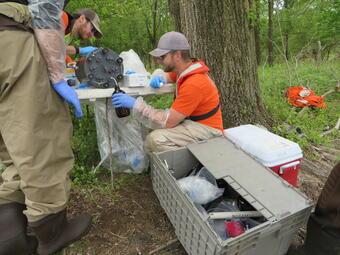
Field readings are being collected using a water-quality multimeter prior to initiating a sample from the bacteria analyzer.
Novel Bacterial Monitoring of Urbanized Waterways in the Lower Delaware River and Passaic River Basins.
Active
By New Jersey Water Science Center
December 14, 2023
As part of the Urban Water Federal Partnership, the U.S. Geological Survey (USGS) New Jersey Water Science Center (NJWSC) is currently assessing the use of innovative, near real-time bacteria monitoring technology to provide rapid results on bacteria concentrations to water regulators. Traditional methods of collecting and quantifying fecal indicator bacteria (FIB) is labor intensive, expensive, and may be inefficient to capture diurnal results in water quality and protect human health, as analytic results take around 24 hours. The USGS will evaluate data quality from the near real-time pathogen monitoring systems by comparing collected data with traditional FIB sampling methods to determine the effectiveness of the instrument. Once validated these instruments can potentially be used by water-resource managers and researchers to evaluate rapidly changing FIB conditions to protect public health.
Media
Sources/Usage: Public Domain. View Media Details
Project Overview
Innovative, high frequency pathogen monitoring technology is being evaluated by the USGS New Jersey Water Science Center in urban waterways along major river basins within New Jersey. The USGS will evaluate data quality from the near real-time pathogen monitoring systems by comparing collected data with traditional fecal indicator bacteria (FIB) sampling methods to determine the effectiveness of the instrument. These instruments may allow water-resource managers to monitor FIB fluctuations in near-real time, potentially in less time than traditional sampling methods. A measurement initiated early in the day could provide a more definitive indication of the bacterial condition prior to the initiation of recreational activities. In addition, near real-time measurement could eliminate the need for multiple negative tests prior to reopening a closed recreation area, expanding availability of recreational opportunities. The data collected during this evaluation also will result in denser datasets, which will aid in understanding the complexities of bacterial fluctuations due to sediment resuspension, water-level changes due to boat passage, tidal changes, drought, and rainfall.
Technology
The novel bacteria monitoring system—which is one of the first in the nation—can remotely sample on demand and provide Escherichia coli (E. coli) and total coliform concentrations in a fraction of time required of traditional sampling methods. The device pumps sample water into a dedicated cartridge where it is combined with reagents and incubated. Absorbance and fluorescence points are autonomously detected at regular intervals throughout incubation until a point of inflection is determined. E. coli and total coliform concentrations, in colony forming units (CFU), are calculated from the point of inflection using a proprietary algorithm. The device contains seven ports for sample collection which can analyze seven samples before a battery and sample cartridge change is needed.
Media
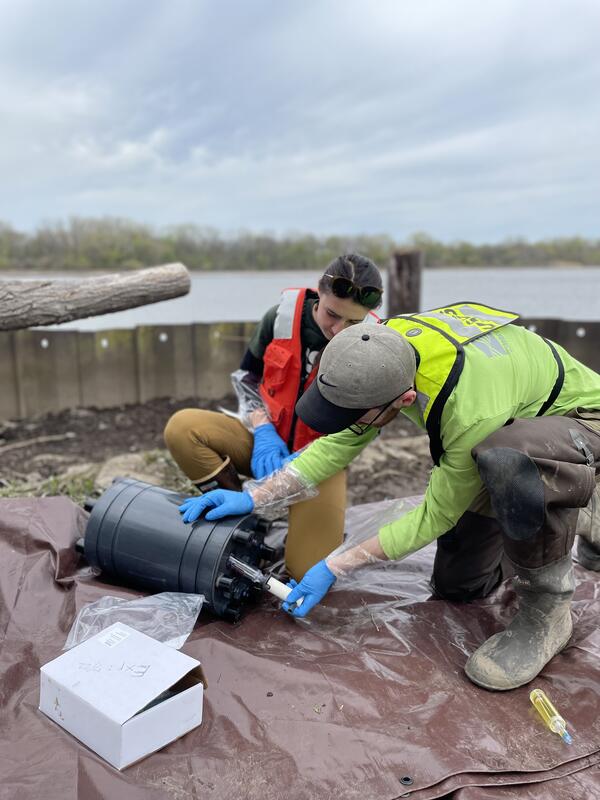
USGS Hydrographers Kathryn Cahalane and Lucas Sirotniak replace used sample cartridges for each of the seven sampling ports of the bacteria analyzer.
Sources/Usage: Public Domain. View Media Details
Media
Field readings are being collected using a water-quality multimeter prior to initiating a sample from the bacteria analyzer.
Sources/Usage: Public Domain. View Media Details
Media
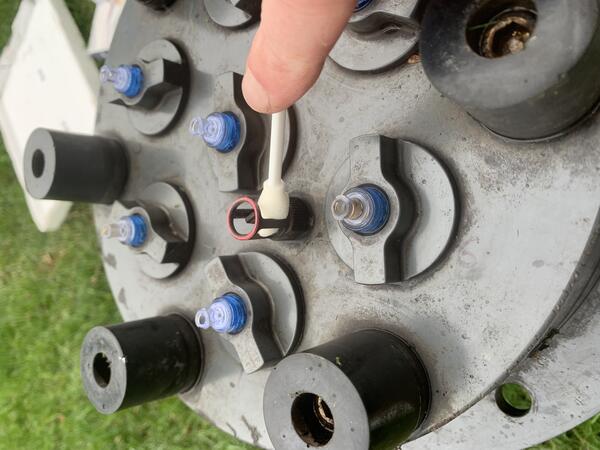
Hydrographer Dan Skulski cleans the device of fouling prior to changing out the sample cartriges.
Sources/Usage: Public Domain. View Media Details
Study Areas
Lower Delaware River, at Pyne Poynt in Camden, NJ and Passaic River downstream of the confluence of the Pompton and Passaic Rivers, at Two Bridges. Additional deployments within the Lower Delaware River and Passaic River Basins are being considered for future work.
Priority Research Questions:
- Does the innovative technology produce accurate E. coli and total coliform results in a freshwater environment?
- Does the innovative technology produce results in a timely manner that can be useful for water-management officials?
- Is the innovative technology practical and efficient compared to traditional sampling methods?
- What are the major advantages and disadvantages of the innovative technology?
Media
Sources/Usage: Public Domain. View Media Details
------
NJWSC Field Team:
Dan Skulski
Jacob Gray
Lucas Sirtoniak
Kathryn Cahalane

Sampler_Platform 3
Field readings are being collected using a water-quality multimeter prior to initiating a sample from the bacteria analyzer.

Cleaning the Sampler
Hydrographer Dan Skulski cleans the device of fouling prior to changing out the sample cartriges.
Hydrographer Dan Skulski cleans the device of fouling prior to changing out the sample cartriges.

Sampler Power
Hydrographer Dan Skulski replaces the battery of the automatic bacteria analyzer.
Hydrographer Dan Skulski replaces the battery of the automatic bacteria analyzer.

Sampler_Platform_2
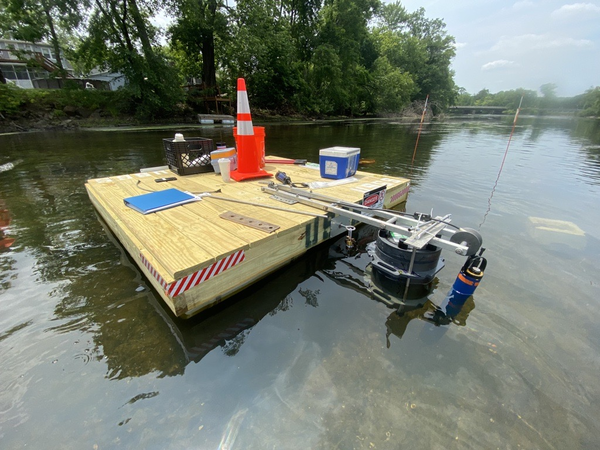
Floating platform deployment for the automatic bacteria analyzer, facing downstream, at Passaic River below Pompton River at Two Bridges, New Jersey.
Floating platform deployment for the automatic bacteria analyzer, facing downstream, at Passaic River below Pompton River at Two Bridges, New Jersey.

Sampler Platform
Floating sampling platform deployment for the automatic bacteria analyzer,facing upstream, at Passaic River below Pompton River at Two Bridges, New Jersey.
Floating sampling platform deployment for the automatic bacteria analyzer,facing upstream, at Passaic River below Pompton River at Two Bridges, New Jersey.

Setting the sampler
Hydrographer Jake Gray removes the automatic bacteria analyzer to perform regular servicing.
Hydrographer Jake Gray removes the automatic bacteria analyzer to perform regular servicing.

Two-Bridges Gage
The automatic bacteria analyzer is positioned in line with the continuous water quality monitor onsite, allowing for the simultaneous collection of field readings during automatic bacteria analyzer samples.
The automatic bacteria analyzer is positioned in line with the continuous water quality monitor onsite, allowing for the simultaneous collection of field readings during automatic bacteria analyzer samples.

Bacteria Sampler set up
Bottom view of the Fluidon Alert System. Hydrographer Kathryn Cahalane looks on while hydrographers Lucas Sirotniak and Daniel Skulski replace sampling cartridges.
Bottom view of the Fluidon Alert System. Hydrographer Kathryn Cahalane looks on while hydrographers Lucas Sirotniak and Daniel Skulski replace sampling cartridges.

Novel Bacteria Sampling
Hydrographer Daniel Skulski collects a field blank sample from the novel bacteria sampler as hydrographer Jacob Gray assists.
Hydrographer Daniel Skulski collects a field blank sample from the novel bacteria sampler as hydrographer Jacob Gray assists.

Pyne Poynt Deploy
USGS Hydrographers Lucas Sirotniak and Jacob Gray clean the deployment tube during weekly servicing on the Delaware River at Pyne Poynt, Camden, NJ.
USGS Hydrographers Lucas Sirotniak and Jacob Gray clean the deployment tube during weekly servicing on the Delaware River at Pyne Poynt, Camden, NJ.

Pyne Poynt at High Tide
Peak tide following a rainy weekend, looking along the Pyne Poynt Park waterfront, where the Fluidion Alert System is deployed.
Peak tide following a rainy weekend, looking along the Pyne Poynt Park waterfront, where the Fluidion Alert System is deployed.

Pyne Poynt at Low Tide
Low tide looking along the Pyne Poynt Park waterfront, where the Fluidion Alert System is deployed.
Low tide looking along the Pyne Poynt Park waterfront, where the Fluidion Alert System is deployed.

Fluidion Monitor set up
USGS Hydrographers Kathryn Cahalane and Lucas Sirotniak replace used sample cartridges for each of the seven sampling ports of the bacteria analyzer.
USGS Hydrographers Kathryn Cahalane and Lucas Sirotniak replace used sample cartridges for each of the seven sampling ports of the bacteria analyzer.

Gathering Samples
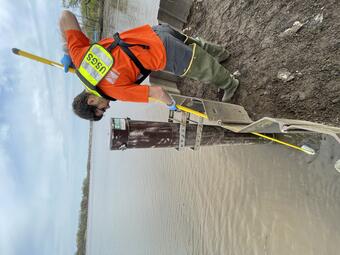
Hydrographer Jacob Gray using a pole sampler to collect a lab validation sample concurrent with the bacteria analyzer sample.
Hydrographer Jacob Gray using a pole sampler to collect a lab validation sample concurrent with the bacteria analyzer sample.

Monitor Installation
USGS Hydrographers Lucas Sirotniak and Jacob Gray placing the bacteria analyzer in the deployment tube at the Delaware River, Pyne Poynt, Camden, New Jersey.
USGS Hydrographers Lucas Sirotniak and Jacob Gray placing the bacteria analyzer in the deployment tube at the Delaware River, Pyne Poynt, Camden, New Jersey.
As part of the Urban Water Federal Partnership, the U.S. Geological Survey (USGS) New Jersey Water Science Center (NJWSC) is currently assessing the use of innovative, near real-time bacteria monitoring technology to provide rapid results on bacteria concentrations to water regulators. Traditional methods of collecting and quantifying fecal indicator bacteria (FIB) is labor intensive, expensive, and may be inefficient to capture diurnal results in water quality and protect human health, as analytic results take around 24 hours. The USGS will evaluate data quality from the near real-time pathogen monitoring systems by comparing collected data with traditional FIB sampling methods to determine the effectiveness of the instrument. Once validated these instruments can potentially be used by water-resource managers and researchers to evaluate rapidly changing FIB conditions to protect public health.
Media
Sources/Usage: Public Domain. View Media Details
Project Overview
Innovative, high frequency pathogen monitoring technology is being evaluated by the USGS New Jersey Water Science Center in urban waterways along major river basins within New Jersey. The USGS will evaluate data quality from the near real-time pathogen monitoring systems by comparing collected data with traditional fecal indicator bacteria (FIB) sampling methods to determine the effectiveness of the instrument. These instruments may allow water-resource managers to monitor FIB fluctuations in near-real time, potentially in less time than traditional sampling methods. A measurement initiated early in the day could provide a more definitive indication of the bacterial condition prior to the initiation of recreational activities. In addition, near real-time measurement could eliminate the need for multiple negative tests prior to reopening a closed recreation area, expanding availability of recreational opportunities. The data collected during this evaluation also will result in denser datasets, which will aid in understanding the complexities of bacterial fluctuations due to sediment resuspension, water-level changes due to boat passage, tidal changes, drought, and rainfall.
Technology
The novel bacteria monitoring system—which is one of the first in the nation—can remotely sample on demand and provide Escherichia coli (E. coli) and total coliform concentrations in a fraction of time required of traditional sampling methods. The device pumps sample water into a dedicated cartridge where it is combined with reagents and incubated. Absorbance and fluorescence points are autonomously detected at regular intervals throughout incubation until a point of inflection is determined. E. coli and total coliform concentrations, in colony forming units (CFU), are calculated from the point of inflection using a proprietary algorithm. The device contains seven ports for sample collection which can analyze seven samples before a battery and sample cartridge change is needed.
Media
USGS Hydrographers Kathryn Cahalane and Lucas Sirotniak replace used sample cartridges for each of the seven sampling ports of the bacteria analyzer.
Sources/Usage: Public Domain. View Media Details
Media
Field readings are being collected using a water-quality multimeter prior to initiating a sample from the bacteria analyzer.
Sources/Usage: Public Domain. View Media Details
Media
Hydrographer Dan Skulski cleans the device of fouling prior to changing out the sample cartriges.
Sources/Usage: Public Domain. View Media Details
Study Areas
Lower Delaware River, at Pyne Poynt in Camden, NJ and Passaic River downstream of the confluence of the Pompton and Passaic Rivers, at Two Bridges. Additional deployments within the Lower Delaware River and Passaic River Basins are being considered for future work.
Priority Research Questions:
- Does the innovative technology produce accurate E. coli and total coliform results in a freshwater environment?
- Does the innovative technology produce results in a timely manner that can be useful for water-management officials?
- Is the innovative technology practical and efficient compared to traditional sampling methods?
- What are the major advantages and disadvantages of the innovative technology?
Media
Sources/Usage: Public Domain. View Media Details
------
NJWSC Field Team:
Dan Skulski
Jacob Gray
Lucas Sirtoniak
Kathryn Cahalane
Sampler_Platform 3
Field readings are being collected using a water-quality multimeter prior to initiating a sample from the bacteria analyzer.
Field readings are being collected using a water-quality multimeter prior to initiating a sample from the bacteria analyzer.
Cleaning the Sampler
Hydrographer Dan Skulski cleans the device of fouling prior to changing out the sample cartriges.
Hydrographer Dan Skulski cleans the device of fouling prior to changing out the sample cartriges.
Sampler Power
Hydrographer Dan Skulski replaces the battery of the automatic bacteria analyzer.
Hydrographer Dan Skulski replaces the battery of the automatic bacteria analyzer.
Sampler_Platform_2
Floating platform deployment for the automatic bacteria analyzer, facing downstream, at Passaic River below Pompton River at Two Bridges, New Jersey.
Floating platform deployment for the automatic bacteria analyzer, facing downstream, at Passaic River below Pompton River at Two Bridges, New Jersey.
Sampler Platform
Floating sampling platform deployment for the automatic bacteria analyzer,facing upstream, at Passaic River below Pompton River at Two Bridges, New Jersey.
Floating sampling platform deployment for the automatic bacteria analyzer,facing upstream, at Passaic River below Pompton River at Two Bridges, New Jersey.
Setting the sampler
Hydrographer Jake Gray removes the automatic bacteria analyzer to perform regular servicing.
Hydrographer Jake Gray removes the automatic bacteria analyzer to perform regular servicing.
Two-Bridges Gage
The automatic bacteria analyzer is positioned in line with the continuous water quality monitor onsite, allowing for the simultaneous collection of field readings during automatic bacteria analyzer samples.
The automatic bacteria analyzer is positioned in line with the continuous water quality monitor onsite, allowing for the simultaneous collection of field readings during automatic bacteria analyzer samples.
Bacteria Sampler set up
Bottom view of the Fluidon Alert System. Hydrographer Kathryn Cahalane looks on while hydrographers Lucas Sirotniak and Daniel Skulski replace sampling cartridges.
Bottom view of the Fluidon Alert System. Hydrographer Kathryn Cahalane looks on while hydrographers Lucas Sirotniak and Daniel Skulski replace sampling cartridges.
Novel Bacteria Sampling
Hydrographer Daniel Skulski collects a field blank sample from the novel bacteria sampler as hydrographer Jacob Gray assists.
Hydrographer Daniel Skulski collects a field blank sample from the novel bacteria sampler as hydrographer Jacob Gray assists.
Pyne Poynt Deploy
USGS Hydrographers Lucas Sirotniak and Jacob Gray clean the deployment tube during weekly servicing on the Delaware River at Pyne Poynt, Camden, NJ.
USGS Hydrographers Lucas Sirotniak and Jacob Gray clean the deployment tube during weekly servicing on the Delaware River at Pyne Poynt, Camden, NJ.
Pyne Poynt at High Tide
Peak tide following a rainy weekend, looking along the Pyne Poynt Park waterfront, where the Fluidion Alert System is deployed.
Peak tide following a rainy weekend, looking along the Pyne Poynt Park waterfront, where the Fluidion Alert System is deployed.
Pyne Poynt at Low Tide
Low tide looking along the Pyne Poynt Park waterfront, where the Fluidion Alert System is deployed.
Low tide looking along the Pyne Poynt Park waterfront, where the Fluidion Alert System is deployed.
Fluidion Monitor set up
USGS Hydrographers Kathryn Cahalane and Lucas Sirotniak replace used sample cartridges for each of the seven sampling ports of the bacteria analyzer.
USGS Hydrographers Kathryn Cahalane and Lucas Sirotniak replace used sample cartridges for each of the seven sampling ports of the bacteria analyzer.
Gathering Samples
Hydrographer Jacob Gray using a pole sampler to collect a lab validation sample concurrent with the bacteria analyzer sample.
Hydrographer Jacob Gray using a pole sampler to collect a lab validation sample concurrent with the bacteria analyzer sample.
Monitor Installation
USGS Hydrographers Lucas Sirotniak and Jacob Gray placing the bacteria analyzer in the deployment tube at the Delaware River, Pyne Poynt, Camden, New Jersey.
USGS Hydrographers Lucas Sirotniak and Jacob Gray placing the bacteria analyzer in the deployment tube at the Delaware River, Pyne Poynt, Camden, New Jersey.