



USGS Scientist Publishes Article on Observations of Vortex Trapping of Suspended Sand Grains Over Ripples
SPCMSC Research Physical Scientist Donya Frank-Gilchrist first-authored a recently published manuscript titled “Vortex Trapping of Suspended Sand Grains Over Ripples.”
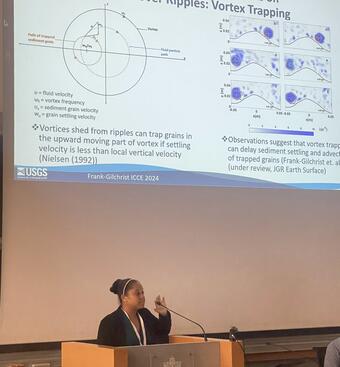
Dr. Donya Frank-Gilchrist of the USGS St. Petersburg Coastal and Marine Science Center (SPCMSC) recently published a manuscript on vortex-trapped suspended sand grains over ripples. This research provides one of the first direct measurements of vortex trapping of sand grains by turbulent coherent structures or vortices shed from ripples, which was hypothesized over 30 years ago. High-resolution laboratory measurements revealed that vortices shed from ripples can trap sand grains and suspend them longer than expected. The vortices mobilized sand grains along the ripple slopes just prior to flow reversal and advected the suspended sediment grains. During several flow cycles, some sand grains were temporarily trapped in the vortex, prescribing semi-circular trajectories off-center from the vortex core in quadrants of the vortex that were closest to the ripple slope, as hypothesized. During some flow cycles, it was observed that sand grains did not always settle but instead were trapped in the vortex and then advected back over the ripple crest in the opposite direction when the oscillatory flow reversed. Comparisons of the horizontal and vertical sediment grain velocities with the respective components of the fluid velocity yielded linear relationships, in agreement with the theory. Vortex-trapped grains may be transported over much greater distances than expected of typical oscillatory flows. Therefore, the accuracy of sediment transport predictions by large-scale numerical models may be impacted as these models do not typically account for small-scale non-linear processes like vortex trapping. Measurements for this study were made while Donya was a National Research Council Post-Doctoral Research Associate at the U.S. Naval Research Laboratory. This research was conducted with the U.S. Naval Research Laboratory and the Naval Meteorology and Oceanography Command of the U.S. Navy.