



RADish Profile: Steve Jackson
Explore interviews with scientists and managers researching and implementing the resist-accept-direct (RAD) framework.
Dr. Steve Jackson
Senior Advisor for Biodiversity and Climate Change, USGS National CASC (Retired)
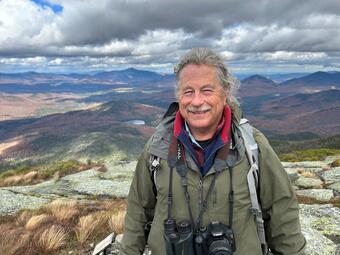
Steve Jackson began his career as a scientist and professor, but in 2012 he pivoted to a new position as the Director of the USGS Southwest Climate Adaptation Science Center. This move put him in a rewarding new role bridging the gap between the communities of research and the communities of practice that manage real-world landscapes.
As Steve described, “There was a huge communication gulf between the two [research and practice],” he told us. “This was an opportunity to become a knowledge broker, a social engineer, and why not a RADiator! A radiator of ideas to connect people and get conversations started that wouldn’t have happened otherwise.”
As a longtime leader in climate adaptation, Steve Jackson has been RAD-ical from the start, helping shape the RAD framework alongside fellow RADishes since its inception. We caught up with Steve for a quick chat about all things RAD!
Q: What kind of RADish are you? (e.g., land RAD, marine RAD, fire RAD, etc.)
I’ve mostly worked with terrestrial ecosystems, wetlands, forests, and woodlands, focusing on how vegetation has changed over the past 25,000 years in response to climate change and human impacts.
Q: How long have you been a RADish?
I’ve been working on environmental change for most of my career, studying how climate change drives ecosystem change. The RAD framework started to take shape after a 2017 session at the National Adaptation Forum in St. Paul, Minnesota, titled "When Resistance is Futile: Adaptation in the Face of System Transformation." It was organized by Bruce Stein, who was then the Chief Scientist for the National Wildlife Federation, the session featured just three speakers: himself, John Morton from USFWS, and me. Each of us offered different perspectives, and that session sparked the formation of what became the FedNet group, a team of federal scientists and land managers.
From there, a working group led by Greg Schuurman at the National Park Service started developing the ideas further in 2018. At the same time, the USGS, through Abby Lynch and Laura Thompson, began a parallel effort focused on ecological transformation. Eventually, those paths converged, and RAD became the overarching framework it is today. It’s never been a central part of what I do, but it has always been close to my work, and I’ve tried to contribute whenever I’ve had the opportunity.
Q: How important do you think cross-organizations partnerships are for RAD?
That’s an excellent question, and one that is close to my heart. The truth is, we don’t know what’s going to work as the climate continues to shift. There’s a lot of uncertainty about where we’re headed, both in terms of the future climate and how ecosystems will respond along the way. That makes it critical to try different approaches and learn by doing it.
In that sense, having multiple agencies with different missions, constraints, and tools isn’t just a challenge, it’s a huge opportunity. A treatment that might not be possible in a wilderness area or national park but could be tested on military land or private property. Different jurisdictions give us the flexibility to experiment, compare outcomes, and build a broader understanding, together. If one approach fails somewhere, we might still have a backup elsewhere, and understanding why it failed will be valuable for moving forward and establishing an adaptive learning process.
Q: What are some of the biggest challenges you’ve seen managers face when choosing between resisting, accepting, or directing change?
A big one is letting go of historical baselines. The historical norms of conservation are deeply embedded in the DNA of conservation and restoration that come largely from the development of those fields in the mid to late 20th century.
Another element is the public. Getting people to understand that change is inevitable in the face of climate change and that we need to respond to it intentionally can be challenging. So is communicating clearly what we’re doing and why.
Q: In one sentence, how would you explain RAD to someone outside of science?
This question is actually really hard, but let me give it a crack. RAD really reduces this problem of what do we do in the face of change down to three mutually exclusive choices: 1) we can resist change and endeavor to keep things as they were, 2) we can just accept whatever fate delivers us or we can try to identify what we most value, and 3) we can try to direct change towards the most desirable outcomes or the least undesirable outcomes. So that’s way more than a sentence, and I didn’t even get to scratch the surface of it!