



From Stream to Spider: How PFAS Move Through Aquatic and Terrestrial Food Webs
Per- and polyfluoroalkyl substances (PFAS) are persistent synthetic chemicals that accumulate in the environment and living organisms. A USGS study examined how different PFAS compounds move through a stream ecosystem and are transferred from aquatic to terrestrial food webs. The findings documented that not all PFAS behave the same once they enter the environment, leading to differences in bioaccumulation and subsequent exposure risks.
Per- and polyfluoroalkyl substances (PFAS) are man-made chemicals used in numerous industrial and consumer products such as non-stick pans, waterproof clothing, and firefighting foams. These chemicals are extremely stable (difficult to break down) and mobile in water, leading to environmental contamination on a global scale. It is for these reasons that they are often referred to as “forever chemicals.”
To better understand PFAS movement in freshwater ecosystems, USGS researchers conducted a study in a stream that received food processing wastewater known to contain high levels of PFAS. Their goal was to investigate how different PFAS accumulate in animals living in and adjacent to the stream, and how ecological processes influence their movement through the environment. The study focused on several key questions:
- How do the chemical properties and concentrations of individual PFAS affect their uptake in organisms?
- What role does trophic transfer—the movement of contaminants through the food chain—play in PFAS exposure?
How does insect metamorphosis influence PFAS retention and transfer?
The researchers found PFAS not only in the stream’s water and sediment but also in algae, aquatic insects (both larvae and adults), fish, and even spiders living along the banks. Some PFAS, like PFOS (a long-chain PFAS), increased in concentration as they moved up the aquatic food chain—a process called biomagnification. Others, like 6:2 FTS (a shorter-chain PFAS), didn’t accumulate as much in aquatic species but increased in concentration in terrestrial predators (i.e., spiders).
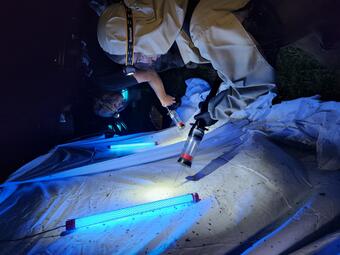
Aquatic insects played a key role in understanding PFAS movement from water to land. When they emerged from the water as adults, they carried PFAS with them, exposing land predators to these “forever” chemicals. One group of spiders, called tetragnathids, was especially susceptible to accumulating PFAS because they live near water and their primary diet is adult aquatic insects that emerge from the stream. This makes these spiders useful as “biosentinels” (organisms that help scientists monitor the transport of pollutants across ecosystems) because they are important predators (eating up to 800 million tons of insects each year) and are found all over the world.
This research shows that all PFAS don’t behave the same way in all environments or organisms. Their movement depends on both the chemical makeup, biology of the species they interact with, where organisms like to hang out, and the food they eat. Understanding these patterns is vital for protecting ecosystems and public health, as well as for informing PFAS remediation and environmental recovery.
This study has been supported by the U.S. Geological Survey Ecosystems Mission Area, through the Environmental Health Program (Contaminant Biology and Toxic Substances Hydrology).
Per- and polyfluoroalkyl substances (PFAS) are persistent synthetic chemicals that accumulate in the environment and living organisms. A USGS study examined how different PFAS compounds move through a stream ecosystem and are transferred from aquatic to terrestrial food webs. The findings documented that not all PFAS behave the same once they enter the environment, leading to differences in bioaccumulation and subsequent exposure risks.
Per- and polyfluoroalkyl substances (PFAS) are man-made chemicals used in numerous industrial and consumer products such as non-stick pans, waterproof clothing, and firefighting foams. These chemicals are extremely stable (difficult to break down) and mobile in water, leading to environmental contamination on a global scale. It is for these reasons that they are often referred to as “forever chemicals.”
To better understand PFAS movement in freshwater ecosystems, USGS researchers conducted a study in a stream that received food processing wastewater known to contain high levels of PFAS. Their goal was to investigate how different PFAS accumulate in animals living in and adjacent to the stream, and how ecological processes influence their movement through the environment. The study focused on several key questions:
- How do the chemical properties and concentrations of individual PFAS affect their uptake in organisms?
- What role does trophic transfer—the movement of contaminants through the food chain—play in PFAS exposure?
How does insect metamorphosis influence PFAS retention and transfer?
The researchers found PFAS not only in the stream’s water and sediment but also in algae, aquatic insects (both larvae and adults), fish, and even spiders living along the banks. Some PFAS, like PFOS (a long-chain PFAS), increased in concentration as they moved up the aquatic food chain—a process called biomagnification. Others, like 6:2 FTS (a shorter-chain PFAS), didn’t accumulate as much in aquatic species but increased in concentration in terrestrial predators (i.e., spiders).
Aquatic insects played a key role in understanding PFAS movement from water to land. When they emerged from the water as adults, they carried PFAS with them, exposing land predators to these “forever” chemicals. One group of spiders, called tetragnathids, was especially susceptible to accumulating PFAS because they live near water and their primary diet is adult aquatic insects that emerge from the stream. This makes these spiders useful as “biosentinels” (organisms that help scientists monitor the transport of pollutants across ecosystems) because they are important predators (eating up to 800 million tons of insects each year) and are found all over the world.
This research shows that all PFAS don’t behave the same way in all environments or organisms. Their movement depends on both the chemical makeup, biology of the species they interact with, where organisms like to hang out, and the food they eat. Understanding these patterns is vital for protecting ecosystems and public health, as well as for informing PFAS remediation and environmental recovery.
This study has been supported by the U.S. Geological Survey Ecosystems Mission Area, through the Environmental Health Program (Contaminant Biology and Toxic Substances Hydrology).