



Critical minerals are essential to the economy and national security of the Nation and have supply chains that are vulnerable to disruption.
The USGS leads the Federal government in developing the List of Critical Minerals and provides crucial and rich information about critical mineral availability, supply chains, and economic impacts. The USGS uses a cross-sectoral and data-driven approach to developing the List.
What are critical minerals?
Minerals that are “critical” are both essential to the Nation’s economy or national security and have supply chains that are vulnerable to disruption.
Critical minerals are defined in the Energy Act of 2020. According to the Act, minerals are considered “critical” if they fit three criteria:
- The mineral must be “essential to the economic or national security of the United States.”
- The mineral must “serve an essential function in the manufacturing of a product… the absence of which would have significant consequences for the economic or national security of the United States”
- The mineral must have a supply chain that is “vulnerable to disruption (including restrictions associated with foreign political risk, abrupt demand growth, military conflict, violent unrest, anti-competitive or protectionist behaviors, and other risks through-out the supply chain)”.
In addition, the Act specifies that the “critical minerals’ cannot include fuel minerals such as oil, gas, coal or uranium. Water, ice, snow or “common varieties of sand, gravel, stone, pumice, cinders and clay” are also excluded from being critical minerals.
USGS and the List of Critical Minerals
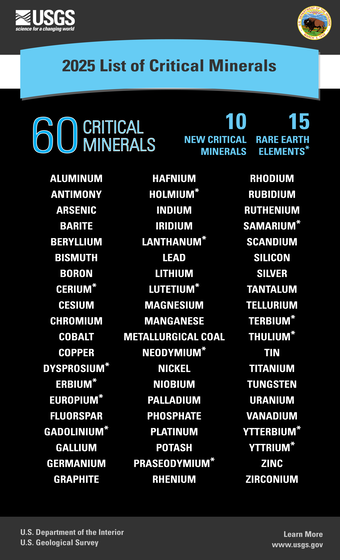
The USGS leads the government in developing the List of Critical Minerals. The 2025 List of Critical Minerals includes 60 minerals.
According to the Energy Act of 2020, the USGS is required to review and publish the List of Critical Minerals – and the methodology used to create it - at least once every three years. The Energy Act of 2020 also directs USGS to complete resource assessments for each critical mineral, and to track and forecast critical mineral production, consumption and recycling patterns.
The USGS has a long history of mineral supply chain analysis and mineral data collection, including through the National Minerals Information Center. In developing the List of Critical Minerals, the USGS considers minerals used in over 230 sectors of the economy, from energy infrastructure to advanced technology manufacturing, and from aerospace engineering to medical equipment.
About Critical Minerals
Why does the List of Critical Minerals matter?
How is the List of Critical Minerals created?
A Brief History of Critical Minerals
How do critical minerals affect me?
critical minerals science
Explore the Latest
About the 2025 List
The U.S. relies on 90 countries for the minerals needed to drive the economy and protect national security. The List of Critical Minerals is an essential tool for understanding which mineral commodities are most needed and have supply chains most at risk.
The List of Critical Minerals is based on risks to mineral supply chains supporting every sector of the economy, and a wide range of technologies ranging from energy to aerospace to consumer electronics.
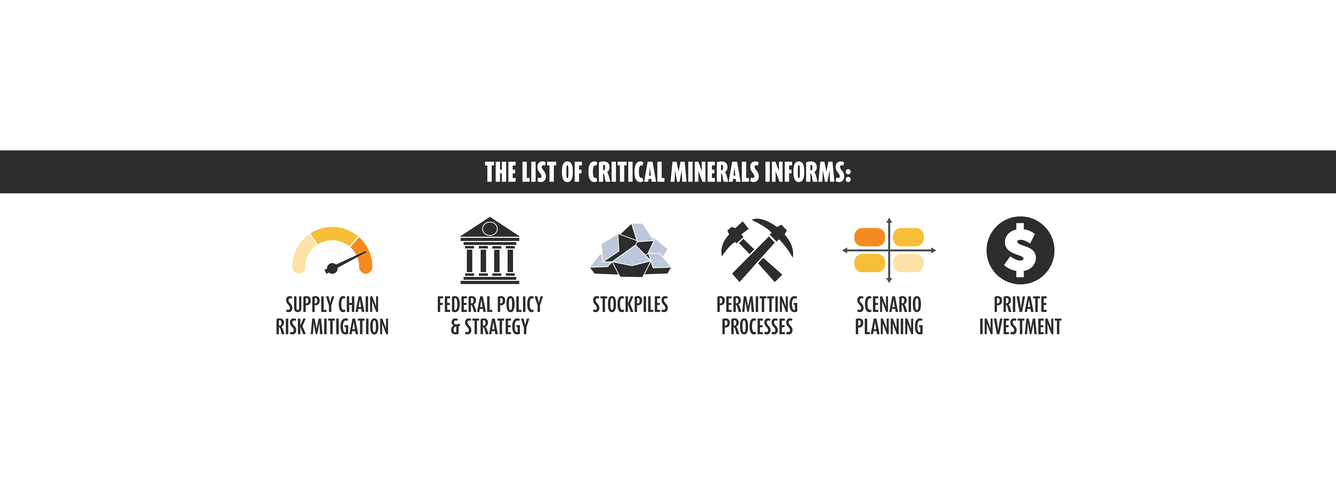
Both the public and private sectors use the List of Critical Minerals to inform major decisions and investments. The List, and the analysis behind it, provide insights needed to assess risks, plan for disruptions, bolster supply chain resilience, and evaluate the effectiveness of different actions.
Here are some ways that the List of Critical Minerals is used:
To Assess Risks to the Nation’s Economy and National Security
The federal government relies on the List of Critical Minerals and the analysis behind it to assess risks to core functions, such as national defense, from supply chain disruptions. This allows federal agencies to plan for potential disruptions, identify substitutes for vulnerable supply chains, and effectively allocate resources towards building resilience.
To Evaluate Business Risks
Industries use the List of Critical Minerals, and the analysis behind it, to assess what parts of their business could be most vulnerable to supply chain disruptions, allowing them to plan for potential disruptions, identify substitutes for vulnerable supply chains, and effectively allocate resources towards building resilience.
To Guide Federal Policies to Bolster Supply Chains
The List of Critical Minerals helps guide federal policy to make critical minerals more available in the U.S., including through direct investments, tax incentives for U.S. mineral processing, and streamlined mining permits.
The List of Critical Minerals, and the analysis behind it, also inform decisions about trade relationships and foreign investments.
To Prioritize Mapping Efforts
In addition to analyzing reliance on imported minerals, the USGS is mapping potential domestic sources of critical minerals. The USGS uses the List of Critical Minerals to prioritize mapping through the Earth Mapping Resources Initiative (Earth MRI), both below the ground and above the ground in mine wastes.
To Identify Effective Actions
Reviewing the List every three years provides an opportunity to revisit and monitor the status of specific mineral supply chains. This ongoing analysis can provide information about what actions were or were not effective at strengthening mineral supply chains in the past and identify mineral supply chains that have emerging vulnerabilities.
The Inter-Agency Process
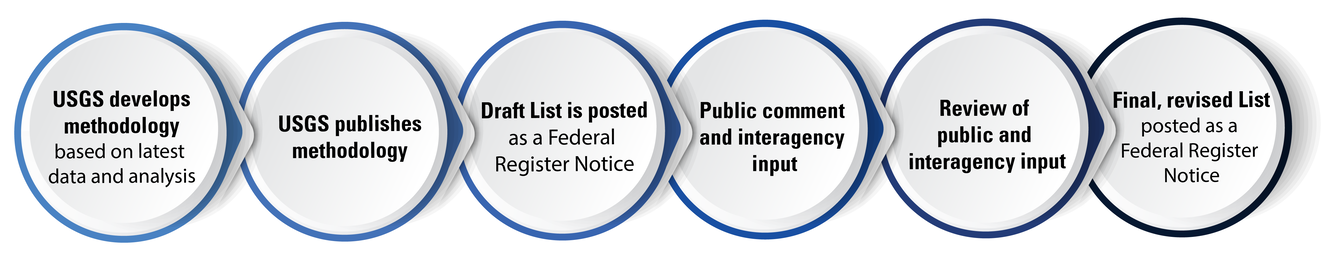
The USGS leverages expertise across the federal government, in private industry and in academia to understand how minerals are produced and used and to assess their supply chain risks. The process for developing the List of Critical Minerals is laid out in the Energy Act of 2020 (Section 7002). The steps are:
- At least once every 3 years, the USGS updates the data-driven methodology for determining which minerals meet the criteria for criticality laid out in the Energy Act of 2020.
- While updating the methodology for the List of Critical Minerals, the USGS consults with experts in academia, government and industry to ensure that the methodology incorporates the most advanced science and data up to that point and reflects the perspectives of diverse decision-makers.
- USGS drafts a methodology for developing the List of Critical Minerals.
- The draft is peer-reviewed by experts in the field and revised accordingly before being published.
- USGS uses the methodology to develop the draft List of Critical Minerals.
- USGS posts the published methodology and draft List of Critical Minerals to the Federal Register to solicit public input.
- The USGS seeks input from other federal agencies through the Critical Minerals Subcommittee of the National Science and Technology Council.
- USGS receives comments and questions from a wide cross-section of the public, including from academic experts, industry professionals, companies, public citizens and Tribes. USGS responses to public comment on the 2022 List of Critical Minerals are summarized here.
- In accordance with the Energy Act of 2020, the Secretary of the Interior has the authority to designate additional minerals to the List or remove minerals on the List.
- USGS publishes the List of Critical Minerals. The List is posted on the Federal Register.
Our Data-Driven Methodology
USGS uses data on foreign and domestic mineral production, mineral imports and exports, industry use, and other data to provide technical input for the List of Critical Minerals. Many of these data are collected and analyzed by the USGS National Minerals Information Center. USGS reviews the methodology and updates it, as necessary, at least once every 3 years.
Methodology for the 2025 List of Critical Minerals
USGS used an updated methodology to quantify the risks associated with potential supply chain disruptions and recommend mineral commodities for inclusion on the updated 2025 List of Critical Minerals. The updated methodology uses an economic model that the USGS developed to estimate the potential effects of foreign trade disruptions of mineral commodities on the U.S. economy. The analysis also provides a prioritization based on the results. The economic model has several advantages over previous assessments, including the ability to directly compare the results against other economic risks and the costs of initiatives aimed at reducing the risks. A plain language summary of the methodology follows:
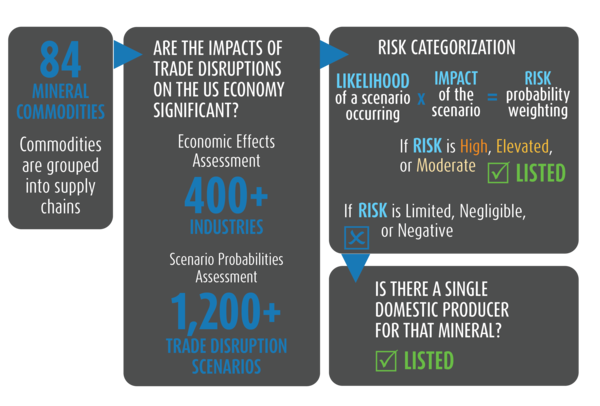
Eighty-four mineral commodities were grouped into supply chains
To determine if the impacts of trade disruption on the U.S. economy are significant, an economics effects assessment and a scenario probabilities assessment were conducted. Over 400 industries and more than 1,200 trade disruption scenarios were analyzed as part of the assessments.
Each mineral commodity was then categorized by its risk of a trade disruption. A risk probability weighting was calculated by multiplying the likelihood of a scenario occurring by the impact of the scenario. If the risk was high, elevated, or moderate, the commodity was proposed for inclusion on the List.
If the risk is limited, negligible, or negative, the commodity is then assessed for a single point of failure in the supply chain. If there is a single domestic producer for that commodity, it is proposed for inclusion on the List.
For more details, see the full methods and techniques report for the 2025 List of Critical Minerals.
Methodology for the 2022 List of Critical Minerals
Read about the methodology used to provide technical input for the 2022 List of Critical Minerals in the full technical report for the 2022 methodology.
Although you may not see them, you likely rely on critical mineral supply chains every day. Critical minerals are essential parts of phones and laptops, airplanes and satellite systems, medical devices, electric car batteries, wind turbines, solar panels,and even cosmetics.
When these supply chains are disrupted, our entire society feels the effects. For instance, during the Covid-19 pandemic, disruptions to the supply chains of critical minerals in microchips produced long waits for cars, laptops, and even dishwashers.
Explore some of the ways you might encounter critical minerals in your daily life below.
in Data Centers
in Mobile Devices
in Medical Implants
in Satellites
in Renewable Energy
in Fireworks
How did the List of Critical Minerals come to be?
A "National Plan"
Calls for a “national mineral plan” surfaced in the 1920s, as American scientists recognized the importance of understanding mineral resources and supply chains in an increasingly globalized and industrial world. Around the same time, the USGS began using standardized methods to collect mineral statistics, including information about mineral production and supply chains.
The Strategic and Critical Materials Stock Piling Act
In 1939, as WWII began and mineral supplies became stressed, Congress passed the “Strategic and Critical Materials Stock Piling Act.” The Act was intended to bolster stockpiling and supply chains of “certain strategic and critical materials” that would become essential to national defense. The President was given the authority to name which materials were considered “strategic and critical”.
A Renewed Interest
In more recent years, as supply chain science has advanced and the Nation’s mineral needs have changed, there has been a renewed interest in identifying minerals that are critical today, and especially in sectors within and beyond the national defense sphere, including for advanced consumer technologies and energy infrastructure.
A number of pieces of legislation in recent years have laid the foundation for developing increasingly sophisticated lists of critical minerals. Additionally, in 2010, the National Science and Technology Council established a Critical Minerals Subcommittee to coordinate across federal agencies on matters related to critical minerals
Explore the timeline below for more recent critical mineral events.
From mapping potential resources to annual mineral reports, the USGS delivers science that is essential for short- and long- term planning on how to manage, use and strengthen the supply chains of mineral resources.
Explore some of our topics below.
Mineral Assessments
Mapping with a focus on critical mineral resources
Mineral Supply Chain Analysis
Critical Minerals in Mine Wastes

About the 2025 List of Critical Minerals
Critical minerals are essential to the economy and national security of the Nation and have supply chains that are vulnerable to disruption.
The USGS leads the Federal government in developing the List of Critical Minerals and provides crucial and rich information about critical mineral availability, supply chains, and economic impacts. The USGS uses a cross-sectoral and data-driven approach to developing the List.
What are critical minerals?
Minerals that are “critical” are both essential to the Nation’s economy or national security and have supply chains that are vulnerable to disruption.
Critical minerals are defined in the Energy Act of 2020. According to the Act, minerals are considered “critical” if they fit three criteria:
- The mineral must be “essential to the economic or national security of the United States.”
- The mineral must “serve an essential function in the manufacturing of a product… the absence of which would have significant consequences for the economic or national security of the United States”
- The mineral must have a supply chain that is “vulnerable to disruption (including restrictions associated with foreign political risk, abrupt demand growth, military conflict, violent unrest, anti-competitive or protectionist behaviors, and other risks through-out the supply chain)”.
In addition, the Act specifies that the “critical minerals’ cannot include fuel minerals such as oil, gas, coal or uranium. Water, ice, snow or “common varieties of sand, gravel, stone, pumice, cinders and clay” are also excluded from being critical minerals.
USGS and the List of Critical Minerals
The USGS leads the government in developing the List of Critical Minerals. The 2025 List of Critical Minerals includes 60 minerals.
According to the Energy Act of 2020, the USGS is required to review and publish the List of Critical Minerals – and the methodology used to create it - at least once every three years. The Energy Act of 2020 also directs USGS to complete resource assessments for each critical mineral, and to track and forecast critical mineral production, consumption and recycling patterns.
The USGS has a long history of mineral supply chain analysis and mineral data collection, including through the National Minerals Information Center. In developing the List of Critical Minerals, the USGS considers minerals used in over 230 sectors of the economy, from energy infrastructure to advanced technology manufacturing, and from aerospace engineering to medical equipment.
About Critical Minerals
Why does the List of Critical Minerals matter?
How is the List of Critical Minerals created?
A Brief History of Critical Minerals
How do critical minerals affect me?
critical minerals science
Explore the Latest
About the 2025 List
The U.S. relies on 90 countries for the minerals needed to drive the economy and protect national security. The List of Critical Minerals is an essential tool for understanding which mineral commodities are most needed and have supply chains most at risk.
The List of Critical Minerals is based on risks to mineral supply chains supporting every sector of the economy, and a wide range of technologies ranging from energy to aerospace to consumer electronics.
Both the public and private sectors use the List of Critical Minerals to inform major decisions and investments. The List, and the analysis behind it, provide insights needed to assess risks, plan for disruptions, bolster supply chain resilience, and evaluate the effectiveness of different actions.
Here are some ways that the List of Critical Minerals is used:
To Assess Risks to the Nation’s Economy and National Security
The federal government relies on the List of Critical Minerals and the analysis behind it to assess risks to core functions, such as national defense, from supply chain disruptions. This allows federal agencies to plan for potential disruptions, identify substitutes for vulnerable supply chains, and effectively allocate resources towards building resilience.
To Evaluate Business Risks
Industries use the List of Critical Minerals, and the analysis behind it, to assess what parts of their business could be most vulnerable to supply chain disruptions, allowing them to plan for potential disruptions, identify substitutes for vulnerable supply chains, and effectively allocate resources towards building resilience.
To Guide Federal Policies to Bolster Supply Chains
The List of Critical Minerals helps guide federal policy to make critical minerals more available in the U.S., including through direct investments, tax incentives for U.S. mineral processing, and streamlined mining permits.
The List of Critical Minerals, and the analysis behind it, also inform decisions about trade relationships and foreign investments.
To Prioritize Mapping Efforts
In addition to analyzing reliance on imported minerals, the USGS is mapping potential domestic sources of critical minerals. The USGS uses the List of Critical Minerals to prioritize mapping through the Earth Mapping Resources Initiative (Earth MRI), both below the ground and above the ground in mine wastes.
To Identify Effective Actions
Reviewing the List every three years provides an opportunity to revisit and monitor the status of specific mineral supply chains. This ongoing analysis can provide information about what actions were or were not effective at strengthening mineral supply chains in the past and identify mineral supply chains that have emerging vulnerabilities.
The Inter-Agency Process
The USGS leverages expertise across the federal government, in private industry and in academia to understand how minerals are produced and used and to assess their supply chain risks. The process for developing the List of Critical Minerals is laid out in the Energy Act of 2020 (Section 7002). The steps are:
- At least once every 3 years, the USGS updates the data-driven methodology for determining which minerals meet the criteria for criticality laid out in the Energy Act of 2020.
- While updating the methodology for the List of Critical Minerals, the USGS consults with experts in academia, government and industry to ensure that the methodology incorporates the most advanced science and data up to that point and reflects the perspectives of diverse decision-makers.
- USGS drafts a methodology for developing the List of Critical Minerals.
- The draft is peer-reviewed by experts in the field and revised accordingly before being published.
- USGS uses the methodology to develop the draft List of Critical Minerals.
- USGS posts the published methodology and draft List of Critical Minerals to the Federal Register to solicit public input.
- The USGS seeks input from other federal agencies through the Critical Minerals Subcommittee of the National Science and Technology Council.
- USGS receives comments and questions from a wide cross-section of the public, including from academic experts, industry professionals, companies, public citizens and Tribes. USGS responses to public comment on the 2022 List of Critical Minerals are summarized here.
- In accordance with the Energy Act of 2020, the Secretary of the Interior has the authority to designate additional minerals to the List or remove minerals on the List.
- USGS publishes the List of Critical Minerals. The List is posted on the Federal Register.
Our Data-Driven Methodology
USGS uses data on foreign and domestic mineral production, mineral imports and exports, industry use, and other data to provide technical input for the List of Critical Minerals. Many of these data are collected and analyzed by the USGS National Minerals Information Center. USGS reviews the methodology and updates it, as necessary, at least once every 3 years.
Methodology for the 2025 List of Critical Minerals
USGS used an updated methodology to quantify the risks associated with potential supply chain disruptions and recommend mineral commodities for inclusion on the updated 2025 List of Critical Minerals. The updated methodology uses an economic model that the USGS developed to estimate the potential effects of foreign trade disruptions of mineral commodities on the U.S. economy. The analysis also provides a prioritization based on the results. The economic model has several advantages over previous assessments, including the ability to directly compare the results against other economic risks and the costs of initiatives aimed at reducing the risks. A plain language summary of the methodology follows:
Eighty-four mineral commodities were grouped into supply chains
To determine if the impacts of trade disruption on the U.S. economy are significant, an economics effects assessment and a scenario probabilities assessment were conducted. Over 400 industries and more than 1,200 trade disruption scenarios were analyzed as part of the assessments.
Each mineral commodity was then categorized by its risk of a trade disruption. A risk probability weighting was calculated by multiplying the likelihood of a scenario occurring by the impact of the scenario. If the risk was high, elevated, or moderate, the commodity was proposed for inclusion on the List.
If the risk is limited, negligible, or negative, the commodity is then assessed for a single point of failure in the supply chain. If there is a single domestic producer for that commodity, it is proposed for inclusion on the List.
For more details, see the full methods and techniques report for the 2025 List of Critical Minerals.
Methodology for the 2022 List of Critical Minerals
Read about the methodology used to provide technical input for the 2022 List of Critical Minerals in the full technical report for the 2022 methodology.
Although you may not see them, you likely rely on critical mineral supply chains every day. Critical minerals are essential parts of phones and laptops, airplanes and satellite systems, medical devices, electric car batteries, wind turbines, solar panels,and even cosmetics.
When these supply chains are disrupted, our entire society feels the effects. For instance, during the Covid-19 pandemic, disruptions to the supply chains of critical minerals in microchips produced long waits for cars, laptops, and even dishwashers.
Explore some of the ways you might encounter critical minerals in your daily life below.
in Data Centers
in Mobile Devices
in Medical Implants
in Satellites
in Renewable Energy
in Fireworks
How did the List of Critical Minerals come to be?
A "National Plan"
Calls for a “national mineral plan” surfaced in the 1920s, as American scientists recognized the importance of understanding mineral resources and supply chains in an increasingly globalized and industrial world. Around the same time, the USGS began using standardized methods to collect mineral statistics, including information about mineral production and supply chains.
The Strategic and Critical Materials Stock Piling Act
In 1939, as WWII began and mineral supplies became stressed, Congress passed the “Strategic and Critical Materials Stock Piling Act.” The Act was intended to bolster stockpiling and supply chains of “certain strategic and critical materials” that would become essential to national defense. The President was given the authority to name which materials were considered “strategic and critical”.
A Renewed Interest
In more recent years, as supply chain science has advanced and the Nation’s mineral needs have changed, there has been a renewed interest in identifying minerals that are critical today, and especially in sectors within and beyond the national defense sphere, including for advanced consumer technologies and energy infrastructure.
A number of pieces of legislation in recent years have laid the foundation for developing increasingly sophisticated lists of critical minerals. Additionally, in 2010, the National Science and Technology Council established a Critical Minerals Subcommittee to coordinate across federal agencies on matters related to critical minerals
Explore the timeline below for more recent critical mineral events.
From mapping potential resources to annual mineral reports, the USGS delivers science that is essential for short- and long- term planning on how to manage, use and strengthen the supply chains of mineral resources.
Explore some of our topics below.
Mineral Assessments
Mapping with a focus on critical mineral resources
Mineral Supply Chain Analysis
Critical Minerals in Mine Wastes