



This is a photo of a fish in Ross Lake, WA called the Redside Shiner. Ecologists at the Western Fisheries Research Center are studying this fish and the food web in Ross Lake.
Rachelle C. Johnson, Ph.D.
Rachelle (Shelley) C. Johnson is a Fish Biologist with the Fish Ecology Section of the Western Fisheries Research Center.
Shelley’s research interests stem from an overarching goal of understanding how natural and human-induced environmental change influence the structure and function of aquatic food webs. Her research utilizes a combination of laboratory experiments, field data collection, and modeling to quantify and better understand the food web processes that may pose limitations to the growth and production of native fishes in a variety of habitats. Current research projects use these methods to understand the impacts of invasive fish species to growth and production of native salmonids and evaluate food web limitations to the feasibility of introducing anadromous salmonids above high-head dams. Shelley has previously participated in research characterizing food web impacts following dam removal in the Elwha River, synthesizing science products and cost estimates for dam removals worldwide for the U.S. Geological Survey Dam Removal Science Database, and improving our understanding of barotrauma in fish associated with turbine passage at hydropower dams.
Science and Products
Artificial Light and Salmon
Artificial light is changing the nighttime environment of Lake Washington and reshaping the survival of salmon.
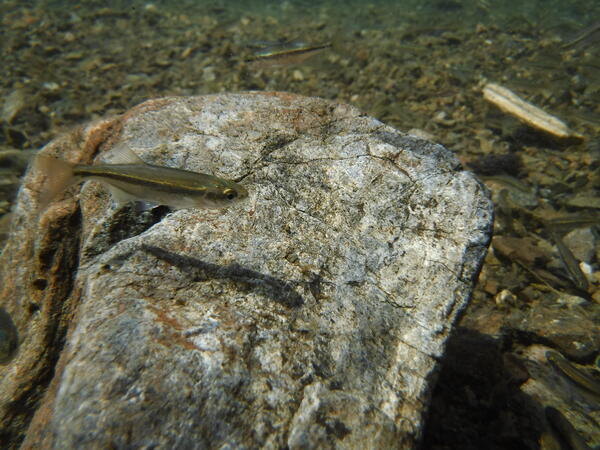
Redside Shiner Fish in Ross Lake, WA
This is a photo of a fish in Ross Lake, WA called the Redside Shiner. Ecologists at the Western Fisheries Research Center are studying this fish and the food web in Ross Lake.
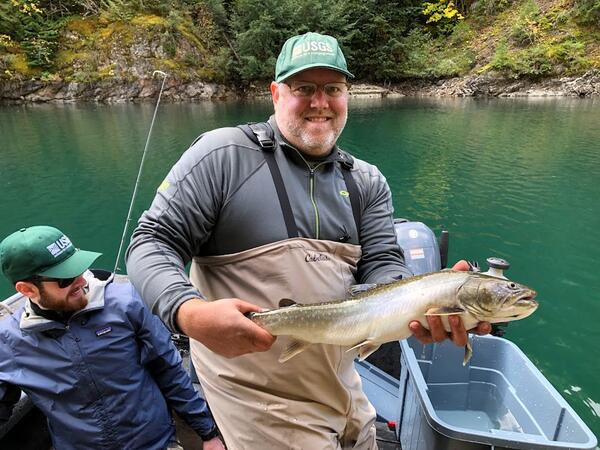
USGS Scientist Holding a Bull Trout in Ross Lake, WA
USGS Scientist Holding a Bull Trout in Ross Lake, WAThis is a photo of scientist, Marshal Hoy, holding a bull trout in Ross Lake. The USGS Western Fisheries Research Center does food web studies in Ross Lake to better understand the ecology and habitat for salmon in the area.
USGS Scientist Holding a Bull Trout in Ross Lake, WA
USGS Scientist Holding a Bull Trout in Ross Lake, WAThis is a photo of scientist, Marshal Hoy, holding a bull trout in Ross Lake. The USGS Western Fisheries Research Center does food web studies in Ross Lake to better understand the ecology and habitat for salmon in the area.
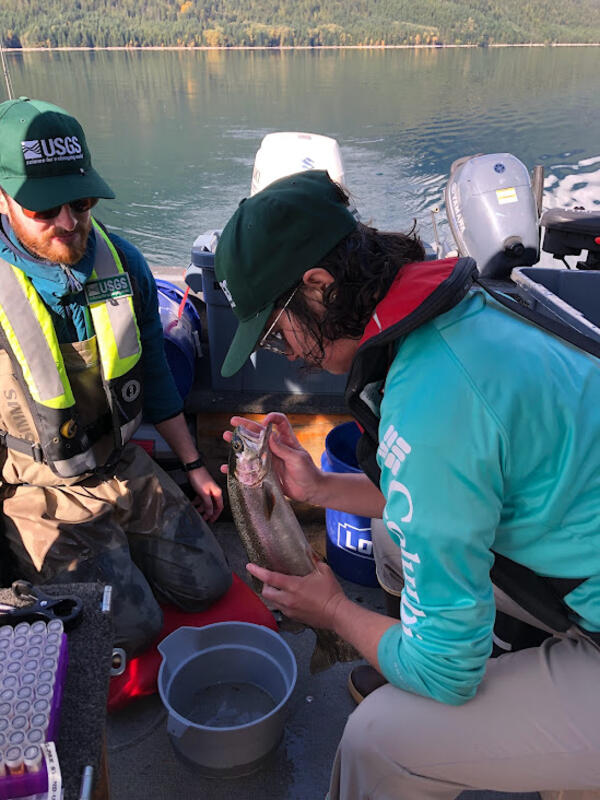
USGS Scientists Collecting Tissue Samples from a Rainbow Trout on Ross Lake.
USGS Scientists Collecting Tissue Samples from a Rainbow Trout on Ross Lake.This is a photo of scientists, Ben Jensen and Shelley Johnson, collecting tissue samples from a rainbow trout on Ross Lake. The USGS Western Fisheries Research Center does work on Ross Lake to understand the food web and ecology for salmon.
USGS Scientists Collecting Tissue Samples from a Rainbow Trout on Ross Lake.
USGS Scientists Collecting Tissue Samples from a Rainbow Trout on Ross Lake.This is a photo of scientists, Ben Jensen and Shelley Johnson, collecting tissue samples from a rainbow trout on Ross Lake. The USGS Western Fisheries Research Center does work on Ross Lake to understand the food web and ecology for salmon.
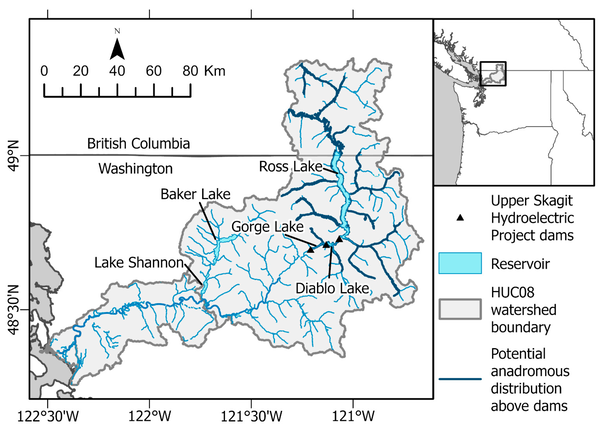
Map of Skagit
Map of the study system. The potential anadromous distribution above the dams indicated is based only on potential physical access to those stream segments (i.e., no migration barriers). Further details and habitat quality results from intrinsic potential modeling can be found in Duda and Hardiman.
Map of the study system. The potential anadromous distribution above the dams indicated is based only on potential physical access to those stream segments (i.e., no migration barriers). Further details and habitat quality results from intrinsic potential modeling can be found in Duda and Hardiman.

Researchers perform gastric lavage on a rainbow trout to sample its stomach contents
Researchers perform gastric lavage on a rainbow trout to sample its stomach contentsResearchers perform gastric lavage on a rainbow trout to sample its stomach contents. This fish was sampled as a part of a food web study on Ross and Diablo Lakes in Washington State to evaluate fish growth and limitations to production.
Researchers perform gastric lavage on a rainbow trout to sample its stomach contents
Researchers perform gastric lavage on a rainbow trout to sample its stomach contentsResearchers perform gastric lavage on a rainbow trout to sample its stomach contents. This fish was sampled as a part of a food web study on Ross and Diablo Lakes in Washington State to evaluate fish growth and limitations to production.

USGS boat tied to dock at Ross Lake, Washington in preparation for food web study
USGS boat tied to dock at Ross Lake, Washington in preparation for food web studyUSGS boat tied to dock at Ross Lake during a week-long sampling trip for a food web study. Ross Lake is a large reservoir on the Upper Skagit River in the North Cascade mountains of northern Washington state.
USGS boat tied to dock at Ross Lake, Washington in preparation for food web study
USGS boat tied to dock at Ross Lake, Washington in preparation for food web studyUSGS boat tied to dock at Ross Lake during a week-long sampling trip for a food web study. Ross Lake is a large reservoir on the Upper Skagit River in the North Cascade mountains of northern Washington state.

Scientist angling on Ross Lake as part of food web study
Scientist angling on Ross Lake as part of food web studyMarshal Hoy, a Biological Science Technician, angling on Ross Lake for Western Fisheries Research Center (WFRC) food web study in October 2021. As a part of this study, fish are sampled for stomach contents, scale samples to assess age and growth, and fin tissue for stable isotopes and genetic analysis.
Scientist angling on Ross Lake as part of food web study
Scientist angling on Ross Lake as part of food web studyMarshal Hoy, a Biological Science Technician, angling on Ross Lake for Western Fisheries Research Center (WFRC) food web study in October 2021. As a part of this study, fish are sampled for stomach contents, scale samples to assess age and growth, and fin tissue for stable isotopes and genetic analysis.

Researcher holding a crayfish collected in Diablo Lake
Researcher holding a crayfish collected in Diablo LakeA native crayfish collected in Diablo Lake for an investigation into food availability for native fish and limitations to their growth. Crayfish are invertebrate prey for salmonids and provide useful representative stable isotope values for benthic members of the food web.
Researcher holding a crayfish collected in Diablo Lake
Researcher holding a crayfish collected in Diablo LakeA native crayfish collected in Diablo Lake for an investigation into food availability for native fish and limitations to their growth. Crayfish are invertebrate prey for salmonids and provide useful representative stable isotope values for benthic members of the food web.

Photo of a juvenile native char in a viewing box at Ross Lake, WA
Photo of a juvenile native char in a viewing box at Ross Lake, WAResearchers placed a juvenile native char into a viewing box to help identify the species. This fish was collected as a part of a food web study on Ross and Diablo Lakes in Washington State in order to evaluate fish growth and limitations to production.
Photo of a juvenile native char in a viewing box at Ross Lake, WA
Photo of a juvenile native char in a viewing box at Ross Lake, WAResearchers placed a juvenile native char into a viewing box to help identify the species. This fish was collected as a part of a food web study on Ross and Diablo Lakes in Washington State in order to evaluate fish growth and limitations to production.
Science and Products
Artificial Light and Salmon
Artificial light is changing the nighttime environment of Lake Washington and reshaping the survival of salmon.
Redside Shiner Fish in Ross Lake, WA
This is a photo of a fish in Ross Lake, WA called the Redside Shiner. Ecologists at the Western Fisheries Research Center are studying this fish and the food web in Ross Lake.
This is a photo of a fish in Ross Lake, WA called the Redside Shiner. Ecologists at the Western Fisheries Research Center are studying this fish and the food web in Ross Lake.
USGS Scientist Holding a Bull Trout in Ross Lake, WA
USGS Scientist Holding a Bull Trout in Ross Lake, WAThis is a photo of scientist, Marshal Hoy, holding a bull trout in Ross Lake. The USGS Western Fisheries Research Center does food web studies in Ross Lake to better understand the ecology and habitat for salmon in the area.
USGS Scientist Holding a Bull Trout in Ross Lake, WA
USGS Scientist Holding a Bull Trout in Ross Lake, WAThis is a photo of scientist, Marshal Hoy, holding a bull trout in Ross Lake. The USGS Western Fisheries Research Center does food web studies in Ross Lake to better understand the ecology and habitat for salmon in the area.
USGS Scientists Collecting Tissue Samples from a Rainbow Trout on Ross Lake.
USGS Scientists Collecting Tissue Samples from a Rainbow Trout on Ross Lake.This is a photo of scientists, Ben Jensen and Shelley Johnson, collecting tissue samples from a rainbow trout on Ross Lake. The USGS Western Fisheries Research Center does work on Ross Lake to understand the food web and ecology for salmon.
USGS Scientists Collecting Tissue Samples from a Rainbow Trout on Ross Lake.
USGS Scientists Collecting Tissue Samples from a Rainbow Trout on Ross Lake.This is a photo of scientists, Ben Jensen and Shelley Johnson, collecting tissue samples from a rainbow trout on Ross Lake. The USGS Western Fisheries Research Center does work on Ross Lake to understand the food web and ecology for salmon.
Map of Skagit
Map of the study system. The potential anadromous distribution above the dams indicated is based only on potential physical access to those stream segments (i.e., no migration barriers). Further details and habitat quality results from intrinsic potential modeling can be found in Duda and Hardiman.
Map of the study system. The potential anadromous distribution above the dams indicated is based only on potential physical access to those stream segments (i.e., no migration barriers). Further details and habitat quality results from intrinsic potential modeling can be found in Duda and Hardiman.
Researchers perform gastric lavage on a rainbow trout to sample its stomach contents
Researchers perform gastric lavage on a rainbow trout to sample its stomach contentsResearchers perform gastric lavage on a rainbow trout to sample its stomach contents. This fish was sampled as a part of a food web study on Ross and Diablo Lakes in Washington State to evaluate fish growth and limitations to production.
Researchers perform gastric lavage on a rainbow trout to sample its stomach contents
Researchers perform gastric lavage on a rainbow trout to sample its stomach contentsResearchers perform gastric lavage on a rainbow trout to sample its stomach contents. This fish was sampled as a part of a food web study on Ross and Diablo Lakes in Washington State to evaluate fish growth and limitations to production.
USGS boat tied to dock at Ross Lake, Washington in preparation for food web study
USGS boat tied to dock at Ross Lake, Washington in preparation for food web studyUSGS boat tied to dock at Ross Lake during a week-long sampling trip for a food web study. Ross Lake is a large reservoir on the Upper Skagit River in the North Cascade mountains of northern Washington state.
USGS boat tied to dock at Ross Lake, Washington in preparation for food web study
USGS boat tied to dock at Ross Lake, Washington in preparation for food web studyUSGS boat tied to dock at Ross Lake during a week-long sampling trip for a food web study. Ross Lake is a large reservoir on the Upper Skagit River in the North Cascade mountains of northern Washington state.
Scientist angling on Ross Lake as part of food web study
Scientist angling on Ross Lake as part of food web studyMarshal Hoy, a Biological Science Technician, angling on Ross Lake for Western Fisheries Research Center (WFRC) food web study in October 2021. As a part of this study, fish are sampled for stomach contents, scale samples to assess age and growth, and fin tissue for stable isotopes and genetic analysis.
Scientist angling on Ross Lake as part of food web study
Scientist angling on Ross Lake as part of food web studyMarshal Hoy, a Biological Science Technician, angling on Ross Lake for Western Fisheries Research Center (WFRC) food web study in October 2021. As a part of this study, fish are sampled for stomach contents, scale samples to assess age and growth, and fin tissue for stable isotopes and genetic analysis.
Researcher holding a crayfish collected in Diablo Lake
Researcher holding a crayfish collected in Diablo LakeA native crayfish collected in Diablo Lake for an investigation into food availability for native fish and limitations to their growth. Crayfish are invertebrate prey for salmonids and provide useful representative stable isotope values for benthic members of the food web.
Researcher holding a crayfish collected in Diablo Lake
Researcher holding a crayfish collected in Diablo LakeA native crayfish collected in Diablo Lake for an investigation into food availability for native fish and limitations to their growth. Crayfish are invertebrate prey for salmonids and provide useful representative stable isotope values for benthic members of the food web.
Photo of a juvenile native char in a viewing box at Ross Lake, WA
Photo of a juvenile native char in a viewing box at Ross Lake, WAResearchers placed a juvenile native char into a viewing box to help identify the species. This fish was collected as a part of a food web study on Ross and Diablo Lakes in Washington State in order to evaluate fish growth and limitations to production.
Photo of a juvenile native char in a viewing box at Ross Lake, WA
Photo of a juvenile native char in a viewing box at Ross Lake, WAResearchers placed a juvenile native char into a viewing box to help identify the species. This fish was collected as a part of a food web study on Ross and Diablo Lakes in Washington State in order to evaluate fish growth and limitations to production.