



Pachymelus bicolor, m, face, madagascar
Images
USGS Bee Lab at the Eastern Ecological Science Center images.
Filter Total Items: 4493

Pachymelus bicolor, m, face, madagascar

Palaeorhiza species, f, Papau New Guinea, face
Palaeorhiza species, Badass Masked Bee, specimen collected in Papua New GuineaThin, relatively hairless, dangerous looking Masked Bees are waspish in aspect since they carry their pollen and nectar internally rather than trapped in external hairs.
Palaeorhiza species, Badass Masked Bee, specimen collected in Papua New GuineaThin, relatively hairless, dangerous looking Masked Bees are waspish in aspect since they carry their pollen and nectar internally rather than trapped in external hairs.

Panax trifolius, Dwarf Ginseng, Howard County, Md, Helen Lowe Metzman
Panax trifolius, Dwarf Ginseng, Howard County, Md, Helen Lowe MetzmanTiny. One would want this in your woodland rock garden. Dwarf Ginseng, Panax trifolius. Specimen and picture by Helen Lowe Metzman. Photography Information: Canon Mark II 5D, Zerene Stacker, Stackshot Sled, 65mm Canon MP-E 1-5X macro lens, Twin Macro Flash in Styrofoam Cooler, F5.0, ISO 100, Shutter Speed 200.
Panax trifolius, Dwarf Ginseng, Howard County, Md, Helen Lowe Metzman
Panax trifolius, Dwarf Ginseng, Howard County, Md, Helen Lowe MetzmanTiny. One would want this in your woodland rock garden. Dwarf Ginseng, Panax trifolius. Specimen and picture by Helen Lowe Metzman. Photography Information: Canon Mark II 5D, Zerene Stacker, Stackshot Sled, 65mm Canon MP-E 1-5X macro lens, Twin Macro Flash in Styrofoam Cooler, F5.0, ISO 100, Shutter Speed 200.

Panurginus atramontensis, f, face, Prince George's Co, MD
Panurginus atramontensis, f, face, Prince George's Co, MDAn Uncommon (or is it?) Deerberry specialist. If you don't collect bees on Deerberry (Vaccinium staminium) you will never see this bee (Panurginus atramontensis). It only gathers pollen and probably almost all of its nectar from this plant.
Panurginus atramontensis, f, face, Prince George's Co, MD
Panurginus atramontensis, f, face, Prince George's Co, MDAn Uncommon (or is it?) Deerberry specialist. If you don't collect bees on Deerberry (Vaccinium staminium) you will never see this bee (Panurginus atramontensis). It only gathers pollen and probably almost all of its nectar from this plant.
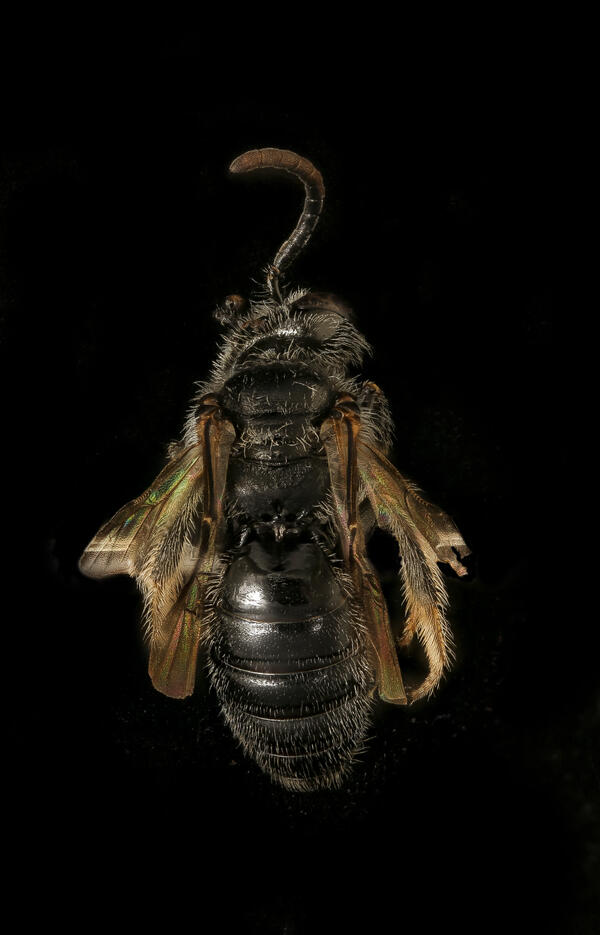
Panurginus atramontensis, m, back, Prince George's Co, MD
Panurginus atramontensis, m, back, Prince George's Co, MDAn Uncommon (or is it?) Deerberry specialist. If you don't collect bees on Deerberry (Vaccinium staminium) you will never see this bee (Panurginus atramontensis). It only gathers pollen and probably almost all of its nectar from this plant.
Panurginus atramontensis, m, back, Prince George's Co, MD
Panurginus atramontensis, m, back, Prince George's Co, MDAn Uncommon (or is it?) Deerberry specialist. If you don't collect bees on Deerberry (Vaccinium staminium) you will never see this bee (Panurginus atramontensis). It only gathers pollen and probably almost all of its nectar from this plant.

Panurginus potentilla, m, side, prince georges county
Panurginus potentilla, m, side, prince georges countyA tiny tiny bee, a specialist on Potentilla or Cinquefoil plants in North America. This one came from a colony I discovered in a dirt patch right in the front lawn of our laboratory. These sorts of bare dirt / clay / sand areas are often great bee nesting sites.
Panurginus potentilla, m, side, prince georges county
Panurginus potentilla, m, side, prince georges countyA tiny tiny bee, a specialist on Potentilla or Cinquefoil plants in North America. This one came from a colony I discovered in a dirt patch right in the front lawn of our laboratory. These sorts of bare dirt / clay / sand areas are often great bee nesting sites.

Panurginus, species A, Sounth Dakota, Side
Undescribed Panurginus Species from Badlands National Park, South Dakota
Undescribed Panurginus Species from Badlands National Park, South Dakota

Panurginus, species A, South Dakota, back
Undescribed Panurginus Species from Badlands National Park
Undescribed Panurginus Species from Badlands National Park

Paracmaeodera species, u, face, Krugar National Park, South Africa
Paracmaeodera species, u, face, Krugar National Park, South AfricaOne of the graciously metallic species of the subgenus Paracmaeodera found on flowers and bowl traps in Kruger National Park, South Africa. Photo by Anders Croft.
Paracmaeodera species, u, face, Krugar National Park, South Africa
Paracmaeodera species, u, face, Krugar National Park, South AfricaOne of the graciously metallic species of the subgenus Paracmaeodera found on flowers and bowl traps in Kruger National Park, South Africa. Photo by Anders Croft.

Paracolletes, m, australia, face
Paracolletes species, On and Off Bee, specimen collected in AustraliaThis species is unusually sexually dimorphic in color. The males are quite bright, as can be seen here, the females are what might be called the "null hypothesis" for bee coloration "“ brownish grey on the head and thorax with a black abdomen with white transverse hair bands.
Paracolletes species, On and Off Bee, specimen collected in AustraliaThis species is unusually sexually dimorphic in color. The males are quite bright, as can be seen here, the females are what might be called the "null hypothesis" for bee coloration "“ brownish grey on the head and thorax with a black abdomen with white transverse hair bands.

Paragus haemorrhous, F, Face, badlands, sd
A little flower fly from the Badlands of South Dakota, this one was part of a study led by Diane Larson looking at the web of pollinators on some of the rare plant communities found in the gumbo soils of Badlands National Park. An interesting species found in North America, Europe, and Africa.
A little flower fly from the Badlands of South Dakota, this one was part of a study led by Diane Larson looking at the web of pollinators on some of the rare plant communities found in the gumbo soils of Badlands National Park. An interesting species found in North America, Europe, and Africa.

Paranthidium jugatorium, m, ga, baker, face
Why do you insist, Pilgrim, on planting your garden with geraniums, tea roses, and begonias? You could be planting your garden to Woodlands sunflowers and then you would have the opportunity to help out the uncommon and undoubtedly declining Paranthidium jugatorium.
Why do you insist, Pilgrim, on planting your garden with geraniums, tea roses, and begonias? You could be planting your garden to Woodlands sunflowers and then you would have the opportunity to help out the uncommon and undoubtedly declining Paranthidium jugatorium.

Osmia atriventris, F, side, beltsville, md
One of the common spring Osmia, this specimen came from bowl traps right at the lab...unlike other specimens it was processed right away and the luminescence of the eyes of this particular specimen retained at least some of the flavor of what they look like when alive.Canon Mark II 5D, Zerene Stacker, Stackshot Sled, 65mm Canon MP-E 1-5X macro lens, Twin Macro Flas
One of the common spring Osmia, this specimen came from bowl traps right at the lab...unlike other specimens it was processed right away and the luminescence of the eyes of this particular specimen retained at least some of the flavor of what they look like when alive.Canon Mark II 5D, Zerene Stacker, Stackshot Sled, 65mm Canon MP-E 1-5X macro lens, Twin Macro Flas

Osmia brevicornis,f, jaw, kyrgystan
Osmia, as members of the family Megachilidae often use their jaws in the formation of nests ... collecting plant material or mud and such uses create some wicked cool structures, here are the big jaws of an Osmia from Kyrgystan. This specimen was taken upside down and then inverted to get a bit more dramatic lighting on the lower part of the face.
Osmia, as members of the family Megachilidae often use their jaws in the formation of nests ... collecting plant material or mud and such uses create some wicked cool structures, here are the big jaws of an Osmia from Kyrgystan. This specimen was taken upside down and then inverted to get a bit more dramatic lighting on the lower part of the face.

Osmia bruneri, M, Park co., Wyoming, back
Here is a series of male and female western glinting Osmia. There is a whole clade of Osmia that have thrust aside the drab dark colors of their Osmini kin for fresh look of maximum iridescence. That iridescence trends across greens and blues and purples with males often more on the green side.
Here is a series of male and female western glinting Osmia. There is a whole clade of Osmia that have thrust aside the drab dark colors of their Osmini kin for fresh look of maximum iridescence. That iridescence trends across greens and blues and purples with males often more on the green side.

Osmia bruneri, M, Park co., Wyoming, side
Here is a series of male and female western glinting Osmia. There is a whole clade of Osmia that have thrust aside the drab dark colors of their Osmini kin for fresh look of maximum iridescence. That iridescence trends across greens and blues and purples with males often more on the green side.
Here is a series of male and female western glinting Osmia. There is a whole clade of Osmia that have thrust aside the drab dark colors of their Osmini kin for fresh look of maximum iridescence. That iridescence trends across greens and blues and purples with males often more on the green side.

Osmia Californica, f, ca, santa barbara co., face
Check out the midnight blue on the female. Your Prius should look so good. Female photos by Wayne Boo. Photography Information: Canon Mark II 5D, Zerene Stacker, Stackshot Sled, 65mm Canon MP-E 1-5X macro lens, Twin Macro Flash in Styrofoam Cooler, F5.0, ISO 100, Shutter Speed 200.
Check out the midnight blue on the female. Your Prius should look so good. Female photos by Wayne Boo. Photography Information: Canon Mark II 5D, Zerene Stacker, Stackshot Sled, 65mm Canon MP-E 1-5X macro lens, Twin Macro Flash in Styrofoam Cooler, F5.0, ISO 100, Shutter Speed 200.

Osmia californica, m, wy, lincoln, back
Check out the midnight blue on the female. Your Prius should look so good. Female photos by Wayne Boo. Photography Information: Canon Mark II 5D, Zerene Stacker, Stackshot Sled, 65mm Canon MP-E 1-5X macro lens, Twin Macro Flash in Styrofoam Cooler, F5.0, ISO 100, Shutter Speed 200.
Check out the midnight blue on the female. Your Prius should look so good. Female photos by Wayne Boo. Photography Information: Canon Mark II 5D, Zerene Stacker, Stackshot Sled, 65mm Canon MP-E 1-5X macro lens, Twin Macro Flash in Styrofoam Cooler, F5.0, ISO 100, Shutter Speed 200.

Osmia calla, f, back, Mariposa, CA, 2017-07-13-17.03
Osmia calla, f, back, Mariposa, CA, 2017-07-13-17.03Ah the glow in the dark Mason bees of the West. Very jealous...we don't have this model of Osmia out east. For some reason bright green works for a whole passel of Osmia and the related Hoplitis. Funny how this blingy green/blue/purple invades certain genera of bees and is completely absent from others. What is the driver. I like to think it is bee aesthetics.
Osmia calla, f, back, Mariposa, CA, 2017-07-13-17.03
Osmia calla, f, back, Mariposa, CA, 2017-07-13-17.03Ah the glow in the dark Mason bees of the West. Very jealous...we don't have this model of Osmia out east. For some reason bright green works for a whole passel of Osmia and the related Hoplitis. Funny how this blingy green/blue/purple invades certain genera of bees and is completely absent from others. What is the driver. I like to think it is bee aesthetics.

Osmia calla, f, face, Mariposa, CA, 2017-07-13-17.14
Osmia calla, f, face, Mariposa, CA, 2017-07-13-17.14Ah the glow in the dark Mason bees of the West. Very jealous...we don't have this model of Osmia out east. For some reason bright green works for a whole passel of Osmia and the related Hoplitis. Funny how this blingy green/blue/purple invades certain genera of bees and is completely absent from others. What is the driver. I like to think it is bee aesthetics.
Osmia calla, f, face, Mariposa, CA, 2017-07-13-17.14
Osmia calla, f, face, Mariposa, CA, 2017-07-13-17.14Ah the glow in the dark Mason bees of the West. Very jealous...we don't have this model of Osmia out east. For some reason bright green works for a whole passel of Osmia and the related Hoplitis. Funny how this blingy green/blue/purple invades certain genera of bees and is completely absent from others. What is the driver. I like to think it is bee aesthetics.

Osmia calla, f, right, Mariposa, CA, 2017-07-13-17.31
Osmia calla, f, right, Mariposa, CA, 2017-07-13-17.31Ah the glow in the dark Mason bees of the West. Very jealous...we don't have this model of Osmia out east. For some reason bright green works for a whole passel of Osmia and the related Hoplitis. Funny how this blingy green/blue/purple invades certain genera of bees and is completely absent from others. What is the driver. I like to think it is bee aesthetics.
Osmia calla, f, right, Mariposa, CA, 2017-07-13-17.31
Osmia calla, f, right, Mariposa, CA, 2017-07-13-17.31Ah the glow in the dark Mason bees of the West. Very jealous...we don't have this model of Osmia out east. For some reason bright green works for a whole passel of Osmia and the related Hoplitis. Funny how this blingy green/blue/purple invades certain genera of bees and is completely absent from others. What is the driver. I like to think it is bee aesthetics.