



2026-2030 Landsat Science Team
The Landsat Science Team supports USGS and NASA in maintaining scientific integrity, data quality, and mission continuity. Their work informs mission planning and development and helps maximize the value of the Landsat archive through improved science products, expanded applications and strategic insight that helps the Landsat program continue to serve the public effectively.
Return to Landsat Science Team Overview
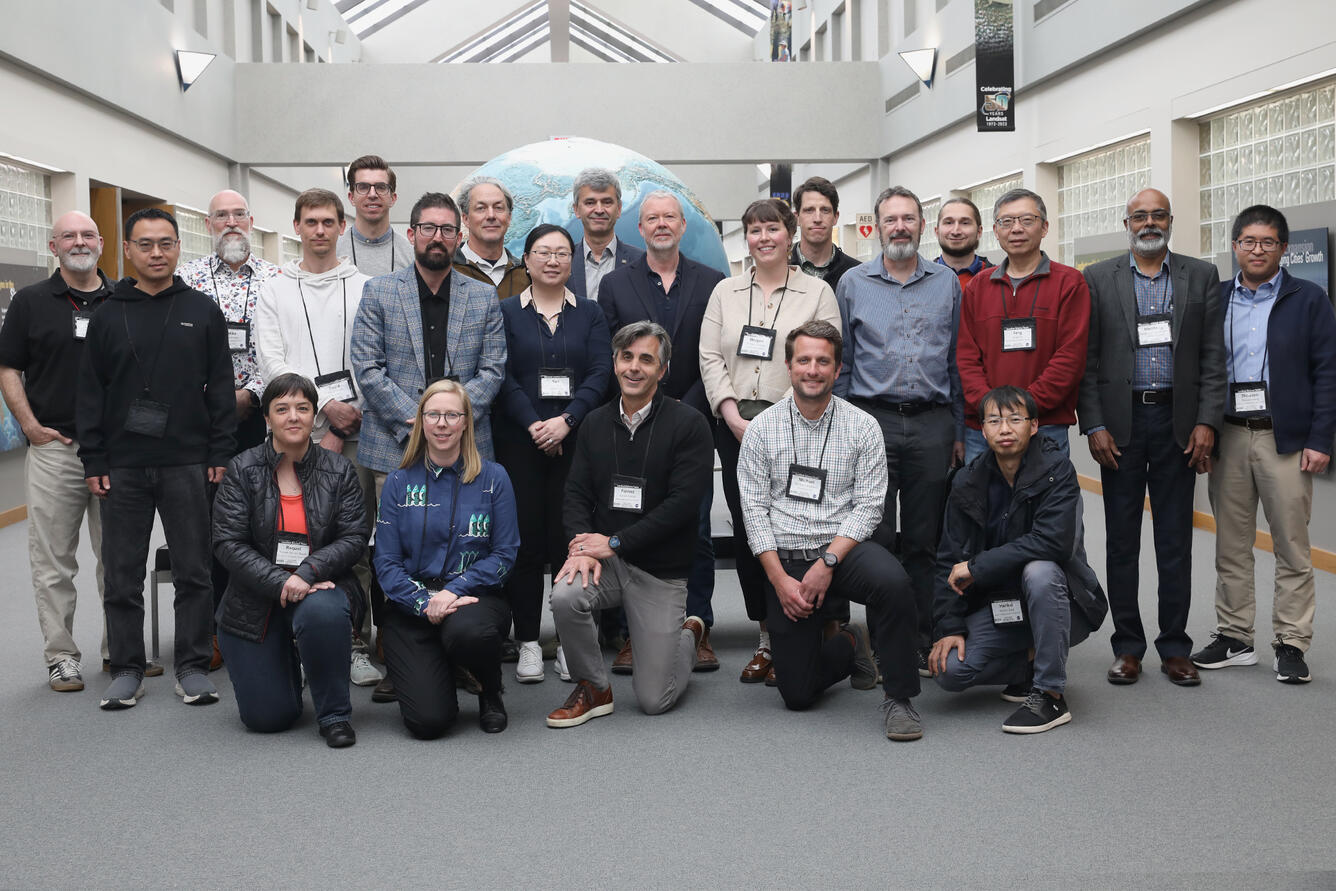
The 2026-2030 Landsat Science Team
Dr. Edward Bair (PI), Leidos, Inc.: Next generation snow cover mapping and establishment of a long-term ground validation site
Dr. Nimrod Carmon (PI) and Dr. Gregory Okin (CO-I), University of California, Los Angeles: Fully probabilistic atmospheric correction for Landsat
Dr. Morgan Crowley (PI), Canadian Forest Service: Advancing fire monitoring with Landsat and Canada’s WildFireSat
Dr. Raquel De Los Reyes (PI), The German Aerospace Center (DLR): Towards a harmonized atmospheric correction for EnMAP, CHIME, Landsat archive, and Landsat observables
Dr. Phillip Dennison (Co-PI) and Dr Michael Campbell (Co-PI), University of Utah: Developing non-photosynthetic vegetation cover capabilities for Landsat
Dr. David Frantz (PI), Trier University: Dr. Patrick Hostert (Co-I) Humboldt University of Berlin; Sebastian van der Linden (CO-I), University of Greifswald; Dr. Dirk Pflugmacher (Co-I), Humboldt University of Berlin; Dr. Cornelius Senf (Co-I), Technical University of Munich: Synergistic data processing pipelines for Landsat and European satellite missions
Dr. Feng Gao (PI), USDA Agriculture Research Service: Tracking Crop Growth and Condition in Near Real-time Using Harmonized Landsat and Sentinel-2 Data
Dr. Dean Hively (PI), USGS Lower Mississippi Water Science Center: Measuring agricultural conservation land cover with next generation Earth observation: detecting green vegetation, crop residue, and soil in the context of surface moisture variability
Dr. Kyle Knipper (Co-PI) and Dr. Martha Anderson (Co-PI), USDA Agriculture Research Service: From leaf to Landsat: A multi-scale approach to developing information for agricultural management from Landsat
Dr. Forrest Melton (PI), NASA Earth Science Division: OpenET: Supporting US sustainable water management with Landsat
Dr. Ryan O’Shea (PI), Science Systems and Applications, Inc: Harmonizing inland and coastal water quality monitoring from the Landsat Program: Harmful algal blooms
Dr. David Roy (PI), Michigan State University; Hankui K. Zhang (Co-I), South Dakota State University; and Lin Yan (Co-I), Michigan State University: Pathfinding the steps to ensure global analysis ready consistent reflectance from the Landsat MSS to the next Landsat era
Dr. Peter Strobl (PI), European Commission: Stronger together – next generation interoperability for Landsat and Copernicus
Medhavy Thankappan (PI), Geoscience Australia (GA); Dr. Kimberlee Baldry (Co-I); GA and Dr. Courtney Bright (Co-I), Commonwealth Scientific and Industrial Research Organisation (CSIRO): Maximizing the impact of interoperable Landsat Analysis-Ready Surface Reflectance for Operational Land, Water and Antarctic Monitoring
Dr. Greg Vaughan (PI), USGS Astrogeology Science Center: Characterizing/monitoring active volcanoes and geothermal systems with Landsat
Dr. Eric Vermote (PI), NASA Goddard Space Flight Center: Maintenance and Refinement of the Land Surface Reflectance Code (LaSRC) for Landsat and Sentinel 2
Dr. Mike Wulder (PI), Canadian Forest Service; Joanne C. White (Co-I) Canadian Forest Service; Txomin Hermosilla (Co-I) Canadian Forest Service: From pixels to products to policy: Creating and sharing information to advance science and applications with Landsat
Dr. Yun Yang (PI), Cornell University; Dr. Zhuosen Wang (Co-I), University of Maryland: Improving and synergizing Landsat evapotranspiration and albedo using multi-satellite observations