



Aquifer compaction and land subsidence
By Virginia and West Virginia Water Science Center
August 2022 (approx.)

Detailed Description
This animated infographic shows how aquifer compaction can lead to land subsidence. When water is pumped from a confined aquifer faster than it can recharge, the water pressure in the aquifer begins to decrease. As water pressure decreases, both the confining layers and the aquifers themselves can start to compact under the weight of the overlying sediments. This causes subsidence at the surface.
Sources/Usage
Public Domain.
Related

Land Subsidence on the Virginia Coastal Plain
Land subsidence is a loss of ground elevation, often experienced as the ground slowly sinking over the course of years. In eastern Virginia, high rates of groundwater use is a major factor in the land subsidence affecting the area. The Virginia-West Virginia Water Science Center, with the help of our partners, has been monitoring land subsidence in the Virginia Coastal Plain since 1979 using a...

Aquifer Compaction due to Groundwater Pumping
Although land subsidence caused by groundwater pumping has caused many negative effects on human civil works for centuries, especially in the highly developed urban or industrialized areas of Europe, the relation between subsidence and groundwater pumpage was not understood or recognized for a long time. Recognition began in 1928 when pioneer researcher O.E. Meinzer of the U.S. Geological Survey...
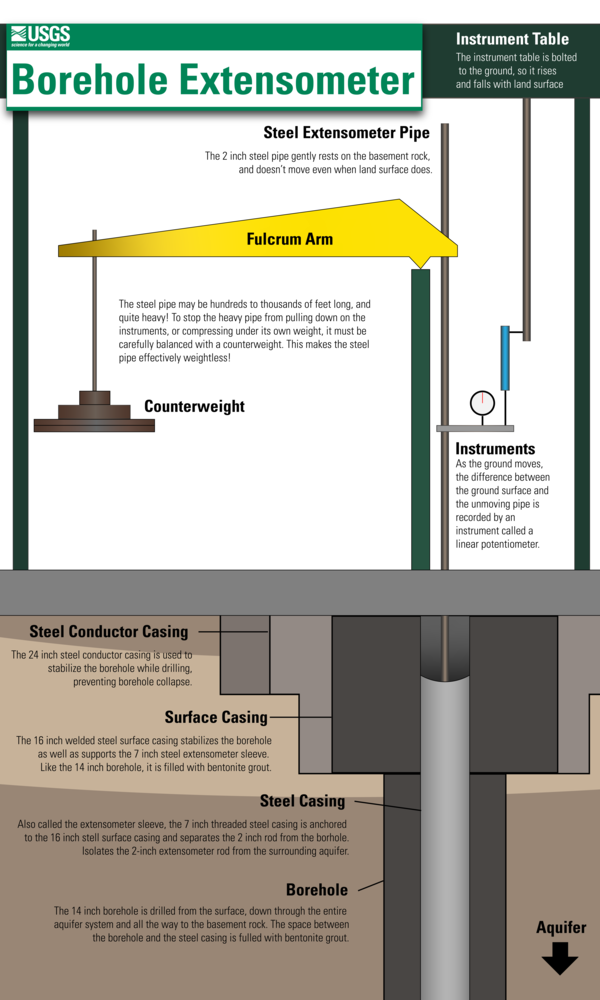
Subsidence Infographics
Subsidence Infographics



Related
Land Subsidence on the Virginia Coastal Plain
Land subsidence is a loss of ground elevation, often experienced as the ground slowly sinking over the course of years. In eastern Virginia, high rates of groundwater use is a major factor in the land subsidence affecting the area. The Virginia-West Virginia Water Science Center, with the help of our partners, has been monitoring land subsidence in the Virginia Coastal Plain since 1979 using a...
Aquifer Compaction due to Groundwater Pumping
Although land subsidence caused by groundwater pumping has caused many negative effects on human civil works for centuries, especially in the highly developed urban or industrialized areas of Europe, the relation between subsidence and groundwater pumpage was not understood or recognized for a long time. Recognition began in 1928 when pioneer researcher O.E. Meinzer of the U.S. Geological Survey...
Subsidence Infographics
Subsidence Infographics