
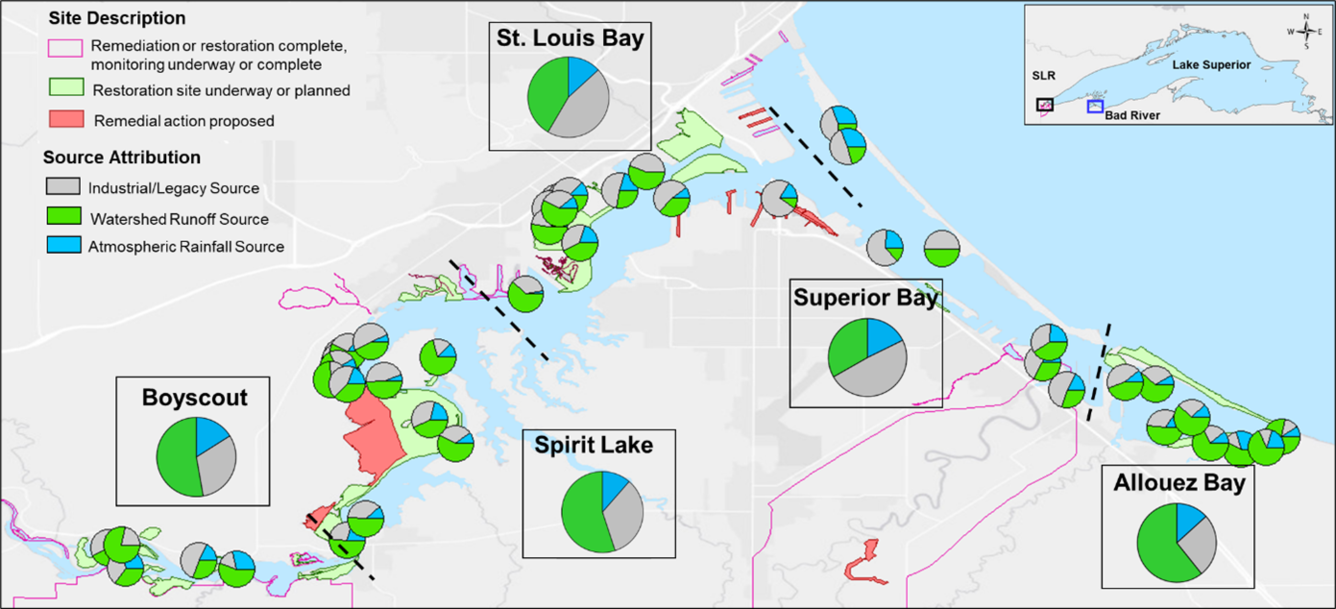
Distribution of mercury sources in sediments of the St. Louis River
By Upper Midwest Water Science Center
2021 (approx.)
Detailed Description
Distribution of mercury sources in sediments of the St. Louis River. The St. Louis River has historical mercury contamination from mixed industry as well as mercury inputs from upstream runoff and rainfall. Due to contamination and habitat degradation, the river is designated as an Area of Concern within the Great Lakes. Figure: Janssen et al. 2021, https://doi.org/10.1016/j.scitotenv.2021.146284
Sources/Usage
Public Domain.
Related
Examining historical mercury sources in the Saint Louis River estuary: How legacy contamination influences biological mercury levels in Great Lakes coastal regions Examining historical mercury sources in the Saint Louis River estuary: How legacy contamination influences biological mercury levels in Great Lakes coastal regions
Industrial chemical contamination within coastal regions of the Great Lakes can pose serious risks to wetland habitat and offshore fisheries, often resulting in fish consumption advisories that directly affect human and wildlife health. Mercury (Hg) is a contaminant of concern in many of these highly urbanized and industrialized coastal regions, one of which is the Saint Louis River...
Authors
Sarah E. Janssen, Joel C. Hoffman, Ryan F. Lepak, David P. Krabbenhoft, David M. Walters, Collin A. Eagles-Smith, Greg Peterson, Jacob M. Ogorek, John F. DeWild, Anne M Cotter, Mark Pearson, Michael T. Tate, Roger B. Yeardley, Marc A. Mills
How Spiders Can Help Us Connect Aquatic Mercury Contamination to Terrestrial Food Webs
Just in time for Halloween, this "spooky science" study focuses on how spiders can help us connect aquatic mercury contamination to terrestrial food webs.
Related
Examining historical mercury sources in the Saint Louis River estuary: How legacy contamination influences biological mercury levels in Great Lakes coastal regions Examining historical mercury sources in the Saint Louis River estuary: How legacy contamination influences biological mercury levels in Great Lakes coastal regions
Industrial chemical contamination within coastal regions of the Great Lakes can pose serious risks to wetland habitat and offshore fisheries, often resulting in fish consumption advisories that directly affect human and wildlife health. Mercury (Hg) is a contaminant of concern in many of these highly urbanized and industrialized coastal regions, one of which is the Saint Louis River...
Authors
Sarah E. Janssen, Joel C. Hoffman, Ryan F. Lepak, David P. Krabbenhoft, David M. Walters, Collin A. Eagles-Smith, Greg Peterson, Jacob M. Ogorek, John F. DeWild, Anne M Cotter, Mark Pearson, Michael T. Tate, Roger B. Yeardley, Marc A. Mills
How Spiders Can Help Us Connect Aquatic Mercury Contamination to Terrestrial Food Webs
Just in time for Halloween, this "spooky science" study focuses on how spiders can help us connect aquatic mercury contamination to terrestrial food webs.