



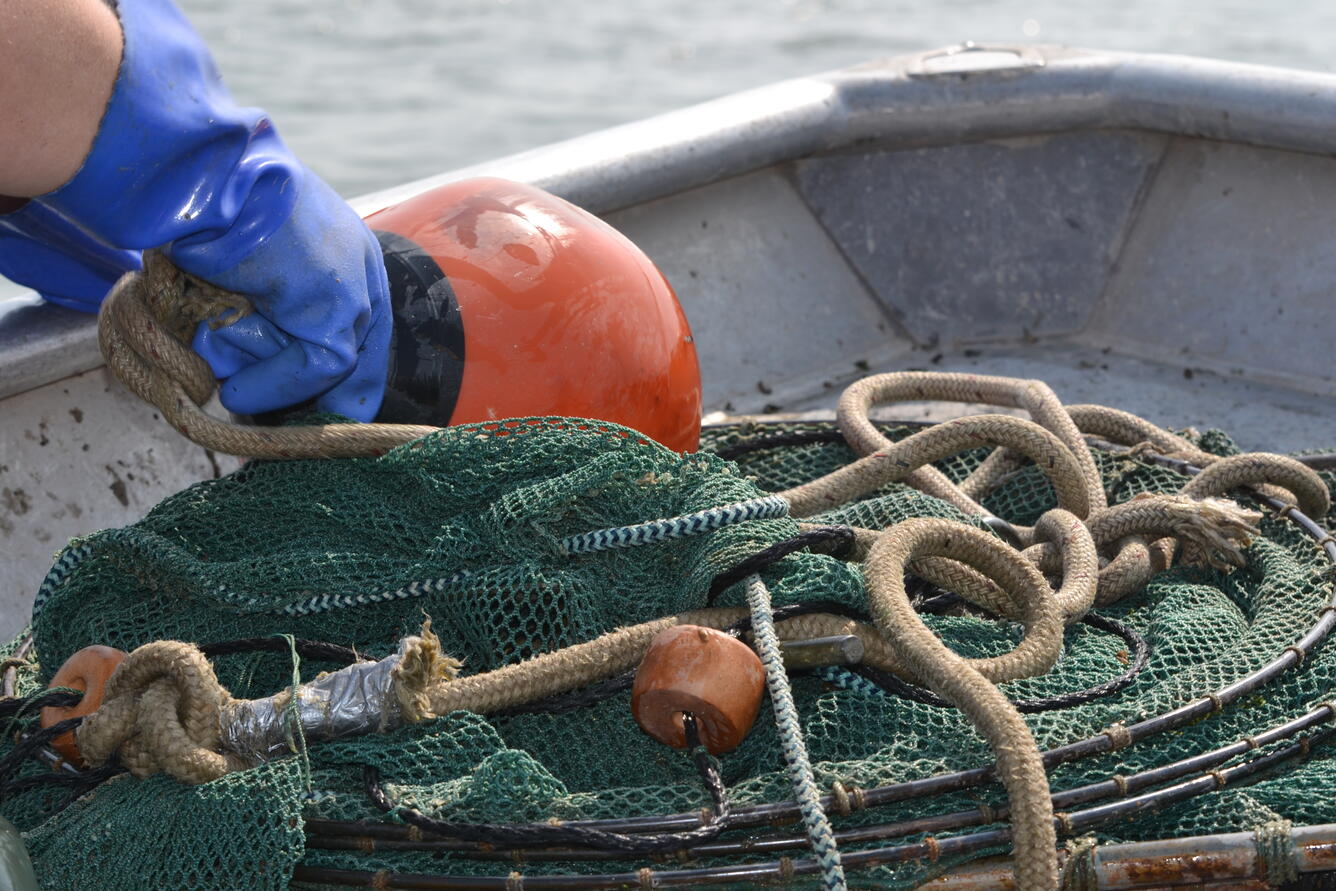
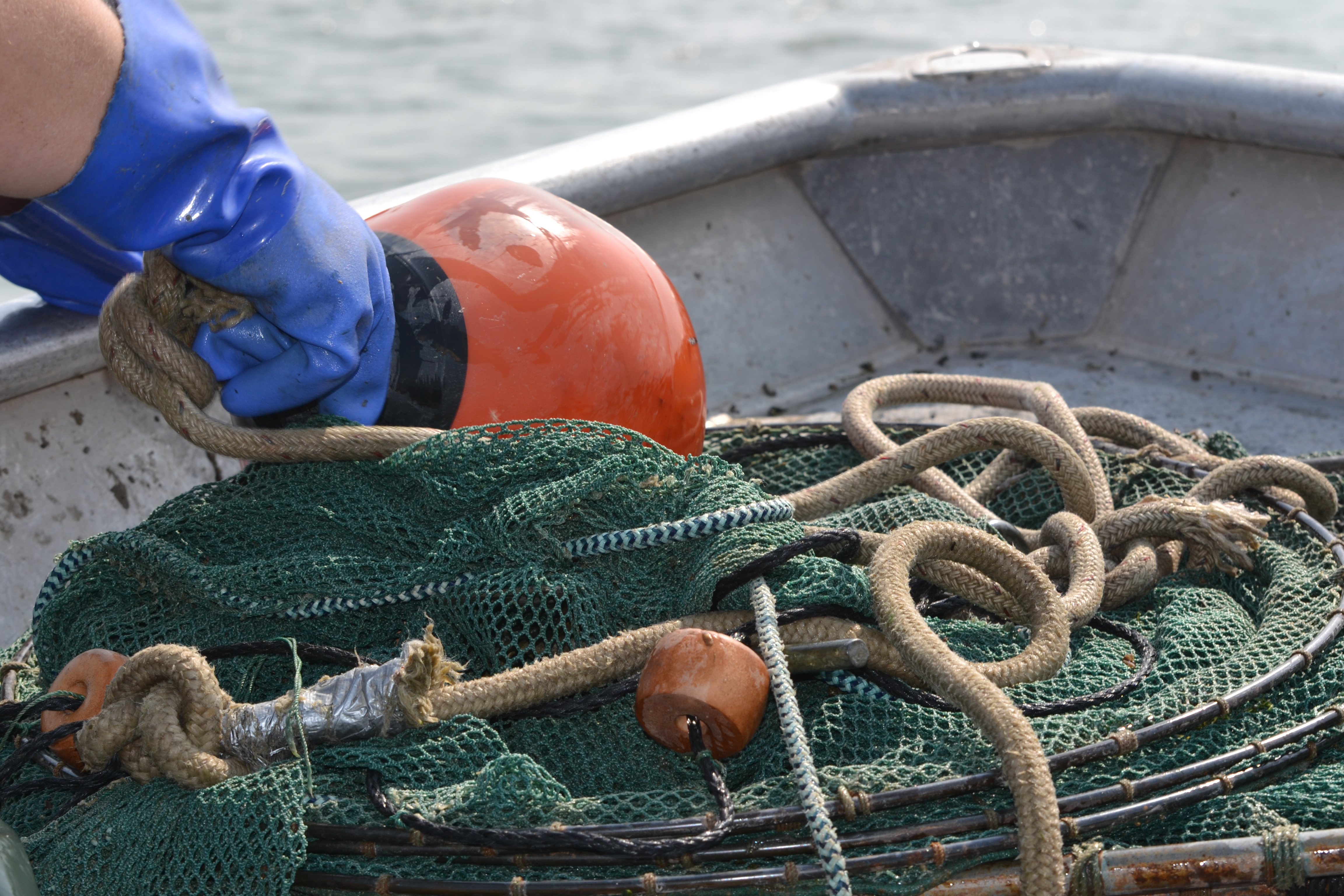
Nets Used to Sample Juvenile Suckers in Upper Klamath Lake, OR


Detailed Description
Lost River and Shortnose suckers are on the verge of extinction in Upper Klamath Lake. Age data indicate that almost all adult suckers remaining in the lake spawning populations were hatched in the early 1990s. Most individuals are approaching their maximum life span, and for the past 22 years the recruitment of new fish into the adult populations has never exceeded mortality losses.
WFRC scientists are working tirelessly to identify the factors driving the loss of juvenile suckers. Though the problem is complex, our researchers have plans to continue to home in on why juvenile suckers are dying in such large numbers.
Sources/Usage
Public Domain.
Related
Predation of Lost River and Shortnose suckers by piscivorous colonial waterbirds in the Upper Klamath Basin: An analysis of predation effects during 2021–2023 Predation of Lost River and Shortnose suckers by piscivorous colonial waterbirds in the Upper Klamath Basin: An analysis of predation effects during 2021–2023
Previously published research indicated that predation by piscivorous colonial waterbirds in the Upper Klamath Basin was a source of mortality for Lost River suckers (Deltistes luxatus) and Shortnose suckers (Chasmistes brevirostris), including mortality of Sucker Assisted Rearing Program (SARP) fish. Avian predation on recently released Chinook Salmon (Oncorhynchus tshawytscha) in the...
Authors
Nathan B Banet, Quinn Payton, Allen F. Evans, Rachael Katelyn Paul-Wilson, Jacob Richard Krause, Brian S. Hayes, Erin Marie Benham
Growth, survival, and cohort formation of juvenile Lost River (Deltistes luxatus) and shortnose suckers (Chasmistes brevirostris) in Upper Klamath Lake, Oregon, and Clear Lake Reservoir, California—2021–22 monitoring report Growth, survival, and cohort formation of juvenile Lost River (Deltistes luxatus) and shortnose suckers (Chasmistes brevirostris) in Upper Klamath Lake, Oregon, and Clear Lake Reservoir, California—2021–22 monitoring report
Authors
Barbara A. Martin, John M. Caldwell, Jacob R. Krause, Alta C. Harris
Does release size into net-pens affect survival of captively reared juvenile endangered suckers in Upper Klamath Lake? Does release size into net-pens affect survival of captively reared juvenile endangered suckers in Upper Klamath Lake?
Objective
Authors
John Michael Caldwell, Summer M. Burdick, Jacob Richard Krause, Alta C. Harris
Endangered Klamath suckers Endangered Klamath suckers
Since Lost River suckers (Deltistes luxatus) and shortnose suckers (Chasmistes brevirostris) hatched in the early 1990s, almost none of the fish have survived to adulthood. When full grown, Lost River suckers are the largest of the Klamath suckers, averaging about two and a half feet long, whereas shortnose suckers are at around twenty-one inches. Rather than an inability to spawn, these...
Authors
Summer M. Burdick
Growth, survival, and cohort formation of juvenile Lost River (Deltistes luxatus) and shortnose suckers (Chasmistes brevirostris) in Upper Klamath Lake, Oregon, and Clear Lake Reservoir, California—2020 monitoring report Growth, survival, and cohort formation of juvenile Lost River (Deltistes luxatus) and shortnose suckers (Chasmistes brevirostris) in Upper Klamath Lake, Oregon, and Clear Lake Reservoir, California—2020 monitoring report
Authors
Barbara A. Martin, Caylen M. Kelsey, Summer M. Burdick, Ryan J. Bart
Growth, survival, and cohort formation of juvenile Lost River (Deltistes luxatus) and shortnose suckers (Chasmistes brevirostris) in Upper Klamath Lake, Oregon, and Clear Lake Reservoir, California—2019 Monitoring Report Growth, survival, and cohort formation of juvenile Lost River (Deltistes luxatus) and shortnose suckers (Chasmistes brevirostris) in Upper Klamath Lake, Oregon, and Clear Lake Reservoir, California—2019 Monitoring Report
Populations of federally endangered Lost River (Deltistes luxatus) and shortnose suckers (Chasmistes brevirostris) in Upper Klamath Lake, Oregon, and Clear Lake Reservoir (hereinafter, Clear Lake), California, are experiencing long-term decreases in abundance. Upper Klamath Lake populations are decreasing not only due to adult mortality, which is relatively low, but also because they are...
Authors
Ryan J. Bart, Caylen M. Kelsey, Summer M. Burdick, Marshal S. Hoy, Carl O. Ostberg
Avian predation of juvenile Lost River and Shortnose Suckers in Upper Klamath Lake: An assessment of Sucker assisted rearing program releases during 2018–2020 Avian predation of juvenile Lost River and Shortnose Suckers in Upper Klamath Lake: An assessment of Sucker assisted rearing program releases during 2018–2020
To bolster recruitment in Endangered Species Act (ESA) listed Lost River Suckers (Deltistes luxatus) and Shortnose Suckers (Chasmistes brevirostris) in the Upper Klamath Basin (UKB), the U.S. Fish and Wildlife Service (USFWS) and its partners have implemented the Sucker Assisted Rearing Program (SARP). As part of this program, juvenile suckers were reared in captivity, implanted with...
Authors
Allen F. Evans, Quinn Payton, Nathan V Banet, Bradley M. Cramer, Caylen Kelsey, David A. Hewitt
Odds ratios and hurdle models: a long-term analysis of parasite infection patterns in endangered young-of-the-year suckers from Upper Klamath Lake, Oregon, USA Odds ratios and hurdle models: a long-term analysis of parasite infection patterns in endangered young-of-the-year suckers from Upper Klamath Lake, Oregon, USA
We used odds ratios and a hurdle model to analyze parasite co-infections over 25 years on >20,000 young-of-the year of endangered Shortnose and Lost River Suckers. Host ecologies differed as did parasite infections. Shortnose Suckers were more likely to be caught inshore and 3–5 times more likely to have Bolbophorus spp. and Contracaecum sp. infections, and Lost River Suckers were more...
Authors
Douglas F. Markle, Andrew Janik, James T. Peterson, Anindo Choudhury, David C. Simon, Vasyl V. Tkach, Mark R. Terwilliger, Justin L. Sanders, Michael L. Kent
Distribution and habitat associations of radio-tagged adult Lost River suckers and shortnose suckers in Upper Klamath Lake, Oregon Distribution and habitat associations of radio-tagged adult Lost River suckers and shortnose suckers in Upper Klamath Lake, Oregon
Radiotelemetry was used to investigate the summer distribution and diel habitat associations of endangered adult Lost River suckers Deltistes luxatus and shortnose suckers Chasmistes brevirostris in northern Upper Klamath Lake, Oregon. From 2002 to 2004, Lost River and shortnose suckers were tracked by boat, and water depth and water quality were measured at each fish location. A series...
Authors
Nolan P. Banish, Barbara J. Adams, Rip S. Shively, Michael M. Mazur, David A. Beauchamp, Tamara M. Wood
Monitoring of Lost River and shortnose suckers in Upper Klamath Lake, Oregon Monitoring of Lost River and shortnose suckers in Upper Klamath Lake, Oregon
Abstract not available
Authors
E.C. Janney, B.S. Hayes, R.S. Shively, T.J. Tyler, G.N. Blackwood
Related
Predation of Lost River and Shortnose suckers by piscivorous colonial waterbirds in the Upper Klamath Basin: An analysis of predation effects during 2021–2023 Predation of Lost River and Shortnose suckers by piscivorous colonial waterbirds in the Upper Klamath Basin: An analysis of predation effects during 2021–2023
Previously published research indicated that predation by piscivorous colonial waterbirds in the Upper Klamath Basin was a source of mortality for Lost River suckers (Deltistes luxatus) and Shortnose suckers (Chasmistes brevirostris), including mortality of Sucker Assisted Rearing Program (SARP) fish. Avian predation on recently released Chinook Salmon (Oncorhynchus tshawytscha) in the...
Authors
Nathan B Banet, Quinn Payton, Allen F. Evans, Rachael Katelyn Paul-Wilson, Jacob Richard Krause, Brian S. Hayes, Erin Marie Benham
Growth, survival, and cohort formation of juvenile Lost River (Deltistes luxatus) and shortnose suckers (Chasmistes brevirostris) in Upper Klamath Lake, Oregon, and Clear Lake Reservoir, California—2021–22 monitoring report Growth, survival, and cohort formation of juvenile Lost River (Deltistes luxatus) and shortnose suckers (Chasmistes brevirostris) in Upper Klamath Lake, Oregon, and Clear Lake Reservoir, California—2021–22 monitoring report
Authors
Barbara A. Martin, John M. Caldwell, Jacob R. Krause, Alta C. Harris
Does release size into net-pens affect survival of captively reared juvenile endangered suckers in Upper Klamath Lake? Does release size into net-pens affect survival of captively reared juvenile endangered suckers in Upper Klamath Lake?
Objective
Authors
John Michael Caldwell, Summer M. Burdick, Jacob Richard Krause, Alta C. Harris
Endangered Klamath suckers Endangered Klamath suckers
Since Lost River suckers (Deltistes luxatus) and shortnose suckers (Chasmistes brevirostris) hatched in the early 1990s, almost none of the fish have survived to adulthood. When full grown, Lost River suckers are the largest of the Klamath suckers, averaging about two and a half feet long, whereas shortnose suckers are at around twenty-one inches. Rather than an inability to spawn, these...
Authors
Summer M. Burdick
Growth, survival, and cohort formation of juvenile Lost River (Deltistes luxatus) and shortnose suckers (Chasmistes brevirostris) in Upper Klamath Lake, Oregon, and Clear Lake Reservoir, California—2020 monitoring report Growth, survival, and cohort formation of juvenile Lost River (Deltistes luxatus) and shortnose suckers (Chasmistes brevirostris) in Upper Klamath Lake, Oregon, and Clear Lake Reservoir, California—2020 monitoring report
Authors
Barbara A. Martin, Caylen M. Kelsey, Summer M. Burdick, Ryan J. Bart
Growth, survival, and cohort formation of juvenile Lost River (Deltistes luxatus) and shortnose suckers (Chasmistes brevirostris) in Upper Klamath Lake, Oregon, and Clear Lake Reservoir, California—2019 Monitoring Report Growth, survival, and cohort formation of juvenile Lost River (Deltistes luxatus) and shortnose suckers (Chasmistes brevirostris) in Upper Klamath Lake, Oregon, and Clear Lake Reservoir, California—2019 Monitoring Report
Populations of federally endangered Lost River (Deltistes luxatus) and shortnose suckers (Chasmistes brevirostris) in Upper Klamath Lake, Oregon, and Clear Lake Reservoir (hereinafter, Clear Lake), California, are experiencing long-term decreases in abundance. Upper Klamath Lake populations are decreasing not only due to adult mortality, which is relatively low, but also because they are...
Authors
Ryan J. Bart, Caylen M. Kelsey, Summer M. Burdick, Marshal S. Hoy, Carl O. Ostberg
Avian predation of juvenile Lost River and Shortnose Suckers in Upper Klamath Lake: An assessment of Sucker assisted rearing program releases during 2018–2020 Avian predation of juvenile Lost River and Shortnose Suckers in Upper Klamath Lake: An assessment of Sucker assisted rearing program releases during 2018–2020
To bolster recruitment in Endangered Species Act (ESA) listed Lost River Suckers (Deltistes luxatus) and Shortnose Suckers (Chasmistes brevirostris) in the Upper Klamath Basin (UKB), the U.S. Fish and Wildlife Service (USFWS) and its partners have implemented the Sucker Assisted Rearing Program (SARP). As part of this program, juvenile suckers were reared in captivity, implanted with...
Authors
Allen F. Evans, Quinn Payton, Nathan V Banet, Bradley M. Cramer, Caylen Kelsey, David A. Hewitt
Odds ratios and hurdle models: a long-term analysis of parasite infection patterns in endangered young-of-the-year suckers from Upper Klamath Lake, Oregon, USA Odds ratios and hurdle models: a long-term analysis of parasite infection patterns in endangered young-of-the-year suckers from Upper Klamath Lake, Oregon, USA
We used odds ratios and a hurdle model to analyze parasite co-infections over 25 years on >20,000 young-of-the year of endangered Shortnose and Lost River Suckers. Host ecologies differed as did parasite infections. Shortnose Suckers were more likely to be caught inshore and 3–5 times more likely to have Bolbophorus spp. and Contracaecum sp. infections, and Lost River Suckers were more...
Authors
Douglas F. Markle, Andrew Janik, James T. Peterson, Anindo Choudhury, David C. Simon, Vasyl V. Tkach, Mark R. Terwilliger, Justin L. Sanders, Michael L. Kent
Distribution and habitat associations of radio-tagged adult Lost River suckers and shortnose suckers in Upper Klamath Lake, Oregon Distribution and habitat associations of radio-tagged adult Lost River suckers and shortnose suckers in Upper Klamath Lake, Oregon
Radiotelemetry was used to investigate the summer distribution and diel habitat associations of endangered adult Lost River suckers Deltistes luxatus and shortnose suckers Chasmistes brevirostris in northern Upper Klamath Lake, Oregon. From 2002 to 2004, Lost River and shortnose suckers were tracked by boat, and water depth and water quality were measured at each fish location. A series...
Authors
Nolan P. Banish, Barbara J. Adams, Rip S. Shively, Michael M. Mazur, David A. Beauchamp, Tamara M. Wood
Monitoring of Lost River and shortnose suckers in Upper Klamath Lake, Oregon Monitoring of Lost River and shortnose suckers in Upper Klamath Lake, Oregon
Abstract not available
Authors
E.C. Janney, B.S. Hayes, R.S. Shively, T.J. Tyler, G.N. Blackwood