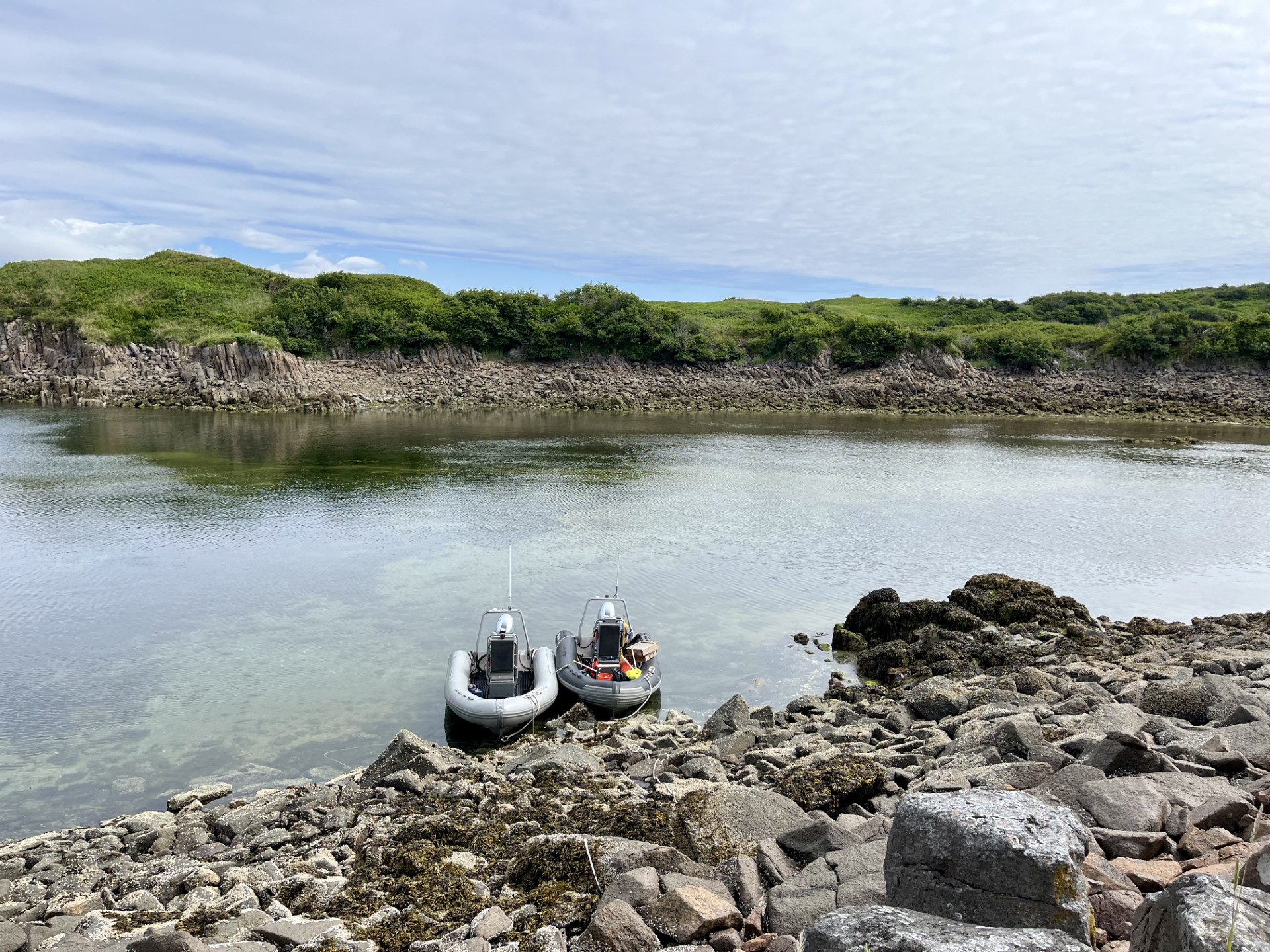
Waiting for passengers at Katmai National Park and Preserve
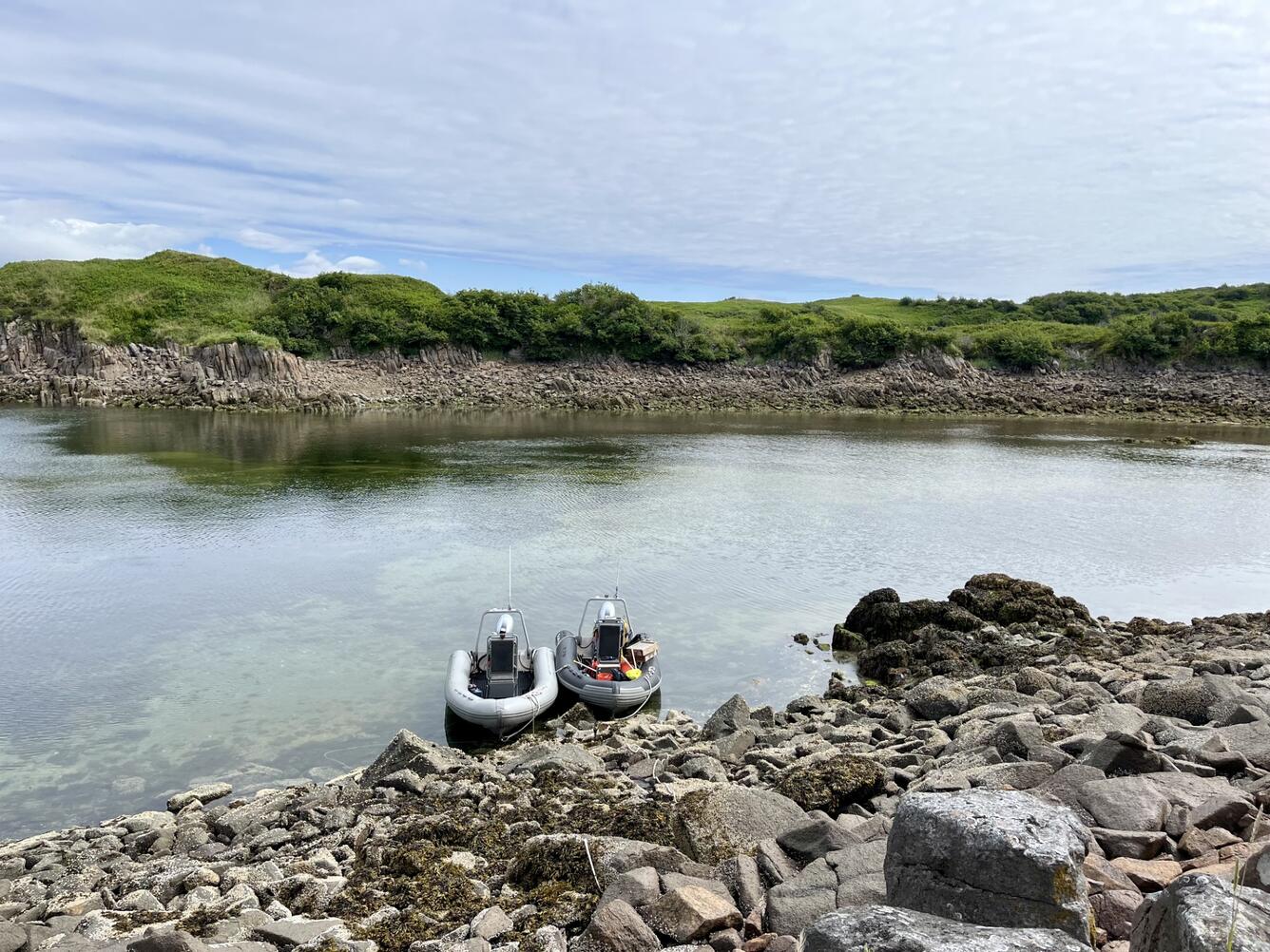
Detailed Description
Ridged hull inflatable skiffs are used by scientists to conduct rocky intertidal monitoring for the Nearshore Component of the Gulf Watch Alaska program. Data are collected to estimate percent cover and densities of intertidal invertebrates and algae to assess change in communities from sheltered rocky shorelines.
Sources/Usage
Public Domain.
Related
Nearshore Marine Ecosystem Research
Nearshore ecosystems include many resources that are of high ecological, recreational, subsistence, and economic value. They also are subject to influences from a wide variety of natural and human-caused perturbations, which can originate in terrestrial or oceanic environments. Our research is designed to evaluate sources of variation in the nearshore and how they influence resources of high...
Rocky Intertidal Data from Prince William Sound, Katmai National Park and Preserve, and Kenai Fjords National Park Rocky Intertidal Data from Prince William Sound, Katmai National Park and Preserve, and Kenai Fjords National Park
This data package includes four (4) child items with data from the Gulf Watch Alaska (GWA) long-term monitoring program (nearshore monitoring component) rocky intertidal study. Child Item One: "Rocky Intertidal Sea Star Size, Count, and Disease Data from Prince William Sound, Katmai National Park and Preserve, and Kenai Fjords National Park". The data include: (1) size and disease state...
Intertidal Temperature Data from Kachemak Bay, Prince William Sound, Katmai National Park and Preserve, and Kenai Fjords National Park Intertidal Temperature Data from Kachemak Bay, Prince William Sound, Katmai National Park and Preserve, and Kenai Fjords National Park
These data are part of the Gulf Watch Alaska (GWA) long-term monitoring program. This dataset consists of date, time, and temperature measurements from intertidal rocky sampling sites, including predicted tide height at the time of the reading, which is used to distinguish air from water temperature readings. The data are provided as comma separated values (.csv) files derived from data...
Evidence of increased mussel abundance related to the Pacific marine heatwave and sea star wasting Evidence of increased mussel abundance related to the Pacific marine heatwave and sea star wasting
Mussels occupy a key middle trophic position in nearshore food webs linking primary producers to predators. Climate-related environmental changes may synergistically combine with changes in predator abundance to affect intertidal ecosystems. We examined the influence of two major events on mussel (Mytilus trossulus) abundance in the northern Gulf of Alaska: the recent Pacific marine...
Authors
Sarah Beth Traiger, James L. Bodkin, Heather Coletti, Brenda Ballachey, Dean Thomas, Daniel Esler, Katrin Iken, Brenda Konar, Mandy Lindeberg, Daniel Monson, Brian H. Robinson, Robert M. Suryan, Ben Weitzman
Sea star wasting disease pathology in Pisaster ochraceus shows a basal-to-surface process affecting color phenotypes differently Sea star wasting disease pathology in Pisaster ochraceus shows a basal-to-surface process affecting color phenotypes differently
Sea star wasting disease (SSWD) refers to a suite of poorly described non-specific clinical signs including abnormal posture, epidermal ulceration, and limb autotomy (sloughing) causing mortalities of over 20 species of sea stars and subsequent ecological shifts throughout the northeastern Pacific. While SSWD is widely assumed to be infectious, with environmental conditions facilitating...
Authors
Thierry M. Work, Tina M. Weatherby, Christopher M. DeRito, Ryan M. Besemer, Ian Hewson
Related
Nearshore Marine Ecosystem Research
Nearshore ecosystems include many resources that are of high ecological, recreational, subsistence, and economic value. They also are subject to influences from a wide variety of natural and human-caused perturbations, which can originate in terrestrial or oceanic environments. Our research is designed to evaluate sources of variation in the nearshore and how they influence resources of high...
Rocky Intertidal Data from Prince William Sound, Katmai National Park and Preserve, and Kenai Fjords National Park Rocky Intertidal Data from Prince William Sound, Katmai National Park and Preserve, and Kenai Fjords National Park
This data package includes four (4) child items with data from the Gulf Watch Alaska (GWA) long-term monitoring program (nearshore monitoring component) rocky intertidal study. Child Item One: "Rocky Intertidal Sea Star Size, Count, and Disease Data from Prince William Sound, Katmai National Park and Preserve, and Kenai Fjords National Park". The data include: (1) size and disease state...
Intertidal Temperature Data from Kachemak Bay, Prince William Sound, Katmai National Park and Preserve, and Kenai Fjords National Park Intertidal Temperature Data from Kachemak Bay, Prince William Sound, Katmai National Park and Preserve, and Kenai Fjords National Park
These data are part of the Gulf Watch Alaska (GWA) long-term monitoring program. This dataset consists of date, time, and temperature measurements from intertidal rocky sampling sites, including predicted tide height at the time of the reading, which is used to distinguish air from water temperature readings. The data are provided as comma separated values (.csv) files derived from data...
Evidence of increased mussel abundance related to the Pacific marine heatwave and sea star wasting Evidence of increased mussel abundance related to the Pacific marine heatwave and sea star wasting
Mussels occupy a key middle trophic position in nearshore food webs linking primary producers to predators. Climate-related environmental changes may synergistically combine with changes in predator abundance to affect intertidal ecosystems. We examined the influence of two major events on mussel (Mytilus trossulus) abundance in the northern Gulf of Alaska: the recent Pacific marine...
Authors
Sarah Beth Traiger, James L. Bodkin, Heather Coletti, Brenda Ballachey, Dean Thomas, Daniel Esler, Katrin Iken, Brenda Konar, Mandy Lindeberg, Daniel Monson, Brian H. Robinson, Robert M. Suryan, Ben Weitzman
Sea star wasting disease pathology in Pisaster ochraceus shows a basal-to-surface process affecting color phenotypes differently Sea star wasting disease pathology in Pisaster ochraceus shows a basal-to-surface process affecting color phenotypes differently
Sea star wasting disease (SSWD) refers to a suite of poorly described non-specific clinical signs including abnormal posture, epidermal ulceration, and limb autotomy (sloughing) causing mortalities of over 20 species of sea stars and subsequent ecological shifts throughout the northeastern Pacific. While SSWD is widely assumed to be infectious, with environmental conditions facilitating...
Authors
Thierry M. Work, Tina M. Weatherby, Christopher M. DeRito, Ryan M. Besemer, Ian Hewson