An official website of the United States government
Here's how you know
Official websites use .gov
A .gov website belongs to an official government organization in the United States.
Secure .gov websites use HTTPS
A lock () or https:// means you’ve safely connected to the .gov website. Share sensitive information only on official, secure websites.
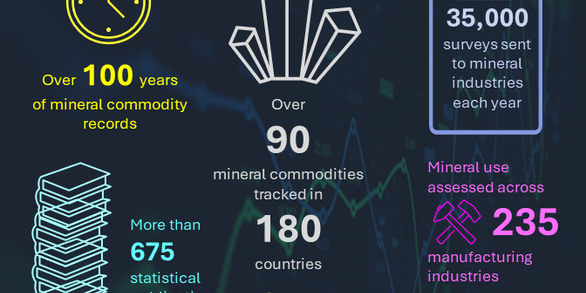
This report is the earliest Government publication to furnish estimates covering 2015 nonfuel mineral industry data. Data sheets contain information on the domestic industry structure, Government programs, tariffs, and 5-year salient statistics for more than 90 individual minerals and materials
The adequacy of mineral resources in light of population growth and rising standards of living has been a concern since the time of Malthus (1798), but many studies erroneously forecast impending peak production or exhaustion because they confuse reserves with “all there is”. Reserves are formally defined as a subset of resources, and even current and potential resources are only a small...
Authors
Lawrence D. Meinert, Gilpin Robinson, Nedal T. Nassar
Electric vehicles have been promoted to reduce greenhouse gas emissions and lessen U.S. dependence on petroleum for transportation. Growth in U.S. sales of electric vehicles has been hindered by technical difficulties and the high cost of the lithium-ion batteries used to power many electric vehicles (more than 50% of the vehicle cost). Groundbreaking has begun for a lithium-ion battery...
Authors
Donald W. Olson, Robert L. Virta, Mahbood Mahdavi, Elizabeth S. Sangine, Steven M. Fortier
Introduction The economic vitality and national security of the United States depend on the reliable supply of numerous nonfuel mineral commodities. Over the past six decades, many of these commodities have been sourced increasingly from outside the United States. The mix of commodities for which the United States is import dependent has changed as technologies have advanced, as...
Authors
Steven M. Fortier, DeYoung, Elizabeth S. Sangine, Emily K. Schnebele
Introduction Tantalum has a unique set of properties that make it useful in a number of diverse applications. The ability of the metal to store and release electrical energy makes it ideally suited for use in certain types of capacitors that are widely used in modern electronics. Approximately 60 percent of global tantalum consumption is in the electronics industry. The ductility and...
Lime is the common term for several chemicals in three major categories: quicklime, hydrated lime and refractory dead-burned dolomite. Lime is almost never found naturally. It is primarily manufactured by burning limestone in kilns, followed by hydration when necessary.
The U.S. Geological Survey (USGS) analyzes mineral and metal supply chains to identify and describe major components of material flows from ore extraction, through intermediate forms, to a final product. Supply chain analyses may be used to identify risks to the United States associated with the supply of critical and strategic minerals and metals and to provide greater supply chain...
The U.S. Geological Survey (USGS) provides information on the current use and flow of minerals and mineral-based materials in the U.S. and world economies. This Data Series report on “Historical Global Statistics for Mineral and Material Commodities” contains information on the production of selected commodities from 1990 to the most current year. The data may be used in the analysis of
Pumice is an extrusive igneous volcanic rock formed through the rapid cooling of air-pocketed lava, which results in a low-density, high-porosity rock. Fine-grained pumice, or pumicite, is defined as minute grains, flakes, threads or shards of volcanic glass, with a size finer than 4 millimeters.
Iodine is a bluish-black lustrous solid (violet-colored in its gaseous state) found primarily in seaweed, underground brines associated with petroleum deposits and caliche ore deposits.
Since 1995, domestic production of lead has increasingly shifted from primary mining and smelting to the recovery of lead-bearing scrap by the secondary lead industry, which accounted for 91 percent of U.S. lead production in 2012. Increasingly stringent environmental regulations for lead emissions in the United States have contributed to the closure of primary lead refineries and the