
An official website of the United States government
Here's how you know
Official websites use .gov
A .gov website belongs to an official government organization in the United States.
Secure .gov websites use HTTPS
A lock () or https:// means you’ve safely connected to the .gov website. Share sensitive information only on official, secure websites.
See a list of recent Hawaiian Volcano Observatory publications and data releases here.
Alternately, use the "Publications" and "Data & Tools" tabs below to explore recent Hawaiian Volcano Observatory publications and data releases. Many of these publications present summaries or data for recent eruptions of Kīlauea, including the 2008-2018 summit lava lake and 2018 lower East Rift Zone and summit collapse.
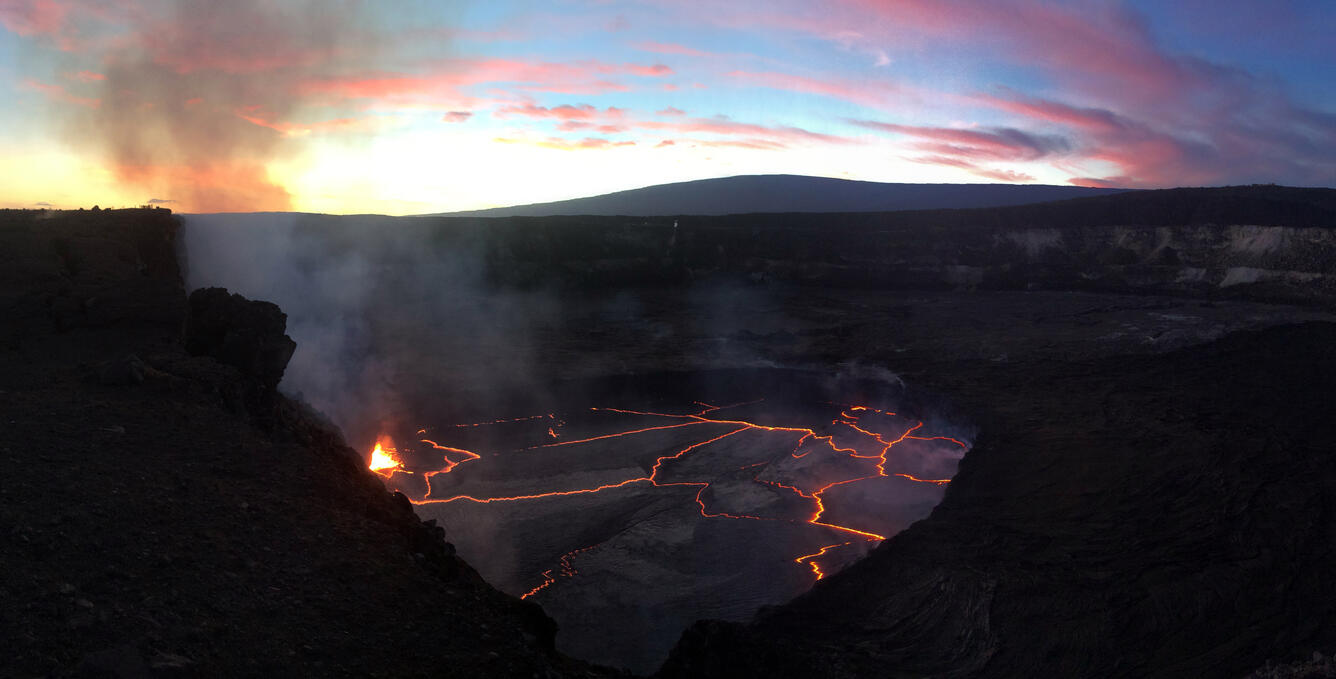
A clear evening provided good views of the lava lake within Halema‘uma‘u Crater at the summit of Kīlauea Volcano on November 26, 2016. Spattering was active along the south margin (left side) of the lava lake, with the gas plume drifting to the southwest (upper left). Mauna Loa, visible in the far distance towering above Kīlauea, provided a stunning backdrop to the lava lake as the sun was setting. HVO and Hawai‘i Volcanoes National Park's Jaggar Museum, perched on the rim of Kīlauea's summit caldera, can be seen on the skyline in the upper right part of the photo.
Strontium isotope ratios of historical Kilauea summit and rift lavas were analyzed by thermal ionization mass spectrometry (TIMS) at the Southwest Isotope Research Laboratories of the U.S. Geological Survey (USGS) in Denver. There were 151 analyses of 49 samples obtained from the field, the collections of the USGS Hawaiian Volcano Observatory (HVO), and the Smithsonian Institution. Data...
In early May 2018, activity at Kilauea volcano, Hawaii, increased, with heightened ash production from the summit commencing on May 17. Volcanic ash can scavenge volatile components from volcanic plumes, resulting in the deposition of potentially harmful elements during ash fallout. Leaching of these species (e.g., by rainfall or in water catchment systems) can have implications for...
Strontium isotope ratios of historical Kilauea summit and rift lavas were analyzed by thermal ionization mass spectrometry (TIMS) at the Southwest Isotope Research Laboratories of the U.S. Geological Survey (USGS) in Denver. There were 151 analyses of 49 samples obtained from the field, the collections of the USGS Hawaiian Volcano Observatory (HVO), and the Smithsonian Institution. Data...
In early May 2018, activity at Kilauea volcano, Hawaii, increased, with heightened ash production from the summit commencing on May 17. Volcanic ash can scavenge volatile components from volcanic plumes, resulting in the deposition of potentially harmful elements during ash fallout. Leaching of these species (e.g., by rainfall or in water catchment systems) can have implications for...