



RAD in the Wild: Black Ridge Canyons Wilderness
Learn more about a resist-accept-direct workshop focused on management decisions at Black Ridge Canyons Wilderness.
This case study is a product of the George Mason Fish and Wildlife Adaptation Internship Program with the National CASC.
Climate Impacts at Black Ridge Canyons Wilderness
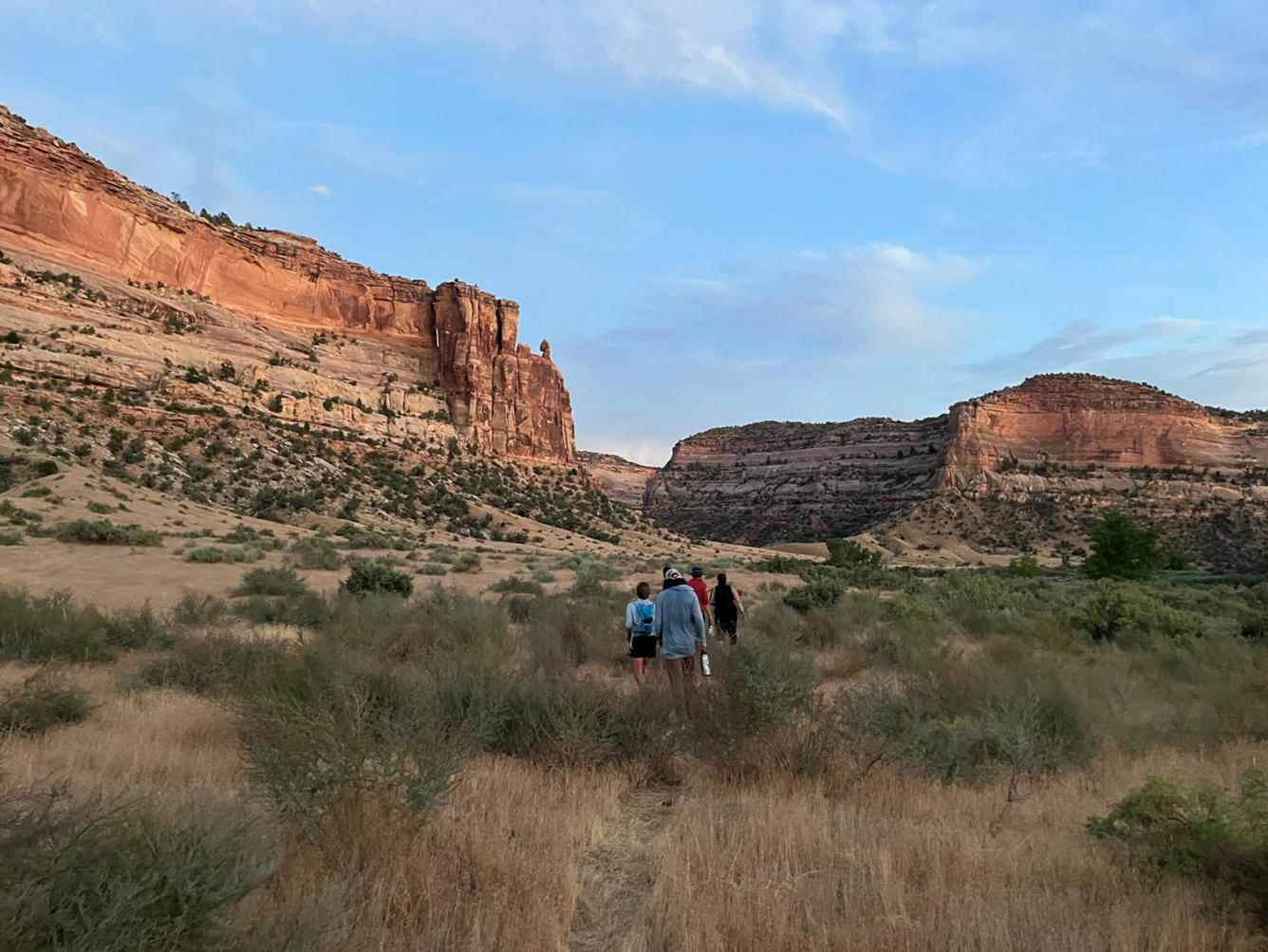
The Black Ridge Canyon Wilderness (BRCW), a federally designated Wilderness Area managed by the Bureau of Land Management (BLM), encompasses a vast area of semi-arid landscape within the Colorado Plateau Region. This ecosystem is characterized by expansive mesas incised by deep, narrow canyons. Upland desert plant communities are dominated by a mix of pinyon and juniper while canyon bottoms are defined by ephemeral streams and pools which support a high diversity of riparian plant and amphibian species.
In recent years, the BLM has been managing for changing environmental conditions throughout BRCW. The area’s ecosystems are increasingly challenged by rising temperatures, variable precipitation, and the spread of invasive species. Increasingly dry conditions are reducing stream flows that are critical for wildlife, including native canyon treefrogs, red-spotted toads, and bighorn sheep. More intense wildfires can further degrade these systems by removing vegetation, which accelerates erosion and causes sediment buildup that further limits water in stream systems. Water availability has become a central issue, with streamflow becoming less predictable. These conditions provide a pathway for invasive species such as the American bullfrog and cheatgrass to spread, outcompeting native species for already limited resources. These combined stressors threaten ecosystem stability and the natural character of the wilderness area.
Exploring the RAD Framework
To identify management objectives and assess the feasibility of potential management actions in response to changing conditions in BRCW, researchers from the U.S. Forest Service Aldo Leopold Wilderness Research Institute facilitated a 2-day workshop for BLM staff and BRCW stakeholders. The workshop was designed around the Resist-Accept-Direct (RAD) framework, which encourages stakeholders to assess the full decision space and discuss management pathways that otherwise may not be considered. Prior to the workshop, researchers convened a team of experts from the North Central Climate Adaptation Science Center, USGS, BLM, and Colorado Mesa University to develop future ecological scenarios for BRCW overall, as well as specifically for native amphibians within ephemeral stream systems. Researchers also interviewed BLM managers and partners to understand how they were experiencing changing environmental conditions. Conversations focused on observed climate impacts, current responses, and the barriers and opportunities shaping future climate adaptation. These discussions also created spaces for managers and partners to share local knowledge, compare experiences across jurisdictions, and identify common challenges. These interviews helped researchers understand diverse stakeholder perspectives, thus contributing towards a shared understanding of changing conditions within BRCW that were used to develop starting points for potential response strategies.
The workshop was structured around a set of core learning objectives designed to guide participants through applying the RAD framework. These objectives included developing actionable management pathways, evaluating trade-offs, and incorporating diverse perspectives. To meet these objectives, participants engaged in both concept building through large-group presentations and applied decision making through small group breakout sessions.
Through this format, participants were able to explore the applications of RAD for adaptive decision-making within wilderness areas. One of the main activities of the workshop was a future wheel exercise, a structured brainstorming tool that helps participants map the cascading effects of a management decision. This helped participants identify potential consequences and ripple effects of specific management actions, therefore improving their ability to make comprehensive decisions.

Through this exercise, participants developed various potential management pathways and associated actions, including in-depth analysis of future implications and trade-offs associated with specific actions to resist, accept, and direct the ecological transformation. In general, participants found that the resist and accept strategies were most desirable for addressing changes such as reduced stream flows and the spread of invasive species like the American bullfrog and cheatgrass. Resist actions focused on active management such as the removal of invasive bullfrogs. Accept strategies focused on learning more about the ecosystem as it changes, which participants felt would support future decisions to resist, accept, or direct change. Lastly, direct strategies included translocating native amphibians to other water sources outside the species’ current habitat. However, participants identified a few potentially negative and impactful ecological ramifications associated with these direct options, such as the potential for disease introduction to native species.
While long-term ecological outcomes still require ongoing monitoring, using the RAD framework helped managers to move from uncertainty toward a clearer understanding of climate-driven ecological transformation. With the information acquired from the RAD workshop, actionable management strategies were identified. This shift marked a transition from uncertainty to a more holistic, structured, and responsive approach to managing dynamic ecosystems.
Lessons Learned
- The RAD Framework worked well for structuring discussions and improving collaboration, leading to a more robust understanding of the decision space.
- The usage of the future wheel exercise highlighted the cascading implications of using resist, accept or direct strategies, and demonstrated that there is considerable uncertainty about the effectiveness of any single decision alternative as a long-term strategy.
- Some participants considered the same action differently within the RAD framework. For example, some participants may consider one management action as directing change whereas, others interpreted it as resisting change. While this does not change the action itself, such differences can delay the formulations of decisions. This may also lead to inconsistent application of the framework, underscoring the need for clearer communication and more effective training on the meaning and use of each strategy. Workshops like this one can promote agreement on how specific management actions fall within the RAD framework, thus enabling clearer communication among managers.
- Participants felt that accept actions were largely tenable as short-term solutions because accepting ecological change in the long-term wouldn’t allow managers to reach shared desired conditions and objectives, including maintaining the natural quality of wilderness.
- Although resist and direct actions detracted from the natural state of wilderness, participants felt that both would be necessary to maintain the area’s natural quality. Examples included short-term actions, such as removing invasive bullfrogs, and longer-term actions, such as translocating native frogs to areas expected to remain climatically suitable into the future.
- Before engaging in any active management which may degrade the natural state of wilderness, participants felt it was necessary to continue to engage in biological research to close knowledge gaps and identify ecological thresholds that would trigger the need to actively intervene.
Contributors
This case study was written by Alani Arnold, George Mason University Fish and Wildlife Adaptation Intern, with input from Jaclyn Rushing and Kira Hefty. It was developed under the guidance of Abigail Lynch and Jackson Valler with the USGS National Climate Adaptation Science Center.
For more information the BRCW RAD workshop, contact:
- Jaclyn Rushing (Jaclyn.Rushing@usda.gov)
- Kira Hefty (Kira.Hefty@usda.gov)