



Explore More RADish Profiles
Explore interviews with scientists and managers researching and implementing the resist-accept-direct (RAD) framework.
Dr. Nicole Ward
Field Supervisor of the Upper Mississippi River Restoration Program, Minnesota DNR
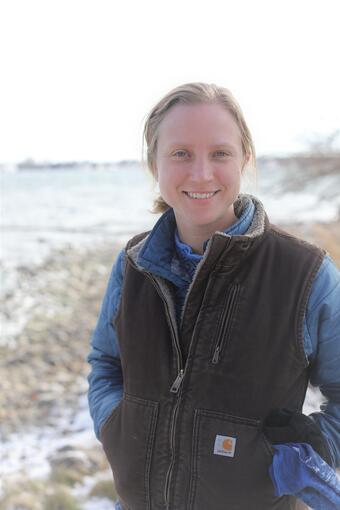
Nicole can trace her career path all the way back to her 7th-grade science fair project, where she tested how long it took to freeze zebra mussels, an invasive species that had recently infested the lake in her Minnesota hometown. Eventually, she became known as the “zebra mussel aficionada” at school and landed an internship with the Minnesota Department of Natural Resources (DNR) the summer after graduating high school.
Nicole went on to earn a PhD in Biological Sciences at Virginia Tech, followed by a Postdoc at the University of Wisconsin-Madison. Today, Nicole is back at the Minnesota DNR as a Field Supervisor of the Upper Mississippi Restoration Program. This role has been a full circle moment for Nicole, bringing her right back to the lakes and rivers that first inspired her journey.
Q: How long have you been a RADish?
I think it was early 2022. Abby Lynch from the NCASC gave a presentation about RAD to a big Minnesota DNR-wide audience.
I asked her a question about how we could think about RAD in really dynamic systems like rivers, and she felt like she couldn’t give me a solid answer, so we ended up chatting afterwards and… then writing a paper together about how we could think about RAD in river systems.
That is how it started. I just asked Abby a question.
Q: How important do you think cross-organization partnerships are for RAD?
When thinking about RAD at larger scales, beyond a specific confined habitat area, cross-organizational work is great because some management agencies have different objectives or priorities, reasons that they exist in various ways, which can make them more predisposed to resisting versus directing, as an example.
But, cross-organizational collaboration could be a way to diversify efforts across the landscape, especially when there's so much uncertainty in the future, as we're not sure that any particular method will work in a certain way over the long term.
The other point is that, if you're in a brainstorming session where you're trying to come up with different resist and direct approaches, having diverse perspectives goes a long way. One way to add diversity is by involving people from different agencies who bring their own thinking styles and priorities, which can ultimately boost creativity. Through conversation and sharing different viewpoints, you can help others and even yourself see things through a different lens.
Q: What are some of the biggest challenges you’ve seen managers face when choosing between resisting, accepting, or directing change?
I see bigger challenges, not necessarily in making choices [between resist, accept, and direct], but in getting a group to really think outside the box. Some folks who have worked in a particular system for so long become very used to a certain way of doing things. But there are shifting baselines, and a lot of times I’m not sure people, myself included, are cognizant of how ecosystems are changing because we’re living in the middle of it.
Growing up in Minnesota, there was never wildfire smoke. Now, our entire summer has been full of it, just like last summer, and people already seem to be getting used to it.
People grapple with the fact that we can’t rely on what we’ve done, measured, or observed in the past because these changes aren’t linear, and their magnitude is only amplifying.
Q: In one sentence (or as close as you can get), how would you explain RAD to someone outside of science?
I like this challenge. The simplest way I’d put it is: RAD is about making sure you consider all the options when you’re faced with change.
When faced with change, it’s pretty intuitive for people to either resist or accept change, but directing is about being an active agent toward shaping a new future.
Explore interviews with scientists and managers researching and implementing the resist-accept-direct (RAD) framework.
Dr. Nicole Ward
Field Supervisor of the Upper Mississippi River Restoration Program, Minnesota DNR
Nicole can trace her career path all the way back to her 7th-grade science fair project, where she tested how long it took to freeze zebra mussels, an invasive species that had recently infested the lake in her Minnesota hometown. Eventually, she became known as the “zebra mussel aficionada” at school and landed an internship with the Minnesota Department of Natural Resources (DNR) the summer after graduating high school.
Nicole went on to earn a PhD in Biological Sciences at Virginia Tech, followed by a Postdoc at the University of Wisconsin-Madison. Today, Nicole is back at the Minnesota DNR as a Field Supervisor of the Upper Mississippi Restoration Program. This role has been a full circle moment for Nicole, bringing her right back to the lakes and rivers that first inspired her journey.
Q: How long have you been a RADish?
I think it was early 2022. Abby Lynch from the NCASC gave a presentation about RAD to a big Minnesota DNR-wide audience.
I asked her a question about how we could think about RAD in really dynamic systems like rivers, and she felt like she couldn’t give me a solid answer, so we ended up chatting afterwards and… then writing a paper together about how we could think about RAD in river systems.
That is how it started. I just asked Abby a question.
Q: How important do you think cross-organization partnerships are for RAD?
When thinking about RAD at larger scales, beyond a specific confined habitat area, cross-organizational work is great because some management agencies have different objectives or priorities, reasons that they exist in various ways, which can make them more predisposed to resisting versus directing, as an example.
But, cross-organizational collaboration could be a way to diversify efforts across the landscape, especially when there's so much uncertainty in the future, as we're not sure that any particular method will work in a certain way over the long term.
The other point is that, if you're in a brainstorming session where you're trying to come up with different resist and direct approaches, having diverse perspectives goes a long way. One way to add diversity is by involving people from different agencies who bring their own thinking styles and priorities, which can ultimately boost creativity. Through conversation and sharing different viewpoints, you can help others and even yourself see things through a different lens.
Q: What are some of the biggest challenges you’ve seen managers face when choosing between resisting, accepting, or directing change?
I see bigger challenges, not necessarily in making choices [between resist, accept, and direct], but in getting a group to really think outside the box. Some folks who have worked in a particular system for so long become very used to a certain way of doing things. But there are shifting baselines, and a lot of times I’m not sure people, myself included, are cognizant of how ecosystems are changing because we’re living in the middle of it.
Growing up in Minnesota, there was never wildfire smoke. Now, our entire summer has been full of it, just like last summer, and people already seem to be getting used to it.
People grapple with the fact that we can’t rely on what we’ve done, measured, or observed in the past because these changes aren’t linear, and their magnitude is only amplifying.
Q: In one sentence (or as close as you can get), how would you explain RAD to someone outside of science?
I like this challenge. The simplest way I’d put it is: RAD is about making sure you consider all the options when you’re faced with change.
When faced with change, it’s pretty intuitive for people to either resist or accept change, but directing is about being an active agent toward shaping a new future.