



A previously undocumented process of hydrothermal manganese mineralization
A new study led by USGS focusing on samples from American Samoa finds that manganese-rich deposits formed beneath the seafloor by warm fluids replacing ancient carbonate sediments.
A new study led by USGS describes a previously undocumented style of hydrothermal manganese-oxide mineralization on the seabed near American Samoa, offering new insight into how seafloor mineral occurrences can form and how widespread similar deposits may be around the world.
The study examined 24 dredge samples collected from three sites along the Samoan volcanic chain in the South Pacific. In many of these samples, researchers found evidence that hot, mineral-rich fluids moved upward through seafloor sediments, progressively replacing the original material with thick layers of manganese-oxide minerals.
Hydrothermal systems occur where heated fluids circulate through Earth's crust and return to the seafloor, carrying dissolved metals and other elements. When those fluids encounter cooler surroundings, minerals can precipitate and accumulate.
Manganese oxides are common components of seafloor mineral occurrences, but the new study documents something researchers had not previously observed: hydrothermal manganese oxides replacing sediment made up of foraminiferal carbonate. Foraminifera are microscopic marine organisms whose shells are commonly composed of calcium carbonate and can accumulate on the seafloor after the organisms die.
From carbonate sediment to manganese-rich occurrences
The researchers divided the samples into two broad groups. Six samples retained some of their original carbonate and volcanic sediment and were classified as “low manganese.” The other 18 samples were strongly altered, with much of the original sediment replaced by manganese-rich minerals.
The highly altered samples contained an average of 51% manganese by weight, making them exceptionally manganese-rich.
Chemical analyses provided strong evidence that the occurrences formed from hydrothermal fluids rather than through a more gradual process in which iron and manganese minerals precipitate directly from cold seawater.
In particular, the samples had elevated lithium, high manganese and low iron concentrations—a combination that distinguishes the occurrences from hydrogenetic iron-manganese crusts, which form slowly from seawater on the seafloor.
Thick mineralized layers and unusual structures
The manganese-oxide occurrences also have striking physical characteristics.
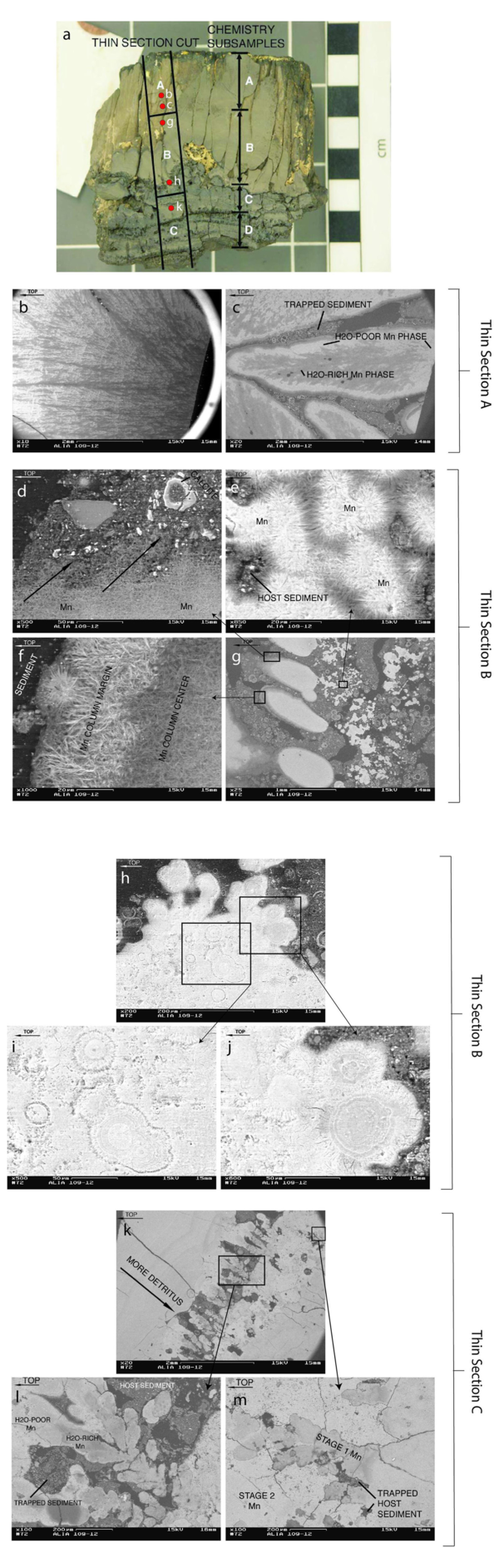
Mineralized layers reach up to 90 millimeters—about 3.5 inches—thick. In some locations, the deposits form column-like structures as long as 44 millimeters and about 10 millimeters wide.
The deposits are composed mainly of birnessite and 10-angstrom phyllomanganate minerals, two types of manganese-rich minerals commonly associated with manganese oxide formation.
Textures preserved in the samples provide clues about how the occurrences formed. Rather than accumulating solely at the seafloor, the minerals appear to have formed beneath the seabed, where warm fluids moved upward through the sediment.
The researchers found evidence for multiple pulses of hydrothermal activity, suggesting that the manganese mineralization developed over repeated episodes rather than during a single event.
A potentially widespread phenomenon
The discovery is significant because it may represent a previously overlooked pathway for forming manganese-rich mineral occurrences.
The three study sites are widely distributed along the Samoan volcanic chain, yet they share distinctive chemical and textural characteristics. That geographic distribution suggests that carbonate sediment-hosted hydrothermal manganese mineralization may occur more broadly than previously recognized.
“These deposits provide a new example of how hydrothermal fluids can transform seafloor sediments and concentrate minerals and metals, including manganese, beneath the seabed,” said USGS Research Geologist Amy Gartman, co-author of the study.
The results could also have implications for characterizing global seabed mineral resources. Manganese and other metals concentrated by hydrothermal processes are of scientific and economic interest, and understanding how and where such occurrences form is an important step toward assessing their distribution.
The researchers emphasize that much remains to be learned about this newly recognized process of mineralization. Further studies in other volcanic and hydrothermal regions could determine whether similar occurrences occur elsewhere in the world's oceans. The discovery in American Samoa suggests that hydrothermal systems may support more diverse and previously unrecognized pathways for concentrating minerals.
Related

Global Seabed Mineral Resources
Related