



The Tennessee Cooperative Fishery Research Unit (est. 1972) is a partnership among the Tennessee Wildlife Resources Agency, Tennessee Technological University, the U.S. Geological Survey, and the U.S. Fish and Wildlife Service.
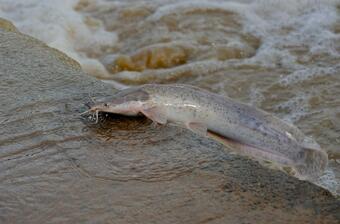
The Tennessee Unit resides at Tennessee Tech University in Cookeville between the Tennessee River and Cumberland River. Tennessee is home to one of the most diverse freshwater fish and mussel communities in the world, including numerous imperiled species. The Tennessee and Cumberland river systems have more than 30 impoundments ranging from coldwater, oligotrophic systems to warmwater, eutrophic systems, each with important sport fisheries. In addition, many impoundments also support popular coldwater tailwater fisheries. Tennessee also has thousands of miles of free-flowing streams and small rivers. With this overwhelming diversity of aquatic fauna and resources in Tennessee, the Unit does not lack for research topics.
Graduate students in the Tennessee Cooperative Fishery Research Unit (TN CFRU) earn either a Master of Science degree in the Department of Biology or a PhD in Environmental Science. Annual stipends for research assistantships are competitive; all tuition and fees are waived. All graduate students must conduct research in addition to completing course work chosen in consultation with an advisory committee. All students in the TN CFRU are supported by research assistantships. Most students assist each other on their projects, thus increasing their research experience and opportunities. All students must deliver at least one seminar at the completion of their research, as well as complete a written thesis and successfully defend it in front of their advisory committee. Students frequently help write a technical final report to fulfill the requirements of the contracts that funded their research. Students usually are expected to give at least one talk about their research at a professional meeting. All students are encouraged to participate in professional societies and university functions.
As part of our mission, Tennessee Unit scientists provide technical assistance ranging from data analysis support, literature reviews, reviewing reports and proposals, and consultations on a variety of natural resource issues affecting citizens of Tennessee and throughout North America.
The Tennessee Cooperative Fishery Research Unit (est. 1972) is a partnership among the Tennessee Wildlife Resources Agency, Tennessee Technological University, the U.S. Geological Survey, and the U.S. Fish and Wildlife Service.
The Tennessee Unit resides at Tennessee Tech University in Cookeville between the Tennessee River and Cumberland River. Tennessee is home to one of the most diverse freshwater fish and mussel communities in the world, including numerous imperiled species. The Tennessee and Cumberland river systems have more than 30 impoundments ranging from coldwater, oligotrophic systems to warmwater, eutrophic systems, each with important sport fisheries. In addition, many impoundments also support popular coldwater tailwater fisheries. Tennessee also has thousands of miles of free-flowing streams and small rivers. With this overwhelming diversity of aquatic fauna and resources in Tennessee, the Unit does not lack for research topics.
Graduate students in the Tennessee Cooperative Fishery Research Unit (TN CFRU) earn either a Master of Science degree in the Department of Biology or a PhD in Environmental Science. Annual stipends for research assistantships are competitive; all tuition and fees are waived. All graduate students must conduct research in addition to completing course work chosen in consultation with an advisory committee. All students in the TN CFRU are supported by research assistantships. Most students assist each other on their projects, thus increasing their research experience and opportunities. All students must deliver at least one seminar at the completion of their research, as well as complete a written thesis and successfully defend it in front of their advisory committee. Students frequently help write a technical final report to fulfill the requirements of the contracts that funded their research. Students usually are expected to give at least one talk about their research at a professional meeting. All students are encouraged to participate in professional societies and university functions.
As part of our mission, Tennessee Unit scientists provide technical assistance ranging from data analysis support, literature reviews, reviewing reports and proposals, and consultations on a variety of natural resource issues affecting citizens of Tennessee and throughout North America.