



The USGS earthquake Sequence Product aims to identify and describe earthquakes that are clustered in space and time as “sequences.” Its overarching goal is to provide simple contextual information regarding the spatial and temporal interconnection of earthquakes.
Overview
The USGS earthquake Sequence Product groups and displays earthquakes that are closely related in space and time. This helps scientists and the public understand how earthquakes are connected and how they unfold. By looking at these sequences, users can see patterns like where aftershocks occur, how strong they are, and how often they happen. This provides insight into earthquake source physics and post-earthquake deformation and response.
Scientific Background
Earthquakes happen all over the world with hundreds being cataloged every day by the USGS Advanced National Seismic System! Most earthquakes are too small or happen far away, like under the ocean, to feel. The smallest earthquakes people typically begin to feel are about magnitude (M) 2.5, with the felt area being relatively small (hundreds of square kms) and damage rarely occurring. Moderate magnitude earthquakes can shake larger areas and sometimes cause destruction. Only rarely do large M greater than 7, destructive earthquakes occur. For example, between 2015 and 2025, scientists recorded about:
1600 M5-M5.9 per year
110 M6-M6.9 per year
13 M7-M7.9 per year
0.7 M8-M8.9 per year (less than one per year).
Earthquakes usually don’t happen alone but instead occur in clusters of space and time called sequences. Scientists talk about two main types of sequences:
Mainshock-Aftershock Sequences:
- These start with the biggest earthquake (the mainshock), followed by smaller earthquakes called aftershocks.
- Sometimes smaller earthquakes happen before the mainshock. These are called foreshocks.
- Aftershocks happen because the mainshock changes stress in the Earth, which can trigger more earthquakes nearby.
- Bigger mainshocks usually cause more aftershocks over a larger area and for a longer time.
- Example: The 2004 Sumatra earthquake (M9.1) caused aftershocks across an area about the size of California!
Swarm Sequences:
- Swarms are clusters of earthquakes without one clear mainshock.
- The biggest earthquake in a swarm often occurs later in the sequence rather than at the beginning.
- Swarms are thought to have an additional “ingredient” that promotes earthquake activity, such as the movement of fluids or magma, or slow fault slip.
- Swarm intensity (earthquake rate or magnitude) may fluctuate based on this "ingredient”, causing the sequence to evolve differently than a typical mainshock-aftershock sequence.
- Example: Yellowstone National Park often experiences earthquake swarms!
Scientists have studied the behavior of earthquakes using earthquake catalogs for a long time and have devised a few simple rules that, on average, describe earthquake behavior in sequences. Still, there is a significant variability in the evolution of each earthquake sequence, and nature can always surprise us.
How the USGS Identifies Sequences for the Sequence Product
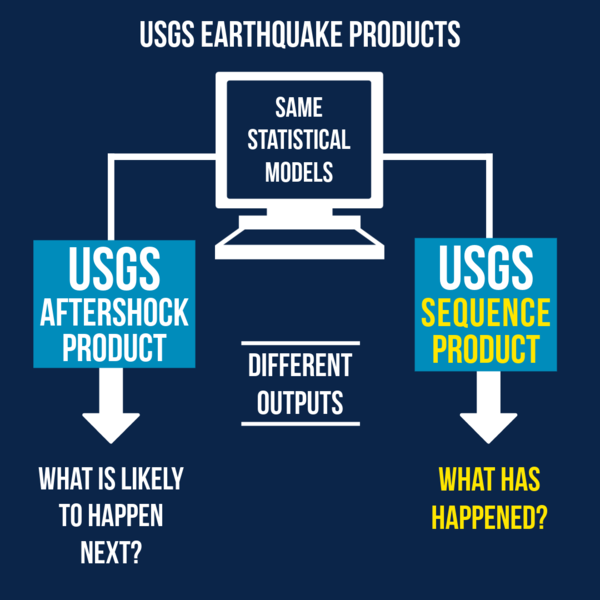
The USGS automatically classifies earthquakes as being part of a sequence by leveraging the same statistical models used by the USGS Aftershock Forecast Product. This ensures that the earthquakes displayed as part of a sequence are the same ones used as input for our Aftershock Forecasts. The Sequence Product differs from the Aftershock Forecast product in that it shows what has happened or is happening in an earthquake sequence, while the Aftershock Forecast predicts what is likely to happen next (Figure 1). Both of these products use the same rules for space and time: the spatial extent is based on the magnitude of the mainshock and the locations of both the mainshock and aftershocks, and the temporal extent is usually one year from when the mainshock happened. See the Aftershock Forecast overview page for details on the automatic triggering criteria for domestic sequences. International Aftershock Forecasts and Sequence Products are occasionally posted, specifically for significant international earthquakes that require an international humanitarian response.
Currently, earthquake sequences are identified by a blue banner on the mainshock's event page (Figure 2). This banner links to a map where all earthquakes, foreshocks, and aftershocks can be viewed. The USGS Sequence Product currently showcases aftershock-mainshock sequences and occasional swarms for which forecasts are made. Click here to view all USGS Sequence Product mainshocks.

The USGS earthquake Sequence Product aims to identify and describe earthquakes that are clustered in space and time as “sequences.” Its overarching goal is to provide simple contextual information regarding the spatial and temporal interconnection of earthquakes.
Overview
The USGS earthquake Sequence Product groups and displays earthquakes that are closely related in space and time. This helps scientists and the public understand how earthquakes are connected and how they unfold. By looking at these sequences, users can see patterns like where aftershocks occur, how strong they are, and how often they happen. This provides insight into earthquake source physics and post-earthquake deformation and response.
Scientific Background
Earthquakes happen all over the world with hundreds being cataloged every day by the USGS Advanced National Seismic System! Most earthquakes are too small or happen far away, like under the ocean, to feel. The smallest earthquakes people typically begin to feel are about magnitude (M) 2.5, with the felt area being relatively small (hundreds of square kms) and damage rarely occurring. Moderate magnitude earthquakes can shake larger areas and sometimes cause destruction. Only rarely do large M greater than 7, destructive earthquakes occur. For example, between 2015 and 2025, scientists recorded about:
1600 M5-M5.9 per year
110 M6-M6.9 per year
13 M7-M7.9 per year
0.7 M8-M8.9 per year (less than one per year).
Earthquakes usually don’t happen alone but instead occur in clusters of space and time called sequences. Scientists talk about two main types of sequences:
Mainshock-Aftershock Sequences:
- These start with the biggest earthquake (the mainshock), followed by smaller earthquakes called aftershocks.
- Sometimes smaller earthquakes happen before the mainshock. These are called foreshocks.
- Aftershocks happen because the mainshock changes stress in the Earth, which can trigger more earthquakes nearby.
- Bigger mainshocks usually cause more aftershocks over a larger area and for a longer time.
- Example: The 2004 Sumatra earthquake (M9.1) caused aftershocks across an area about the size of California!
Swarm Sequences:
- Swarms are clusters of earthquakes without one clear mainshock.
- The biggest earthquake in a swarm often occurs later in the sequence rather than at the beginning.
- Swarms are thought to have an additional “ingredient” that promotes earthquake activity, such as the movement of fluids or magma, or slow fault slip.
- Swarm intensity (earthquake rate or magnitude) may fluctuate based on this "ingredient”, causing the sequence to evolve differently than a typical mainshock-aftershock sequence.
- Example: Yellowstone National Park often experiences earthquake swarms!
Scientists have studied the behavior of earthquakes using earthquake catalogs for a long time and have devised a few simple rules that, on average, describe earthquake behavior in sequences. Still, there is a significant variability in the evolution of each earthquake sequence, and nature can always surprise us.
How the USGS Identifies Sequences for the Sequence Product
The USGS automatically classifies earthquakes as being part of a sequence by leveraging the same statistical models used by the USGS Aftershock Forecast Product. This ensures that the earthquakes displayed as part of a sequence are the same ones used as input for our Aftershock Forecasts. The Sequence Product differs from the Aftershock Forecast product in that it shows what has happened or is happening in an earthquake sequence, while the Aftershock Forecast predicts what is likely to happen next (Figure 1). Both of these products use the same rules for space and time: the spatial extent is based on the magnitude of the mainshock and the locations of both the mainshock and aftershocks, and the temporal extent is usually one year from when the mainshock happened. See the Aftershock Forecast overview page for details on the automatic triggering criteria for domestic sequences. International Aftershock Forecasts and Sequence Products are occasionally posted, specifically for significant international earthquakes that require an international humanitarian response.
Currently, earthquake sequences are identified by a blue banner on the mainshock's event page (Figure 2). This banner links to a map where all earthquakes, foreshocks, and aftershocks can be viewed. The USGS Sequence Product currently showcases aftershock-mainshock sequences and occasional swarms for which forecasts are made. Click here to view all USGS Sequence Product mainshocks.