



ScienceBase Updates - Winter 2026
Winter 2026 topics include news on the ScienceBase modernization project including tips on how to prepare, and a featured data release.
Table of Contents
ScienceBase Modernization Project
The Science, Synthesis, Analysis, and Research Program’s Science Data Management (SDM) branch within Core Science Systems is modernizing ScienceBase to create a more flexible, modernized tech stack with less dependence on custom code. The final product will be a more streamlined, sustainable, and interoperable platform for data release.
The updated system will use Globus services for user authentication, indexing, file transfer, and access to data storage. A lightweight frontend and application programming interface (API) endpoints are being developed using FastAPI, a widely used framework that will provide faster delivery and easier integration with other systems.
We’re merging the ScienceBase Data Release (SBDR) Tool and the United States Geological Survey (USGS) Science Data Catalog (SDC) into a single portal for USGS data release search and discovery. We're calling this combined application the USGS Science Data Portal. It's being built within the SDC website and deployment pipeline.
The consolidation is enabled by our new, shared data model. The model is built using Pydantic, a Python library that defines consistent data structures and validation. It will help ensure data integrity and provide a sustainable foundation for future development. A provisional release is currently available on GitHub.
Within the combined search index of SBDR and SDC, users will be able to find:
- Landing pages for ScienceBase data releases – providing access to both data and metadata
- Landing pages for SDC metadata records – pointing to repositories external to ScienceBase
Data authors will be able to log in to the Science Data Portal and create a new data release within the application, using a more streamlined workflow and user interface.
ScienceBase and the data release process will remain largely unchanged through fiscal year (FY) 2026. Although users won’t see changes this fiscal year, planning ahead will help ensure a smooth transition.
The SDM team is currently testing migration of existing data releases to our development environment and plan to perform a final migration of existing data releases to our production environment in the 4th quarter of FY26. Based on our current timeline, users will be able to create new data releases in the Science Data Portal at the end of FY26 or the 1st quarter of FY27.
We’re working with the Globus Team on the new API. It’s still in development and will likely be ready for testing in the 3rd quarter of FY26. The current API will remain operational through FY26. We anticipate deprecation starting in calendar year 2027. With this timeline, we recommend that users begin testing and converting scripts to the new API during FY26, if possible.
What will stay the same? What will change?
The SBDR Team
We’re still available and will continue to provide the same level of support to data authors and data managers. You can contact us at sciencebase_datarelease@usgs.gov.
The functions of the SBDR Tool
Users will still be able to fill out and submit a form to create a landing page and reserve a digital object identifier (DOI) in one step.
API accessibility
The new system will have an API that allows users to perform create, read, update, and delete operations. We also plan to create Python and R packages to support programmatic interactions. These will be analogous to the sciencebasepy and sbtools libraries that are currently used with ScienceBase. Due to changes in the data model, however, existing scripts will need to be updated.
XML metadata parsing
Data authors will still be able to build their landing pages by uploading XML metadata files and automatically parsing the content.
Revisions
Users will be able to revise their published data releases. The general revision process will be similar to the current one and will allow data authors to comply with all relevant USGS data policies.
Publishing to S3
There will still be an option to copy data files to S3 and generate URLs for use in programmatic workflows. The option will be analogous to the ‘publish to S3’ feature currently in ScienceBase. Although this feature may not be available in the first version of the new system, it will be added in later as an advanced feature.
The following are changes that will affect workflows. Here’s what you need to know:
The data model
The Science Data Portal will use a new Pydantic data model that consolidates the SDC and SBDR data models. It enables interoperability with the USGS Asset Identifier Service (AIS), the People Picker (a directory application for USGS authors and contributors), and uses DCAT vocabulary whenever possible (DCAT is the standard used by metadata catalogs such as data.gov). There will also be a new API and corresponding Python and R libraries for programmatically interacting with the new system.
- Recommendation: if you use programmatic workflows to interact with ScienceBase, plan to update them to fit the new data model and API. Once the new API is available (likely in the 3rd quarter of FY26), the ScienceBase team will be able to provide specific guidance and examples for translating scripts and workflows.
Syncing landing page content with XML
In the new system, landing page content and XML metadata file content will stay in sync. This is a change from the current system, where they can be edited separately. In the future, users will make changes only by editing and re-uploading their XML metadata. Another change is that all landing pages, including those with child items, will require an uploaded XML metadata file.
- Recommendation: for new data releases, keep landing pages and XML metadata file content in sync. Please include an XML file on all top-level landing pages.
ScienceBase identifiers
Digital Object Identifiers (DOIs) for data releases in ScienceBase are persistent links, and we will reroute all DOIs to landing pages in the new system. However, ScienceBase IDs will be replaced with new identifiers. Please note that ScienceBase IDs are currently included in ScienceBase URLs (e.g., the alphanumeric string at the end of https://www.sciencebase.gov/catalog/item/693877efd4be02077d5296bf.
- Recommendation: use DOIs instead of ScienceBase URLs to reference data releases.
Geospatial services
The new system won't support the creation of new geospatial services but will allow existing service URLs to be displayed on landing pages. ArcGIS REST services currently published via ArcGIS Online (AGOL) will persist. Services hosted on the ScienceBase instance of Geoserver, however, will not persist (Geoserver services are the OGC WMS/WFS services that can be automatically generated from shapefiles and rasters in ScienceBase).
- Recommendation: if you’d like to retain Geoserver services, we recommend recreating them in AGOL to generate more persistent service links.
Child item hierarchy
The new system will support only one level of child items. The two supported structures are:
- a single-level landing page
- a top-level landing page with a single level of child items
Existing data releases in ScienceBase that have deeply nested structures will be reorganized to align with one of these structures. The ScienceBase team will work with points of contact for these existing data releases to make sure they fit the new system.
- Recommendation: for new data releases, please limit the hierarchy to one level of child items.
Dynamic and provisional data releases
In the current dynamic data release process, described here, data authors use scripts to automatically update their data releases in ScienceBase. Due to changes in the data model and API, existing scripts for dynamic data releases will need to be updated to fit the new system.
Provisional data releases will be supported in the new system, but the details are still being worked out. We’ll provide additional guidance on the provisional release process in advance of the new version of ScienceBase.
- Recommendation: Don’t start new dynamic data releases in the current version of ScienceBase.
Project pages
Some ScienceBase data releases are grouped under project pages within ScienceBase Communities. These project pages (container folders) won’t be migrated. An alternative to ScienceBase project pages could be Drupal project pages in the USGS website (example). The USGS website automatically harvests information about data releases from their DOI metadata, which won't be affected by the migration. USGS employees who have completed the Drupal content management system training, or those working in collaboration with their science center’s content manager, can compile a list of specific data releases to display on a project page.
- Recommendation: create project pages on the USGS Drupal website instead of ScienceBase Communities to display collections of data releases by project.
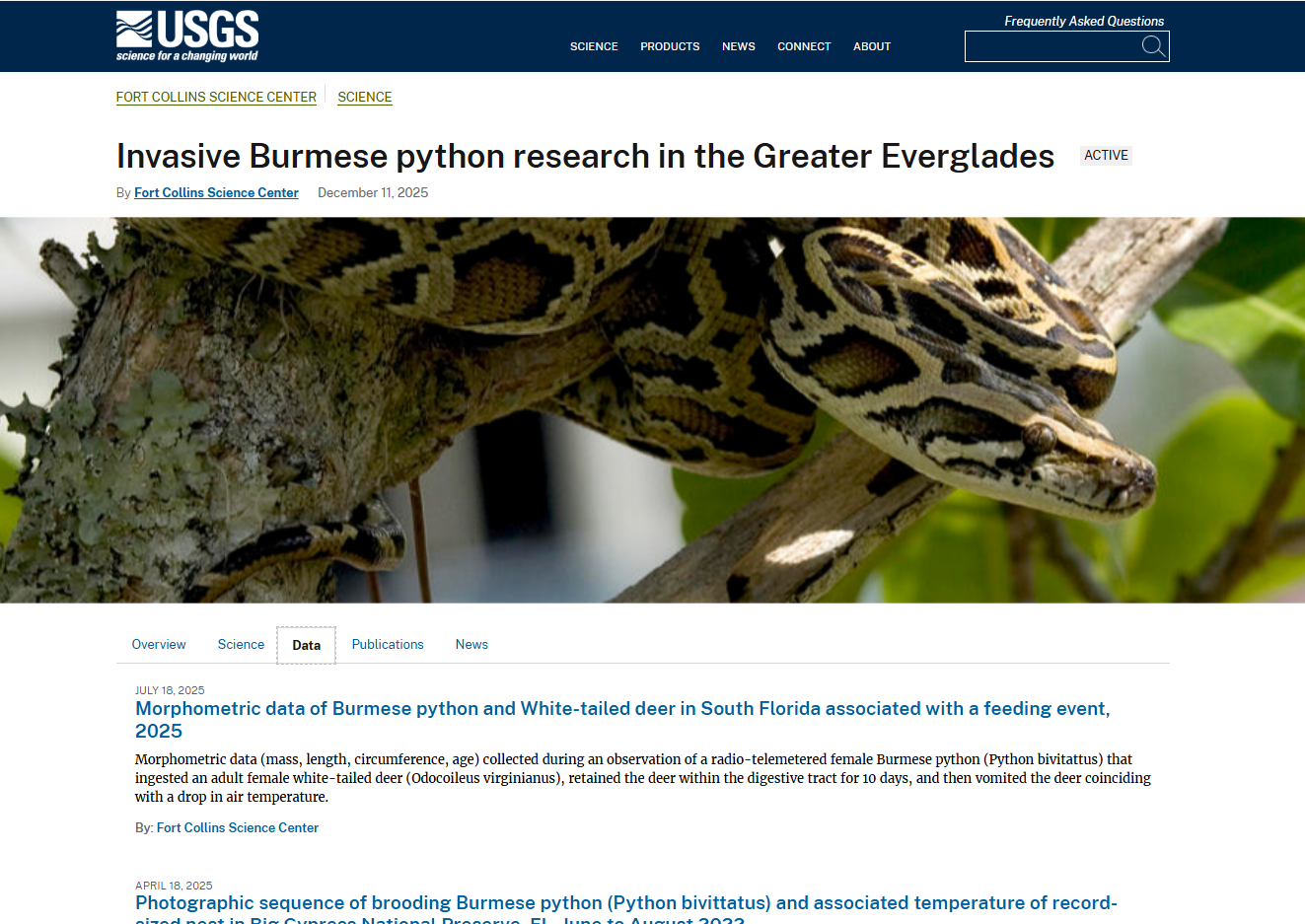
Screenshot of the Invasive Burmese python research in the Greater Everglades project page on the USGS website showing the related data releases.
If you have questions about how these updates will affect your data releases, you can contact us at ask-sdm@usgs.gov. We are also scheduling a series of monthly ‘open office hour’ style meetings to answer user questions.
Featured Data Release
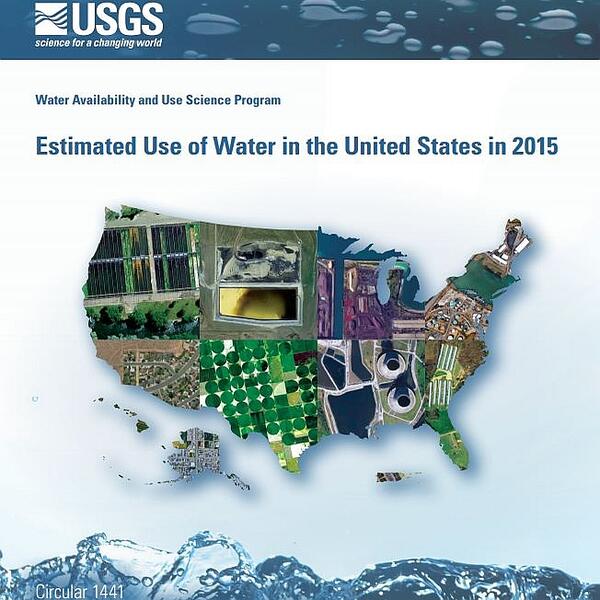
Understanding water use at a local level helps researchers study patterns and trends in resource consumption, which is critical for managing water supplies and planning for future needs. Scientists can use this data to analyze the impacts of population growth, agriculture, industry, and energy production on water demand. It also supports studies on sustainability, climate change, and environmental protection by showing where water resources may be stressed. Overall, water use is a valuable tool for improving water management and guiding policy decisions.
Dieter and others published a dataset in ScienceBase that contains water-use estimates for each U.S. county in 2015. It includes water use for entities like public supply, homes, farms, power plants, factories, mining, livestock, and fish farming. This resource remains a major source of information on county-level water use and provides a benchmark for comparison in newer studies. Since its publication in 2018, the dataset has been cited in over 20 other publications, and the related publication has been cited in 15 policy documents and 22 news articles, some as recently as 2025.
In this Update, we’ve mentioned some migration considerations for ScienceBase data releases. This data release serves as a great example of an easy-to-migrate resource for a couple of reasons:
1) It is a single-level data release, without any deeply nested child items.
2) The metadata record and the XML metadata record are in sync. In other words, the landing page contains no information that isn’t also captured in the metadata record.
You can find more migration considerations in the "Changes” section above.
References
Dataset: Dieter, C.A., Linsey, K.S., Caldwell, R.R., Harris, M.A., Ivahnenko, T.I., Lovelace, J.K., Maupin, M.A., and Barber, N.L., 2018, Estimated Use of Water in the United States County-Level Data for 2015 (ver. 2.0, June 2018): U.S. Geological Survey data release, https://doi.org/10.5066/F7TB15V5.
Related Publication: Dieter, C.A., Maupin, M.A., Caldwell, R.R., Harris, M.A., Ivahnenko, T.I., Lovelace, J.K., Barber, N.L., and Linsey, K.S., 2018, Estimated use of water in the United States in 2015: U.S. Geological Survey Circular 1441, 65 p., https://doi.org/10.3133/cir1441.
Did You Know - Migration FAQs
We've compiled a list of frequently asked questions, which will be updated with new information as it’s available and as progress is made in the coming year.
Find the FAQs here: https://www.usgs.gov/sciencebase-instructions-and-documentation/sciencebase-modernization-faqs