



Jason Kean
My research focuses on the processes controlling debris-flow initiation and growth, particularly after wildfire, but also in unburned areas.
This research includes a field component that obtains direct measurements of debris flows in natural settings, a modeling component that seeks to explain the observations, and an applied component that focuses on assessment of debris-flow hazards. My previous research at the USGS focused on river mechanics, including bank erosion and the development of model-based approaches to gage streams and rivers.
Science and Products
Postfire debris-flow hazard maps
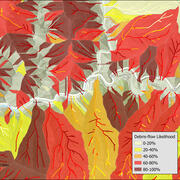
Wildfires can dramatically alter how water moves across the landscape. As a result, even modest rainstorms can trigger dangerous flash floods and debris flows in steep burned areas. In response, the USGS produces postfire debris-flow hazard assessments for recently burned areas. These hazard assessments estimate the likelihood, volume, and combined hazard of debris-flows in recently burned. This...

Improving Postfire Debris-Flow Hazard Assessments In The Pacific Northwest Through Application Of Debris-Flow Models
As part of the Post-fire Hazards and Impacts to Resources and Ecosystems (PHIRE): Support for Response, Recovery, and Mitigation Project, the PHIRE Debris Flow Hazard team is engaging in several studies to better understand the spatial and temporal drivers of postfire debris flows and improve postfire hazard assessments across northern California and the Pacific Northwest.

Calwood Fire "Heil Ranch" Landslide Monitoring Site near Boulder, CO
Wildfire can radically change a mountainous landscape such that even a modest rainstorm is capable of producing deadly and destructive flash flooding and debris flows.

Postfire Landslide Monitoring Station: "Chips" (2021 Dixie Fire) near Belden, CA
Wildfire can increase landslide susceptibility in mountainous terrain. The USGS maintains postfire landslide monitoring stations to track hillslope hydrologic conditions in the years following fire.

Postfire Landslide Monitoring Station: "Chambers" (2021 Dixie Fire) near Belden, CA
Wildfire can increase landslide susceptibility in mountainous terrain. The USGS maintains postfire landslide monitoring stations to track hillslope hydrologic conditions in the years following fire.

Advancing Post-Fire Debris Flow Hazard Science with a Field Deployable Mapping Tool
Mapping the occurrence of post-fire flooding and debris flow is crucial for 1) integrating observations into models used to define rainfall thresholds for early warning, 2) understanding patterns of inundation, and 3) improving models for predictive hazard assessment. Despite the critical role mapping plays in post-fire hazard assessment and early warning, there has not been a...

How Often Do Rainstorms Cause Debris Flows in Burned Areas of the Southwestern U.S.?
Debris flows, sometimes referred to as mudslides, mudflows, lahars, or debris avalanches, are common types of fast-moving landslides. They usually start on steep hillsides as a result of shallow landslides, or from runoff and erosion that liquefy and accelerate to speeds in excess of 35 mi/h. The consistency of debris flows ranges from thin, watery to thick, rocky mud that can carry large items...

Postfire debris-flow hazards
Wildfires can dramatically alter how water moves across the landscape. After a fire, vegetation is removed and soil properties change, reducing the ground’s ability to absorb rainfall. As a result, even modest rainstorms can trigger dangerous flash floods and debris flows in steep burned areas. Postfire debris flows are fast-moving mixtures of water, mud, rocks, and vegetation that can surge...

2009 Station Fire, Dunsmore Canyon, Glendale, California
In 2009, the Station Fire burned 160,000 acres in the San Gabriel Mountains. Vegetation has started to return, but it can take many years for a basin to fully recover from the effects of fire.

Reconstruction of an Avalanche: The West Salt Creek Rock Avalanche
Release Date: MAY 25, 2016 The West Salt Creek Rock Avalanche, Colorado, May 25, 2014

Rainfall and Landslides in Southern California
Southern California is well known to be susceptible to landslides, especially during periods of intense or prolonged rainfall, and these hazards can worsen during El Niño conditions. This page summarizes the causes and impacts of historical and recent rainfall-triggered landslides and debris flows in southern California, including several major winter storms that caused damaging and deadly events...
Science and Products
Postfire debris-flow hazard maps
Wildfires can dramatically alter how water moves across the landscape. As a result, even modest rainstorms can trigger dangerous flash floods and debris flows in steep burned areas. In response, the USGS produces postfire debris-flow hazard assessments for recently burned areas. These hazard assessments estimate the likelihood, volume, and combined hazard of debris-flows in recently burned. This...
Improving Postfire Debris-Flow Hazard Assessments In The Pacific Northwest Through Application Of Debris-Flow Models
As part of the Post-fire Hazards and Impacts to Resources and Ecosystems (PHIRE): Support for Response, Recovery, and Mitigation Project, the PHIRE Debris Flow Hazard team is engaging in several studies to better understand the spatial and temporal drivers of postfire debris flows and improve postfire hazard assessments across northern California and the Pacific Northwest.
Calwood Fire "Heil Ranch" Landslide Monitoring Site near Boulder, CO
Wildfire can radically change a mountainous landscape such that even a modest rainstorm is capable of producing deadly and destructive flash flooding and debris flows.
Postfire Landslide Monitoring Station: "Chips" (2021 Dixie Fire) near Belden, CA
Wildfire can increase landslide susceptibility in mountainous terrain. The USGS maintains postfire landslide monitoring stations to track hillslope hydrologic conditions in the years following fire.
Postfire Landslide Monitoring Station: "Chambers" (2021 Dixie Fire) near Belden, CA
Wildfire can increase landslide susceptibility in mountainous terrain. The USGS maintains postfire landslide monitoring stations to track hillslope hydrologic conditions in the years following fire.
Advancing Post-Fire Debris Flow Hazard Science with a Field Deployable Mapping Tool
Mapping the occurrence of post-fire flooding and debris flow is crucial for 1) integrating observations into models used to define rainfall thresholds for early warning, 2) understanding patterns of inundation, and 3) improving models for predictive hazard assessment. Despite the critical role mapping plays in post-fire hazard assessment and early warning, there has not been a...
How Often Do Rainstorms Cause Debris Flows in Burned Areas of the Southwestern U.S.?
Debris flows, sometimes referred to as mudslides, mudflows, lahars, or debris avalanches, are common types of fast-moving landslides. They usually start on steep hillsides as a result of shallow landslides, or from runoff and erosion that liquefy and accelerate to speeds in excess of 35 mi/h. The consistency of debris flows ranges from thin, watery to thick, rocky mud that can carry large items...
Postfire debris-flow hazards
Wildfires can dramatically alter how water moves across the landscape. After a fire, vegetation is removed and soil properties change, reducing the ground’s ability to absorb rainfall. As a result, even modest rainstorms can trigger dangerous flash floods and debris flows in steep burned areas. Postfire debris flows are fast-moving mixtures of water, mud, rocks, and vegetation that can surge...
2009 Station Fire, Dunsmore Canyon, Glendale, California
In 2009, the Station Fire burned 160,000 acres in the San Gabriel Mountains. Vegetation has started to return, but it can take many years for a basin to fully recover from the effects of fire.
Reconstruction of an Avalanche: The West Salt Creek Rock Avalanche
Release Date: MAY 25, 2016 The West Salt Creek Rock Avalanche, Colorado, May 25, 2014
Rainfall and Landslides in Southern California
Southern California is well known to be susceptible to landslides, especially during periods of intense or prolonged rainfall, and these hazards can worsen during El Niño conditions. This page summarizes the causes and impacts of historical and recent rainfall-triggered landslides and debris flows in southern California, including several major winter storms that caused damaging and deadly events...