
Karen Thorne, Ph.D. (Former Employee)
Science and Products
Filter Total Items: 28
Assessing Genomic Diversity and Clonality in Tape Seagrass in Guam and Surrounding Pacific Islands to Inform Climate Resilient Restoration
Project Overview Seagrass meadows support island communities by sustaining fisheries and protecting shorelines. However, some species, such as tape grass, may lack the genetic variation needed to survive and adapt to warmer, saltier ocean waters. Researchers supported by this Pacific Islands CASC project will sequence the tape grass genome and assess genetic variation across Micronesia...
Habitat Vulnerability to Climate Change: Identifying Climate Change Induced Mass Mortality Events Across Large Landscapes of the United States
USGS researchers will characterize extreme climatic events across U.S. following a review of case studies of mass mortality events associated with climate extremes including drought, precipitation, freeze, heat waves, and storm events.
Coastal Wetland Vulnerability to Climate Change and Sea-Level Rise: Understanding Ecological Thresholds and Ecosystem Transformations
Eighteen USGS coastal scientists from all four coasts of the conterminous United States are working together to advance the understanding of climate change and sea-level rise impacts to coastal wetlands.
By
California Water Science Center, Chesapeake Bay Activities, Eastern Ecological Science Center, Florence Bascom Geoscience Center, Great Lakes Science Center, Pacific Coastal and Marine Science Center, St. Petersburg Coastal and Marine Science Center, Western Ecological Research Center (WERC), Western Geographic Science Center, Wetland and Aquatic Research Center , Woods Hole Coastal and Marine Science Center
Spread of invasive vegetation under climate change in the national parks of the Klamath Region
Project Overview: The Klamath Region of Oregon and California is a global hotspot of biodiversity, but invasive species, climate change, and severe fires threaten native biodiversity, even within national parks. Scientists supported by this Southwest CASC project will create early-warning maps of where invasive plants are most likely to spread, helping national park managers target their
Enhancing Community and Wildlife Resilience to Sea‐Level Rise and Infrastructure Development in the San Pablo Baylands
Project Overview: The San Pablo Baylands support critical wildlife habitat and major transportation infrastructure, but the combined effects of sea-level rise and planned highway redesigns on habitat and public access remain uncertain. Scientists supported by this Southwest CASC project will work with federal, state, and regional managers to fill key data gaps and model how sea-level...
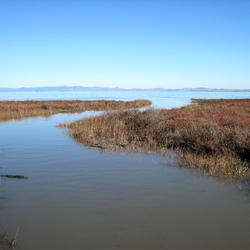
Modeling vulnerability for San Francisco Bay estuary tidal marshes
Karen Thorne researches the effects of inundation and ecological processes within the San Francisco Bay-Delta estuary.
Developing a Pacific Mangrove Monitoring Network (PACMAN) in Response to Sea Level Rise
Continued sea-level rise from a changing climate is expected to result in the loss of many coastal mangrove trees, which, will strongly affect human populations on isolated Western Pacific islands as they rely heavily on mangrove forests for food (fish, shrimp, and crabs), building materials, and firewood. Mangroves also protect local communities from tsunamis and cyclones and are...
Wetland Carbon Working Group: Improving Methodologies and Estimates of Carbon and Greenhouse Gas Flux in Wetlands
WARC researchers are working to quantify the impacts of future climate and land use/land cover change on greenhouse gas emissions and reductions.
Sea-level Rise Vulnerability of Mangrove Forests in Micronesia and the Pacific
The USGS and partners are studying how mangrove forests in the Federated States of Micronesia may respond to sea-level rise over the coming century. Their projections will help Micronesian communities plan for the future.
The Response of Coastal Wetlands to Sea-level Rise: Understanding how Macroscale Drivers Influence Local Processes and Feedbacks
The purpose of this work is to advance our understanding of how coastal wetland responses to sea-level rise (SLR) within the conterminous United States are likely to vary as a function of local, regional, and macroscale drivers, including climate. Based on our interactions with managers and decision makers, as well as our knowledge of the current state of the science, we propose to: (a) conduct a...
The response of coastal wetlands to sea-level rise: Understanding how macroscale drivers influence local processes and feedbacks
The purpose of this work is to advance our understanding of how coastal wetland responses to SLR within the conterminous United States are likely to vary as a function of local, regional, and macroscale drivers, including climate. Based on our interactions with managers and decision makers, as well as our knowledge of the current state of the science, we propose to (a) conduct a national synoptic...
Science to Inform the Management of Mangrove Ecosystems Undergoing Sea Level Rise at Ding Darling National Wildlife Refuge, Sanibel Island, Florida
Mangroves are forested tidal wetlands that occur in tropical, sub-tropical, and warm temperate coastal regions around the world. Mangroves occupy a significant area of coastlines globally and provide important ecosystem services to humans and wildlife. These services include aesthetic value, storm protection, food provisioning, recreation, critical wildlife habitat, and biological carbon
Filter Total Items: 40
No Result Found
Filter Total Items: 83
Marshes to mudflats—Effects of sea-level rise on tidal marshes along a latitudinal gradient in the Pacific Northwest Marshes to mudflats—Effects of sea-level rise on tidal marshes along a latitudinal gradient in the Pacific Northwest
Authors
Karen M. Thorne, Bruce D. Dugger, Kevin J. Buffington, Chase M. Freeman, Christopher N. Janousek, Katherine W. Powelson, Glenn R. Gutenspergen, John Y. Takekawa
Case Study, California Black Rail (Laterallus jamaicensis corturniculus): Science Foundation Chapter 5, Appendix 5.1 in The Baylands and climate change: What can we do? Case Study, California Black Rail (Laterallus jamaicensis corturniculus): Science Foundation Chapter 5, Appendix 5.1 in The Baylands and climate change: What can we do?
The Black Rail is the smallest member of the avian family Rallidae and has a wide-ranging but highly scattered distribution throughout the New World. Of five subspecies, two occur in North America—the Eastern Black Rail (L.j. jamaicensis) and the California Black Rail (L.j. coturniculus). Throughout its range, the Black Rail is a secretive inhabitant of tidal and freshwater wetlands and...
Authors
Jules G. Evens, Karen M. Thorne
Collaborative decision-analytic framework to maximize resilience of tidal marshes to climate change Collaborative decision-analytic framework to maximize resilience of tidal marshes to climate change
Decision makers that are responsible for stewardship of natural resources face many challenges, which are complicated by uncertainty about impacts from climate change, expanding human development, and intensifying land uses. A systematic process for evaluating the social and ecological risks, trade-offs, and cobenefits associated with future changes is critical to maximize resilience and...
Authors
Karen M. Thorne, Brady J. Mattsson, John Y. Takekawa, Jonathan Cummings, Debby Crouse, Giselle Block, Valary Bloom, Matt Gerhart, Steve Goldbeck, Beth Huning, Christina Sloop, Mendel Stewart, Karen Taylor, Laura Valoppi
Importance of biogeomorphic and spatial properties in assessing a tidal salt marsh vulnerability to sea-level rise Importance of biogeomorphic and spatial properties in assessing a tidal salt marsh vulnerability to sea-level rise
We evaluated the biogeomorphic processes of a large (309 ha) tidal salt marsh and examined factors that influence its ability to keep pace with relative sea-level rise (SLR). Detailed elevation data from 1995 and 2008 were compared with digital elevation models (DEMs) to assess marsh surface elevation change during this time. Overall, 37 % (113 ha) of the marsh increased in elevation at...
Authors
Karen M. Thorne, Deborah L. Elliott-Fisk, Glenn D. Wylie, William M. Perry, John Y. Takekawa
Wetland Accretion Rate Model of Ecosystem Resilience (WARMER) and its application to habitat sustainability for endangered species in the San Francisco Estuary Wetland Accretion Rate Model of Ecosystem Resilience (WARMER) and its application to habitat sustainability for endangered species in the San Francisco Estuary
Salt marsh faunas are constrained by specific habitat requirements for marsh elevation relative to sea level and tidal range. As sea level rises, changes in relative elevation of the marsh plain will have differing impacts on the availability of habitat for marsh obligate species. The Wetland Accretion Rate Model for Ecosystem Resilience (WARMER) is a 1-D model of elevation that...
Authors
Kathleen M. Swanson, Judith Z. Drexler, David H. Schoellhamer, Karen M. Thorne, Michael L. Casazza, Cory T. Overton, John C. Callaway, John Y. Takekawa
Final report for sea-level rise response modeling for San Francisco Bay estuary tidal marshes Final report for sea-level rise response modeling for San Francisco Bay estuary tidal marshes
The International Panel on Climate Change has identified coastal ecosystems as areas that will be disproportionally affected by climate change. Current sea-level rise projections range widely with 0.57 to 1.9 meters increase in mea sea level by 2100. The expected accelerated rate of sea-level rise through the 21st century will put many coastal ecosystems at risk, especially those in
Authors
John Y. Takekawa, Karen M. Thorne, Kevin J. Buffington, Kyle A. Spragens, Kathleen M. Swanson, Judith Z. Drexler, David H. Schoellhamer, Cory T. Overton, Michael L. Casazza
Storm surges and climate change implications for tidal marshes: Insight from the San Francisco Bay Estuary, California, USA Storm surges and climate change implications for tidal marshes: Insight from the San Francisco Bay Estuary, California, USA
Tidal marshes are dynamic ecosystems, which are influenced by oceanic and freshwater processes and daily changes in sea level. Projected sea-level rise and changes in storm frequency and intensity will affect tidal marshes by altering suspended sediment supply, plant communities, and the inundation duration and depth of the marsh platform. The objective of this research was to evaluate...
Authors
Karen M. Thorne, Kevin J. Buffington, Kathleen Swanson, John Y. Takekawa
Ecological effects of climate change on salt marsh wildlife: a case study from a highly urbanized estuary Ecological effects of climate change on salt marsh wildlife: a case study from a highly urbanized estuary
Coastal areas are high-risk zones subject to the impacts of global climate change, with significant increases in the frequencies of extreme weather and storm events, and sea-level rise forecast by 2100. These physical processes are expected to alter estuaries, resulting in loss of intertidal wetlands and their component wildlife species. In particular, impacts to salt marshes and their...
Authors
Karen M. Thorne, John Y. Takekawa, Deborah L. Elliott-Fisk
2010 bathymetric survey and digital elevation model of Corte Madera Bay, California 2010 bathymetric survey and digital elevation model of Corte Madera Bay, California
A high-resolution bathymetric survey of Corte Madera Bay, California, was collected in early 2010 in support of a collaborative research project initiated by the San Francisco Bay Conservation and Development Commission and funded by the U.S. Environmental Protection Agency. The primary objective of the Innovative Wetland Adaptation in the Lower Corte Madera Creek Watershed Project is to...
Authors
Amy C. Foxgrover, David P. Finlayson, Bruce E. Jaffe, John Y. Takekawa, Karen M. Thorne, Kyle A. Spragens
Avian communities in tidal salt marshes of San Francisco Bay: A review of functional groups by foraging guild and habitat association Avian communities in tidal salt marshes of San Francisco Bay: A review of functional groups by foraging guild and habitat association
The San Francisco Bay estuary is highly urbanized, but it supports the largest remaining extent of tidal salt marshes on the west coast of North America as well as a diverse native bird community. San Francisco Bay tidal marshes are occupied by more than 113 bird species that represent 31 families, including five subspecies from three families that we denote as tidal-marsh obligates. To...
Authors
John Y. Takekawa, Isa Woo, Rachel J. Gardiner, Michael L. Casazza, Joshua T. Ackerman, Nadav Nur, Leonard Liu, Hildie Spautz
Comparative results of 27A1 NMR spectrometric and ferron colorimetric analyses of hydroxaluminum hydrolysis products in aged mildly acidic aqueous systems Comparative results of 27A1 NMR spectrometric and ferron colorimetric analyses of hydroxaluminum hydrolysis products in aged mildly acidic aqueous systems
No abstract available.
Authors
D.V. Vivit, Karen M. Thorne, J.D. Hem
Science and Products
Filter Total Items: 28
Assessing Genomic Diversity and Clonality in Tape Seagrass in Guam and Surrounding Pacific Islands to Inform Climate Resilient Restoration
Project Overview Seagrass meadows support island communities by sustaining fisheries and protecting shorelines. However, some species, such as tape grass, may lack the genetic variation needed to survive and adapt to warmer, saltier ocean waters. Researchers supported by this Pacific Islands CASC project will sequence the tape grass genome and assess genetic variation across Micronesia...
Habitat Vulnerability to Climate Change: Identifying Climate Change Induced Mass Mortality Events Across Large Landscapes of the United States
USGS researchers will characterize extreme climatic events across U.S. following a review of case studies of mass mortality events associated with climate extremes including drought, precipitation, freeze, heat waves, and storm events.
Coastal Wetland Vulnerability to Climate Change and Sea-Level Rise: Understanding Ecological Thresholds and Ecosystem Transformations
Eighteen USGS coastal scientists from all four coasts of the conterminous United States are working together to advance the understanding of climate change and sea-level rise impacts to coastal wetlands.
By
California Water Science Center, Chesapeake Bay Activities, Eastern Ecological Science Center, Florence Bascom Geoscience Center, Great Lakes Science Center, Pacific Coastal and Marine Science Center, St. Petersburg Coastal and Marine Science Center, Western Ecological Research Center (WERC), Western Geographic Science Center, Wetland and Aquatic Research Center , Woods Hole Coastal and Marine Science Center
Spread of invasive vegetation under climate change in the national parks of the Klamath Region
Project Overview: The Klamath Region of Oregon and California is a global hotspot of biodiversity, but invasive species, climate change, and severe fires threaten native biodiversity, even within national parks. Scientists supported by this Southwest CASC project will create early-warning maps of where invasive plants are most likely to spread, helping national park managers target their
Enhancing Community and Wildlife Resilience to Sea‐Level Rise and Infrastructure Development in the San Pablo Baylands
Project Overview: The San Pablo Baylands support critical wildlife habitat and major transportation infrastructure, but the combined effects of sea-level rise and planned highway redesigns on habitat and public access remain uncertain. Scientists supported by this Southwest CASC project will work with federal, state, and regional managers to fill key data gaps and model how sea-level...
Modeling vulnerability for San Francisco Bay estuary tidal marshes
Karen Thorne researches the effects of inundation and ecological processes within the San Francisco Bay-Delta estuary.
Developing a Pacific Mangrove Monitoring Network (PACMAN) in Response to Sea Level Rise
Continued sea-level rise from a changing climate is expected to result in the loss of many coastal mangrove trees, which, will strongly affect human populations on isolated Western Pacific islands as they rely heavily on mangrove forests for food (fish, shrimp, and crabs), building materials, and firewood. Mangroves also protect local communities from tsunamis and cyclones and are...
Wetland Carbon Working Group: Improving Methodologies and Estimates of Carbon and Greenhouse Gas Flux in Wetlands
WARC researchers are working to quantify the impacts of future climate and land use/land cover change on greenhouse gas emissions and reductions.
Sea-level Rise Vulnerability of Mangrove Forests in Micronesia and the Pacific
The USGS and partners are studying how mangrove forests in the Federated States of Micronesia may respond to sea-level rise over the coming century. Their projections will help Micronesian communities plan for the future.
The Response of Coastal Wetlands to Sea-level Rise: Understanding how Macroscale Drivers Influence Local Processes and Feedbacks
The purpose of this work is to advance our understanding of how coastal wetland responses to sea-level rise (SLR) within the conterminous United States are likely to vary as a function of local, regional, and macroscale drivers, including climate. Based on our interactions with managers and decision makers, as well as our knowledge of the current state of the science, we propose to: (a) conduct a...
The response of coastal wetlands to sea-level rise: Understanding how macroscale drivers influence local processes and feedbacks
The purpose of this work is to advance our understanding of how coastal wetland responses to SLR within the conterminous United States are likely to vary as a function of local, regional, and macroscale drivers, including climate. Based on our interactions with managers and decision makers, as well as our knowledge of the current state of the science, we propose to (a) conduct a national synoptic...
Science to Inform the Management of Mangrove Ecosystems Undergoing Sea Level Rise at Ding Darling National Wildlife Refuge, Sanibel Island, Florida
Mangroves are forested tidal wetlands that occur in tropical, sub-tropical, and warm temperate coastal regions around the world. Mangroves occupy a significant area of coastlines globally and provide important ecosystem services to humans and wildlife. These services include aesthetic value, storm protection, food provisioning, recreation, critical wildlife habitat, and biological carbon
Filter Total Items: 40
No Result Found
Filter Total Items: 83
Marshes to mudflats—Effects of sea-level rise on tidal marshes along a latitudinal gradient in the Pacific Northwest Marshes to mudflats—Effects of sea-level rise on tidal marshes along a latitudinal gradient in the Pacific Northwest
Authors
Karen M. Thorne, Bruce D. Dugger, Kevin J. Buffington, Chase M. Freeman, Christopher N. Janousek, Katherine W. Powelson, Glenn R. Gutenspergen, John Y. Takekawa
Case Study, California Black Rail (Laterallus jamaicensis corturniculus): Science Foundation Chapter 5, Appendix 5.1 in The Baylands and climate change: What can we do? Case Study, California Black Rail (Laterallus jamaicensis corturniculus): Science Foundation Chapter 5, Appendix 5.1 in The Baylands and climate change: What can we do?
The Black Rail is the smallest member of the avian family Rallidae and has a wide-ranging but highly scattered distribution throughout the New World. Of five subspecies, two occur in North America—the Eastern Black Rail (L.j. jamaicensis) and the California Black Rail (L.j. coturniculus). Throughout its range, the Black Rail is a secretive inhabitant of tidal and freshwater wetlands and...
Authors
Jules G. Evens, Karen M. Thorne
Collaborative decision-analytic framework to maximize resilience of tidal marshes to climate change Collaborative decision-analytic framework to maximize resilience of tidal marshes to climate change
Decision makers that are responsible for stewardship of natural resources face many challenges, which are complicated by uncertainty about impacts from climate change, expanding human development, and intensifying land uses. A systematic process for evaluating the social and ecological risks, trade-offs, and cobenefits associated with future changes is critical to maximize resilience and...
Authors
Karen M. Thorne, Brady J. Mattsson, John Y. Takekawa, Jonathan Cummings, Debby Crouse, Giselle Block, Valary Bloom, Matt Gerhart, Steve Goldbeck, Beth Huning, Christina Sloop, Mendel Stewart, Karen Taylor, Laura Valoppi
Importance of biogeomorphic and spatial properties in assessing a tidal salt marsh vulnerability to sea-level rise Importance of biogeomorphic and spatial properties in assessing a tidal salt marsh vulnerability to sea-level rise
We evaluated the biogeomorphic processes of a large (309 ha) tidal salt marsh and examined factors that influence its ability to keep pace with relative sea-level rise (SLR). Detailed elevation data from 1995 and 2008 were compared with digital elevation models (DEMs) to assess marsh surface elevation change during this time. Overall, 37 % (113 ha) of the marsh increased in elevation at...
Authors
Karen M. Thorne, Deborah L. Elliott-Fisk, Glenn D. Wylie, William M. Perry, John Y. Takekawa
Wetland Accretion Rate Model of Ecosystem Resilience (WARMER) and its application to habitat sustainability for endangered species in the San Francisco Estuary Wetland Accretion Rate Model of Ecosystem Resilience (WARMER) and its application to habitat sustainability for endangered species in the San Francisco Estuary
Salt marsh faunas are constrained by specific habitat requirements for marsh elevation relative to sea level and tidal range. As sea level rises, changes in relative elevation of the marsh plain will have differing impacts on the availability of habitat for marsh obligate species. The Wetland Accretion Rate Model for Ecosystem Resilience (WARMER) is a 1-D model of elevation that...
Authors
Kathleen M. Swanson, Judith Z. Drexler, David H. Schoellhamer, Karen M. Thorne, Michael L. Casazza, Cory T. Overton, John C. Callaway, John Y. Takekawa
Final report for sea-level rise response modeling for San Francisco Bay estuary tidal marshes Final report for sea-level rise response modeling for San Francisco Bay estuary tidal marshes
The International Panel on Climate Change has identified coastal ecosystems as areas that will be disproportionally affected by climate change. Current sea-level rise projections range widely with 0.57 to 1.9 meters increase in mea sea level by 2100. The expected accelerated rate of sea-level rise through the 21st century will put many coastal ecosystems at risk, especially those in
Authors
John Y. Takekawa, Karen M. Thorne, Kevin J. Buffington, Kyle A. Spragens, Kathleen M. Swanson, Judith Z. Drexler, David H. Schoellhamer, Cory T. Overton, Michael L. Casazza
Storm surges and climate change implications for tidal marshes: Insight from the San Francisco Bay Estuary, California, USA Storm surges and climate change implications for tidal marshes: Insight from the San Francisco Bay Estuary, California, USA
Tidal marshes are dynamic ecosystems, which are influenced by oceanic and freshwater processes and daily changes in sea level. Projected sea-level rise and changes in storm frequency and intensity will affect tidal marshes by altering suspended sediment supply, plant communities, and the inundation duration and depth of the marsh platform. The objective of this research was to evaluate...
Authors
Karen M. Thorne, Kevin J. Buffington, Kathleen Swanson, John Y. Takekawa
Ecological effects of climate change on salt marsh wildlife: a case study from a highly urbanized estuary Ecological effects of climate change on salt marsh wildlife: a case study from a highly urbanized estuary
Coastal areas are high-risk zones subject to the impacts of global climate change, with significant increases in the frequencies of extreme weather and storm events, and sea-level rise forecast by 2100. These physical processes are expected to alter estuaries, resulting in loss of intertidal wetlands and their component wildlife species. In particular, impacts to salt marshes and their...
Authors
Karen M. Thorne, John Y. Takekawa, Deborah L. Elliott-Fisk
2010 bathymetric survey and digital elevation model of Corte Madera Bay, California 2010 bathymetric survey and digital elevation model of Corte Madera Bay, California
A high-resolution bathymetric survey of Corte Madera Bay, California, was collected in early 2010 in support of a collaborative research project initiated by the San Francisco Bay Conservation and Development Commission and funded by the U.S. Environmental Protection Agency. The primary objective of the Innovative Wetland Adaptation in the Lower Corte Madera Creek Watershed Project is to...
Authors
Amy C. Foxgrover, David P. Finlayson, Bruce E. Jaffe, John Y. Takekawa, Karen M. Thorne, Kyle A. Spragens
Avian communities in tidal salt marshes of San Francisco Bay: A review of functional groups by foraging guild and habitat association Avian communities in tidal salt marshes of San Francisco Bay: A review of functional groups by foraging guild and habitat association
The San Francisco Bay estuary is highly urbanized, but it supports the largest remaining extent of tidal salt marshes on the west coast of North America as well as a diverse native bird community. San Francisco Bay tidal marshes are occupied by more than 113 bird species that represent 31 families, including five subspecies from three families that we denote as tidal-marsh obligates. To...
Authors
John Y. Takekawa, Isa Woo, Rachel J. Gardiner, Michael L. Casazza, Joshua T. Ackerman, Nadav Nur, Leonard Liu, Hildie Spautz
Comparative results of 27A1 NMR spectrometric and ferron colorimetric analyses of hydroxaluminum hydrolysis products in aged mildly acidic aqueous systems Comparative results of 27A1 NMR spectrometric and ferron colorimetric analyses of hydroxaluminum hydrolysis products in aged mildly acidic aqueous systems
No abstract available.
Authors
D.V. Vivit, Karen M. Thorne, J.D. Hem
*Disclaimer: Listing outside positions with professional scientific organizations on this Staff Profile are for informational purposes only and do not constitute an endorsement of those professional scientific organizations or their activities by the USGS, Department of the Interior, or U.S. Government