



Richard Berl, PhD
Richard Berl is a Research Social Scientist with the USGS National Wildlife Health Center in Madison, WI, colocated at the Eastern Ecological Science Center at the Patuxent Research Refuge in Laurel, MD.
Richard is a conservation social scientist with a background in evolutionary theory, behavior, and culture change, who uses integrative quantitative and qualitative approaches to address the management challenges that arise from the complex interactions within rapidly changing social-ecological systems, particularly those related to wildlife health and the impacts of chronic wasting disease.
Science and Products

Improving Deer Management Through Behavioral Science
Managing white-tailed deer populations is a major challenge for wildlife agencies across the Midwest, with implications for crop damage, vehicle collisions, and the spread of diseases such as chronic wasting disease (CWD). This six-year, multistate field experiment tests evidence-based behavioral strategies to increase hunter and landowner participation in deer management. The project will provide...

Developing a decision support tool to assess and predict hunter behavioral dynamics and responses to CWD in Wisconsin
This project is building a modeling tool that helps wildlife managers predict and influence hunter behavior, turning small shifts in harvest patterns into a powerful lever for controlling chronic wasting disease.

Application of a systems approach for management of chronic wasting disease
The USGS National Wildlife Health Center, Montana Cooperative Wildlife Research Unit, Ventana Systems, Inc., and the Wisconsin Department of Natural Resources (WIDNR) are applying a systems approach to map and model the complex relationships among ecological, epidemiological, social, and political processes affecting CWD. Through a participatory modeling process, we gathered subject matter...
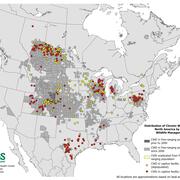
Expanding Distribution of Chronic Wasting Disease
Chronic wasting disease (CWD) has been detected in 37 US states and five Canadian provinces in free-ranging cervids and/or captive cervid facilities.
Science and Products
Improving Deer Management Through Behavioral Science
Managing white-tailed deer populations is a major challenge for wildlife agencies across the Midwest, with implications for crop damage, vehicle collisions, and the spread of diseases such as chronic wasting disease (CWD). This six-year, multistate field experiment tests evidence-based behavioral strategies to increase hunter and landowner participation in deer management. The project will provide...
Developing a decision support tool to assess and predict hunter behavioral dynamics and responses to CWD in Wisconsin
This project is building a modeling tool that helps wildlife managers predict and influence hunter behavior, turning small shifts in harvest patterns into a powerful lever for controlling chronic wasting disease.
Application of a systems approach for management of chronic wasting disease
The USGS National Wildlife Health Center, Montana Cooperative Wildlife Research Unit, Ventana Systems, Inc., and the Wisconsin Department of Natural Resources (WIDNR) are applying a systems approach to map and model the complex relationships among ecological, epidemiological, social, and political processes affecting CWD. Through a participatory modeling process, we gathered subject matter...
Expanding Distribution of Chronic Wasting Disease
Chronic wasting disease (CWD) has been detected in 37 US states and five Canadian provinces in free-ranging cervids and/or captive cervid facilities.