
Travis McDevitt-Galles
Travis McDevitt-Galles is a Biologist at the National Wildlife Health Center.
Science and Products
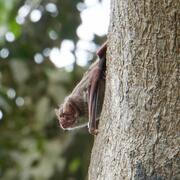
Dynamics of Rabies Transmission in Vampire Bats (Desmodus rotundus) and Potential for Control Through Vaccination
Vampire bats ( Desmodus rotundus) are the primary spreader of rabies, a lethal disease that harms livestock and people across Latin America. Growth of the livestock industry and environmental changes in this region are leading to the expansion of vampire bats’ habitat range, and it is considered likely this species will move into the southern United States.
SARS-CoV-2 and Mpox virus spillback component data (North America, 2022) to create risk assessment of spillback at human-wildlife interface SARS-CoV-2 and Mpox virus spillback component data (North America, 2022) to create risk assessment of spillback at human-wildlife interface
We compiled a data set of species by country metrics related to spillback risk for SARS-CoV-2 (severe acute respiratory syndrome coronavirus 2) and Mpox viruses. This included aggregating species level estimates of susceptibility to SARS-CoV-2 and Mpox infections, species distribution, and county level infection pressure for both viruses.
Hosts, pathogens and hot ponds: Thermal mean and variability contribute to spatial patterns of chytrid infection Hosts, pathogens and hot ponds: Thermal mean and variability contribute to spatial patterns of chytrid infection
Temperature is a primary driver of heterogeneity in host–pathogen dynamics and understanding how patch-scale temperature affects landscape-scale patterns of pathogen infection is key to effective monitoring and management. In field studies, both temperature variability and mean temperature are often related to infection of ectothermic animals by fungal pathogens, and although these...
Authors
Brendan Hobart, Daniel Grear, Megan Winzeler, Travis Mcdevitt-Galles, Timothy Korpita, Erin L. Muths, Valerie McKenzie
Rapid risk assessment framework to estimate potential for spillback at human-wildlife interfaces Rapid risk assessment framework to estimate potential for spillback at human-wildlife interfaces
More than 60% of emerging infectious diseases of humans have a wildlife origin, and when these diseases spread through human populations to new geographical areas, there is a considerable risk of spillback from humans to wildlife species. Spillback events can have severe consequences for wildlife populations, where the disease may cause morbidity and mortality, and human populations...
Authors
Travis Mcdevitt-Galles, Tricia L. Fry, Katherine Richgels, Daniel Grear
Partly cloudy with a chance of mosquitoes: Developing a flexible approach to forecasting mosquito populations Partly cloudy with a chance of mosquitoes: Developing a flexible approach to forecasting mosquito populations
Climate-induced shifts in mosquito phenology and population structure have important implications for the health of humans and wildlife. The timing and intensity of mosquito interactions with infected and susceptible hosts are a primary determinant of vector-borne disease dynamics. Like most ectotherms, rates of mosquito development and corresponding phenological patterns are expected to...
Authors
Travis Mcdevitt-Galles, Arthur DeGaetano, Sarah Elmendorf, John R. Foster, Howard S. Ginsberg, Mevin Hooten, Shannon LaDeau, Katherine McClure, S. Paull, Erin Posthumus, Ilia Rochlin, Daniel Grear
Dynamic population models with temporal preferential sampling to infer phenology Dynamic population models with temporal preferential sampling to infer phenology
To study population dynamics, ecologists and wildlife biologists typically use relative abundance data, which may be subject to temporal preferential sampling. Temporal preferential sampling occurs when the times at which observations are made and the latent process of interest are conditionally dependent. To account for preferential sampling, we specify a Bayesian hierarchical abundance...
Authors
Michael Schwob, Mevin Hooten, Travis Mcdevitt-Galles
Resilience of native amphibian communities following catastrophic drought: Evidence from a decade of regional-scale monitoring Resilience of native amphibian communities following catastrophic drought: Evidence from a decade of regional-scale monitoring
The increasing frequency and severity of drought may exacerbate ongoing global amphibian declines. However, interactions between drought and coincident stressors, coupled with high interannual variability in amphibian abundances, can mask the extent and underlying mechanisms of drought impacts. We synthesized a decade (2009–2019) of regional-scale amphibian monitoring data (2273 surveys...
Authors
Wynne Moss, Travis McDevitt-Galles, Erin Muths, Steven Bobzien, Pieter Johnson, Jessica Purificato
Science and Products
Dynamics of Rabies Transmission in Vampire Bats (Desmodus rotundus) and Potential for Control Through Vaccination
Vampire bats ( Desmodus rotundus) are the primary spreader of rabies, a lethal disease that harms livestock and people across Latin America. Growth of the livestock industry and environmental changes in this region are leading to the expansion of vampire bats’ habitat range, and it is considered likely this species will move into the southern United States.
SARS-CoV-2 and Mpox virus spillback component data (North America, 2022) to create risk assessment of spillback at human-wildlife interface SARS-CoV-2 and Mpox virus spillback component data (North America, 2022) to create risk assessment of spillback at human-wildlife interface
We compiled a data set of species by country metrics related to spillback risk for SARS-CoV-2 (severe acute respiratory syndrome coronavirus 2) and Mpox viruses. This included aggregating species level estimates of susceptibility to SARS-CoV-2 and Mpox infections, species distribution, and county level infection pressure for both viruses.
Hosts, pathogens and hot ponds: Thermal mean and variability contribute to spatial patterns of chytrid infection Hosts, pathogens and hot ponds: Thermal mean and variability contribute to spatial patterns of chytrid infection
Temperature is a primary driver of heterogeneity in host–pathogen dynamics and understanding how patch-scale temperature affects landscape-scale patterns of pathogen infection is key to effective monitoring and management. In field studies, both temperature variability and mean temperature are often related to infection of ectothermic animals by fungal pathogens, and although these...
Authors
Brendan Hobart, Daniel Grear, Megan Winzeler, Travis Mcdevitt-Galles, Timothy Korpita, Erin L. Muths, Valerie McKenzie
Rapid risk assessment framework to estimate potential for spillback at human-wildlife interfaces Rapid risk assessment framework to estimate potential for spillback at human-wildlife interfaces
More than 60% of emerging infectious diseases of humans have a wildlife origin, and when these diseases spread through human populations to new geographical areas, there is a considerable risk of spillback from humans to wildlife species. Spillback events can have severe consequences for wildlife populations, where the disease may cause morbidity and mortality, and human populations...
Authors
Travis Mcdevitt-Galles, Tricia L. Fry, Katherine Richgels, Daniel Grear
Partly cloudy with a chance of mosquitoes: Developing a flexible approach to forecasting mosquito populations Partly cloudy with a chance of mosquitoes: Developing a flexible approach to forecasting mosquito populations
Climate-induced shifts in mosquito phenology and population structure have important implications for the health of humans and wildlife. The timing and intensity of mosquito interactions with infected and susceptible hosts are a primary determinant of vector-borne disease dynamics. Like most ectotherms, rates of mosquito development and corresponding phenological patterns are expected to...
Authors
Travis Mcdevitt-Galles, Arthur DeGaetano, Sarah Elmendorf, John R. Foster, Howard S. Ginsberg, Mevin Hooten, Shannon LaDeau, Katherine McClure, S. Paull, Erin Posthumus, Ilia Rochlin, Daniel Grear
Dynamic population models with temporal preferential sampling to infer phenology Dynamic population models with temporal preferential sampling to infer phenology
To study population dynamics, ecologists and wildlife biologists typically use relative abundance data, which may be subject to temporal preferential sampling. Temporal preferential sampling occurs when the times at which observations are made and the latent process of interest are conditionally dependent. To account for preferential sampling, we specify a Bayesian hierarchical abundance...
Authors
Michael Schwob, Mevin Hooten, Travis Mcdevitt-Galles
Resilience of native amphibian communities following catastrophic drought: Evidence from a decade of regional-scale monitoring Resilience of native amphibian communities following catastrophic drought: Evidence from a decade of regional-scale monitoring
The increasing frequency and severity of drought may exacerbate ongoing global amphibian declines. However, interactions between drought and coincident stressors, coupled with high interannual variability in amphibian abundances, can mask the extent and underlying mechanisms of drought impacts. We synthesized a decade (2009–2019) of regional-scale amphibian monitoring data (2273 surveys...
Authors
Wynne Moss, Travis McDevitt-Galles, Erin Muths, Steven Bobzien, Pieter Johnson, Jessica Purificato