



An Unoccupied Aircraft System (UAS) unit surveys the eruption site at the summit of Kīlauea on January 14, 2022. UAS photos, data, and samples help scientists to understand ongoing volcanic processes and their associated hazards, and to detect changes that might indicate shifts in the character of activity.
Images
Kīlauea images of eruptive activity, field work, and more.
Filter Total Items: 3142

UAS mission at Kīlauea summit — January 14, 2022
An Unoccupied Aircraft System (UAS) unit surveys the eruption site at the summit of Kīlauea on January 14, 2022. UAS photos, data, and samples help scientists to understand ongoing volcanic processes and their associated hazards, and to detect changes that might indicate shifts in the character of activity.

January 14, 2022 — Lava effusion in Halema‘uma‘u
A telephoto lens captured this view of crustal plates forming on the lava lake surface within Halema‘uma‘u on January 14, 2022. The plates are being transported southeast (to the top of the photograph) into the larger lava lake at the summit of Kīlauea. USGS image by C. Parcheta.
A telephoto lens captured this view of crustal plates forming on the lava lake surface within Halema‘uma‘u on January 14, 2022. The plates are being transported southeast (to the top of the photograph) into the larger lava lake at the summit of Kīlauea. USGS image by C. Parcheta.

UAS mission at Kīlauea summit — January 14, 2022
Hawaiian Volcano Observatory scientists prepare an Unoccupied Aircraft Systems (UAS) unit for launch at Kīlauea summit on January 14, 2022. Imagery collected by the UAS will be used to generate a 3-dimensional model that will be used to evaluate the eruption within Halema‘uma‘u for changes.
Hawaiian Volcano Observatory scientists prepare an Unoccupied Aircraft Systems (UAS) unit for launch at Kīlauea summit on January 14, 2022. Imagery collected by the UAS will be used to generate a 3-dimensional model that will be used to evaluate the eruption within Halema‘uma‘u for changes.

January 13, 2022 — Kīlauea summit down-dropped block
January 13, 2022 — Kīlauea summit down-dropped blockClose-up view of the margin of overflows from the active lava lake within Halema‘uma‘u crater at the summit of Kīlauea. These overflows are encroaching northwards onto the lowest of the down-dropped blocks that formed during Kīlauea's 2018 summit collapse events. USGS image by K. Kamibayashi.
January 13, 2022 — Kīlauea summit down-dropped block
January 13, 2022 — Kīlauea summit down-dropped blockClose-up view of the margin of overflows from the active lava lake within Halema‘uma‘u crater at the summit of Kīlauea. These overflows are encroaching northwards onto the lowest of the down-dropped blocks that formed during Kīlauea's 2018 summit collapse events. USGS image by K. Kamibayashi.

January 13, 2022 — Kīlauea summit down-dropped block
January 13, 2022 — Kīlauea summit down-dropped blockThis monitoring station partially survived the 2018 collapse events at the summit of Kīlauea. Located on one of the blocks that “down-dropped” during those events, the station was lowered in elevation by over 150 m (almost 500 ft) in 2018.
January 13, 2022 — Kīlauea summit down-dropped block
January 13, 2022 — Kīlauea summit down-dropped blockThis monitoring station partially survived the 2018 collapse events at the summit of Kīlauea. Located on one of the blocks that “down-dropped” during those events, the station was lowered in elevation by over 150 m (almost 500 ft) in 2018.

January 13, 2022 — Kīlauea summit down-dropped block
January 13, 2022 — Kīlauea summit down-dropped blockEruptions within Halema‘uma‘u crater over the past year have filled in the deepest part of Kīlauea caldera that collapsed during 2018. This image shows the young lava lake surface bounded by fault scarps that formed within the caldera during 2018.
January 13, 2022 — Kīlauea summit down-dropped block
January 13, 2022 — Kīlauea summit down-dropped blockEruptions within Halema‘uma‘u crater over the past year have filled in the deepest part of Kīlauea caldera that collapsed during 2018. This image shows the young lava lake surface bounded by fault scarps that formed within the caldera during 2018.

January 13, 2022 — Kīlauea summit down-dropped block
January 13, 2022 — Kīlauea summit down-dropped blockOn January 13, 2022, Hawaiian Volcano Observatory (HVO) staff conducted a mission to rescue monitoring equipment that was being threatened by overflows from the active lava lake within Halema‘uma‘u at the summit of Kīlauea.
January 13, 2022 — Kīlauea summit down-dropped block
January 13, 2022 — Kīlauea summit down-dropped blockOn January 13, 2022, Hawaiian Volcano Observatory (HVO) staff conducted a mission to rescue monitoring equipment that was being threatened by overflows from the active lava lake within Halema‘uma‘u at the summit of Kīlauea.

January 10, 2022 — Kīlauea
A close up of the perched levee impounding the active lava lake in Halema‘uma‘u crater, at the summit of Kīlauea. Photo taken on January 10, 2022, from the south rim of Kīlauea caldera. USGS photo by M. Patrick.
A close up of the perched levee impounding the active lava lake in Halema‘uma‘u crater, at the summit of Kīlauea. Photo taken on January 10, 2022, from the south rim of Kīlauea caldera. USGS photo by M. Patrick.

January 10, 2022 — Continued lava lake activity in Halema‘uma‘u
January 10, 2022 — Continued lava lake activity in Halema‘uma‘uDespite several brief pauses over the past month, lava lake activity continues in Halema‘uma‘u crater, at the summit of Kīlauea. Lava is erupting from the west vent, which has built a steep spatter cone. The active lake is perched slightly above the surrounding solidified lava. USGS photo by M. Patrick.
January 10, 2022 — Continued lava lake activity in Halema‘uma‘u
January 10, 2022 — Continued lava lake activity in Halema‘uma‘uDespite several brief pauses over the past month, lava lake activity continues in Halema‘uma‘u crater, at the summit of Kīlauea. Lava is erupting from the west vent, which has built a steep spatter cone. The active lake is perched slightly above the surrounding solidified lava. USGS photo by M. Patrick.

January 10, 2022 — Kīlauea
A close up of the surface texture on the active lava lake in Halema‘uma‘u crater, at the summit of Kīlauea. The classic zig-zag pattern in apparent in the incandescent spreading zones between crustal plates that form on the surface of the lava lake. USGS photo by M. Patrick.
A close up of the surface texture on the active lava lake in Halema‘uma‘u crater, at the summit of Kīlauea. The classic zig-zag pattern in apparent in the incandescent spreading zones between crustal plates that form on the surface of the lava lake. USGS photo by M. Patrick.

January 7, 2022—Kīlauea summit eruption reference map
January 7, 2022—Kīlauea summit eruption reference mapThis reference map depicts the ongoing Kīlauea summit eruption on January 7, 2022. One eruptive vent is intermittently active within Halemaʻumaʻu, along the western edge of the lava lake. When this vent is effusing lava, it pours into the active portion of the lake, colored red on this map.
January 7, 2022—Kīlauea summit eruption reference map
January 7, 2022—Kīlauea summit eruption reference mapThis reference map depicts the ongoing Kīlauea summit eruption on January 7, 2022. One eruptive vent is intermittently active within Halemaʻumaʻu, along the western edge of the lava lake. When this vent is effusing lava, it pours into the active portion of the lake, colored red on this map.

Olivine in Hawaiian basalt
(L) Green olivine crystals in lava from Mauna Loa’s 1868 eruption. (R) Microscope image of a single olivine crystal extracted from tephra at Kīlauea. This crystal is about 1 mm (less than 1/16 of an inch) tall.
(L) Green olivine crystals in lava from Mauna Loa’s 1868 eruption. (R) Microscope image of a single olivine crystal extracted from tephra at Kīlauea. This crystal is about 1 mm (less than 1/16 of an inch) tall.
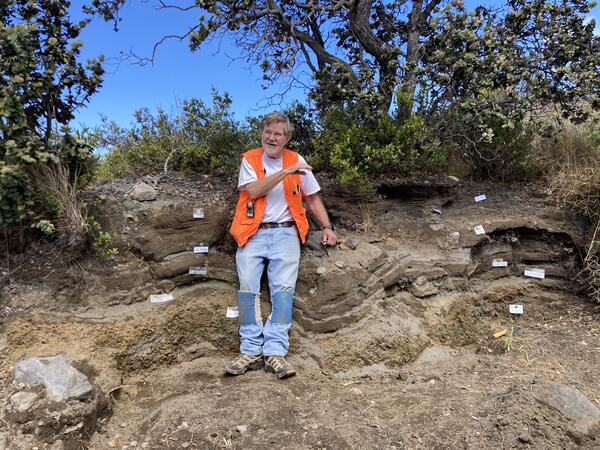
Don Swanson describing Keanakāko‘i Tephra deposits
Don Swanson describing Keanakāko‘i Tephra depositsDon Swanson describes the stratigraphy of Keanakāko‘i deposits near Uēkahuna Bluff at Kīlauea summit within Hawai‘i Volcanoes National Park.
Don Swanson describing Keanakāko‘i Tephra deposits
Don Swanson describing Keanakāko‘i Tephra depositsDon Swanson describes the stratigraphy of Keanakāko‘i deposits near Uēkahuna Bluff at Kīlauea summit within Hawai‘i Volcanoes National Park.

Eruptive activity resumes at west vent in Halema‘uma‘u
Eruptive activity resumes at west vent in Halema‘uma‘uEruptive activity resumed today in Halema‘uma‘u crater, at the summit of Kīlauea volcano, after a brief pause of several days. This photograph shows spattering and lava effusion from the west vent, which has built a steep spatter cone. USGS image by M. Patrick.
Eruptive activity resumes at west vent in Halema‘uma‘u
Eruptive activity resumes at west vent in Halema‘uma‘uEruptive activity resumed today in Halema‘uma‘u crater, at the summit of Kīlauea volcano, after a brief pause of several days. This photograph shows spattering and lava effusion from the west vent, which has built a steep spatter cone. USGS image by M. Patrick.

Halemaʻumaʻu lava pond on December 30, 2021
During recent multi-day pauses in the ongoing Kīlauea summit eruption, a small portion of the Halemaʻumaʻu lava lake has consistently remained active: a small, ovular lava pond just north of the briefly dormant western fissure.
During recent multi-day pauses in the ongoing Kīlauea summit eruption, a small portion of the Halemaʻumaʻu lava lake has consistently remained active: a small, ovular lava pond just north of the briefly dormant western fissure.

Island of Hawai‘i seismicity
Two weeks of earthquake activity preceding the September 29, 2021, eruption at Kīlauea summit. The regions of interest indicated on the map include: KS (Kīlauea summit); ML (Mauna Loa summit); P (Pāhala).
Two weeks of earthquake activity preceding the September 29, 2021, eruption at Kīlauea summit. The regions of interest indicated on the map include: KS (Kīlauea summit); ML (Mauna Loa summit); P (Pāhala).

Lava lake topography during an eruption pause
On the afternoon of December 27, 2021, the summit eruption of Kīlauea was paused and showed only intermittent and weak crustal foundering in the formerly active west side of the lava lake in Halema‘uma‘u. This photo, looking down and toward the east, shows the topography of the formerly active pond of lava during the eruption pause.
On the afternoon of December 27, 2021, the summit eruption of Kīlauea was paused and showed only intermittent and weak crustal foundering in the formerly active west side of the lava lake in Halema‘uma‘u. This photo, looking down and toward the east, shows the topography of the formerly active pond of lava during the eruption pause.

[V1cam] image taken December 23, 2021
View of the west vent in Halemaʻumaʻu and the lava lake, from the northwest rim of the caldera, looking east [V1cam]. Image taken December 23, 2021.
View of the west vent in Halemaʻumaʻu and the lava lake, from the northwest rim of the caldera, looking east [V1cam]. Image taken December 23, 2021.

Western half of the Halema‘uma‘u lava lake during eruption pause
Western half of the Halema‘uma‘u lava lake during eruption pauseActivity was very low during the helicopter overflight of Halema‘uma‘u, at Kīlauea summit, on the morning of December 21. This view shows the west vent (near center) and the western part of the lava lake, where only a tiny portion of the surface was weakly active. The lava lake, which is in a state of pause, now has exposed walls due to a drop in the surface.
Western half of the Halema‘uma‘u lava lake during eruption pause
Western half of the Halema‘uma‘u lava lake during eruption pauseActivity was very low during the helicopter overflight of Halema‘uma‘u, at Kīlauea summit, on the morning of December 21. This view shows the west vent (near center) and the western part of the lava lake, where only a tiny portion of the surface was weakly active. The lava lake, which is in a state of pause, now has exposed walls due to a drop in the surface.

The west vent and lava lake during a pause in Halema‘uma‘u activity
The west vent and lava lake during a pause in Halema‘uma‘u activityAn aerial view of the western portion of Halema‘uma‘u, at Kīlauea summit, during the December 21 helicopter overflight. Eruptive activity is paused, and only a weak gas plume was being emitted from the west vent (center right). Just north of (below) the west vent, a tiny pad of lava remained weakly active within the lake. USGS photo taken by D. Downs.
The west vent and lava lake during a pause in Halema‘uma‘u activity
The west vent and lava lake during a pause in Halema‘uma‘u activityAn aerial view of the western portion of Halema‘uma‘u, at Kīlauea summit, during the December 21 helicopter overflight. Eruptive activity is paused, and only a weak gas plume was being emitted from the west vent (center right). Just north of (below) the west vent, a tiny pad of lava remained weakly active within the lake. USGS photo taken by D. Downs.

Lava lake overflows onto a down-dropped block within Halema‘uma‘u
Lava lake overflows onto a down-dropped block within Halema‘uma‘uThe lava lake within Halema‘uma‘u, at Kīlauea summit, has slowly continued to rise over the past month. As the lake level rises, lava has flowed onto the lowest part of the lowest down-dropped block (right) from the 2018 Kīlauea summit collapse.
Lava lake overflows onto a down-dropped block within Halema‘uma‘u
Lava lake overflows onto a down-dropped block within Halema‘uma‘uThe lava lake within Halema‘uma‘u, at Kīlauea summit, has slowly continued to rise over the past month. As the lake level rises, lava has flowed onto the lowest part of the lowest down-dropped block (right) from the 2018 Kīlauea summit collapse.