U.S. flag

An official website of the United States government

Images

Images of Yellowstone.

Filter Total Items: 697
Three-panel figure showing scrubland vegetation (left), conifers (center), and lodgepole pines (right)
Modern vegetation on different geological substrates in Yellowstone

Modern vegetation on different geological substrates in Yellowstone.  Left: steppe/grassland on glacial clay found in places like Lamar and Hayden Valleys.  Center: Mixed conifer forest in the Absaroka andesite volcanic field in the eastern part of Yellowstone National Park.  Right: Lodgepole pine forest on Central Plateau rhyolite (hydrothermal grass

Modern vegetation on different geological substrates in Yellowstone.  Left: steppe/grassland on glacial clay found in places like Lamar and Hayden Valleys.  Center: Mixed conifer forest in the Absaroka andesite volcanic field in the eastern part of Yellowstone National Park.  Right: Lodgepole pine forest on Central Plateau rhyolite (hydrothermal grass

Vegetation history based on pollen records from three small lakes on different geological substrates in Yellowstone National
Vegetation history based on pollen records from three small lakes on different geological substrates in Yellowstone National Park

Vegetation history based on pollen records from three small lakes on different geological substrates in Yellowstone National Park.   Blue is open vegetation, light green is parkland, dark green is forest.  Top plot is from Slough Creek Pond, in a present grassland area dominated by glacial and lake sediment in the northeast part of Yellowstone Nationa

Bathymetric map of the West Thumb Basin, Yellowstone National Park

Bathymetric map of the West Thumb Basin showing numerous mapped active or inactive hydrothermal vent sites (small white circles) and sampled hot springs (white stars or larger white circles) and sediment cores (yellow diamonds).  The white-black line represents the 160,000-year-old West Thumb Caldera margin.  West Thumb Geyser Basin is near the southern en

Bathymetric map of the West Thumb Basin showing numerous mapped active or inactive hydrothermal vent sites (small white circles) and sampled hot springs (white stars or larger white circles) and sediment cores (yellow diamonds).  The white-black line represents the 160,000-year-old West Thumb Caldera margin.  West Thumb Geyser Basin is near the southern en

Plot showing frequency of rhyolite eruptions in the Yellowstone region over the past 1.3 million years
Schematic summary of rhyolite eruptions in the Yellowstone Plateau volcanic field over the past 1.3 million years

Schematic summary of rhyolite eruptions in the Yellowstone Plateau volcanic field over the past 1.3 million years. Smaller rhyolite eruptions are known intracaldera eruptions, meaning they occurred within existing caldera structures. Additional rhyolite eruptions that occurred outside the caldera are not included in the figure.

Schematic summary of rhyolite eruptions in the Yellowstone Plateau volcanic field over the past 1.3 million years. Smaller rhyolite eruptions are known intracaldera eruptions, meaning they occurred within existing caldera structures. Additional rhyolite eruptions that occurred outside the caldera are not included in the figure.

A brass-disk benchmark set in the top of a concrete post.  Mark is stamped "C9 1923 7337.580"
Benchmark C9, near Apollinaris Spring in Yellowstone National Park

Benchmark C9, installed by the US Coast and Geodetic Survey (now the National Geodetic Survey) in 1923 near Apollinaris Spring in Yellowstone National Park.  The number stamped into the mark, “7337.580,” is the elevation in feet that was determined by surveys the year the benchmark was established.  USGS photo by Michael Poland, September 4, 2024.

Benchmark C9, installed by the US Coast and Geodetic Survey (now the National Geodetic Survey) in 1923 near Apollinaris Spring in Yellowstone National Park.  The number stamped into the mark, “7337.580,” is the elevation in feet that was determined by surveys the year the benchmark was established.  USGS photo by Michael Poland, September 4, 2024.

Satellite images of a small lake in April and August 2024. The lake is surrounded by trees and, on one side, a geyser basin.
Satellite images of Nupahr Lake, Norris Geyser Basin, in 2024

High-resolution satellite images of Norris Geyser Basin showing the area of Porcelain Basin and Nuphar Lake (both images cover the same area).  In the left image, acquired on April 2, 2024, springs on Porcelain Terrace are full of water, and warm hydrothermal water is flowing into Nuphar Lake from the area circled in yellow.  This warm water kept the north

High-resolution satellite images of Norris Geyser Basin showing the area of Porcelain Basin and Nuphar Lake (both images cover the same area).  In the left image, acquired on April 2, 2024, springs on Porcelain Terrace are full of water, and warm hydrothermal water is flowing into Nuphar Lake from the area circled in yellow.  This warm water kept the north

Marsh in the foreground, treed hill in the background. Steam vent at base of hill. Blue sky above.
New steam vent that formed in 2024 near Nymph Lake, Yellowstone National Park

New steam vent at the base of a hill north of Nymph Lake, west of the highway and between Norris Geyser Basin and Roaring Mountain. USGS photo by Mike Poland, September 1, 2024.

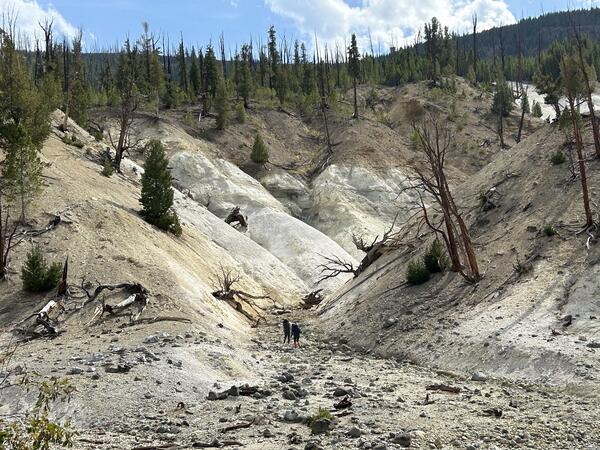
small V-shaped valley with tan/white walls and sporadic small trees
Death Gulch, Yellowstone National Park

USGS scientists equipped with gas masks and monitors exploring Death Gulch. Photo by Shaul Hurwitz, September 2024.

USGS scientists equipped with gas masks and monitors exploring Death Gulch. Photo by Shaul Hurwitz, September 2024.

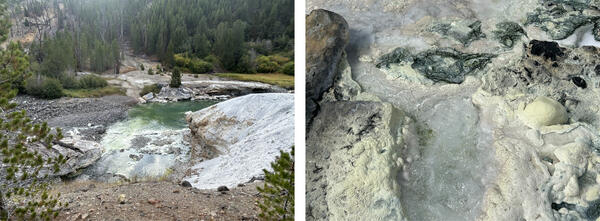
Two photos showing warm springs in a river, one zoomed out to show vegetation, another zoomed in on bubbling water
Wahb Springs, Yellowstone National Park

Wahb Springs in Yellowstone National Park.  Left: zoomed-out photo of the springs (photo by David Roth, September 2024). Right: close-up photo showing the unique organic material floating on the spring water (photo by Shaul Hurwitz, September 2024).

Wahb Springs in Yellowstone National Park.  Left: zoomed-out photo of the springs (photo by David Roth, September 2024). Right: close-up photo showing the unique organic material floating on the spring water (photo by Shaul Hurwitz, September 2024).

Dead lodgepole pine trees along the shoreline of a small lake.  Live trees are present away from the shore.
Dead trees along the edge of Nuphar Lake, Yellowstone National Park, in summer 2024

Photo of dead trees along the edge of Nuphar Lake.  The white staining at the base of the trees is a telltale sign that the trees were immersed in thermal water containing silica.  USGS photo by Mike Poland, September 1, 2024.

Marsh in foreground, tree-covered hill in background with a steam vent at it's base, all under blue sky
new thermal feature that formed in 2024 near Nymph Lake, Yellowstone National Park

Looking south from near a pullout along the Mammoth to Norris road just north of the Nymph Lake overlook. On the other side of the marsh is a tree-covered rhyolite lava flow, and at the base of the flow is a new thermal feature marked by a plume of steam and that formed in early August 2024.   Photo by Mike Poland, USGS, September 1, 2024.

Looking south from near a pullout along the Mammoth to Norris road just north of the Nymph Lake overlook. On the other side of the marsh is a tree-covered rhyolite lava flow, and at the base of the flow is a new thermal feature marked by a plume of steam and that formed in early August 2024.   Photo by Mike Poland, USGS, September 1, 2024.

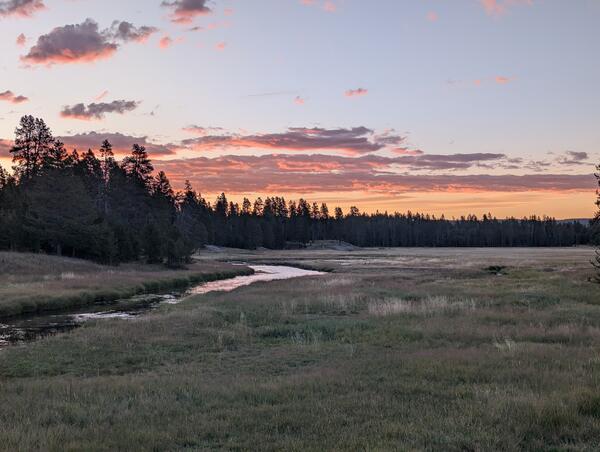
A river winds through a meadow at sunset, with pink clouds in the sky.  Trees are in the background.
Gibbon River near Norris Geyser Basin in Yellowstone National Park

Gibbon River near Norris Geyser Basin in Yellowstone National Park at sunset.  USGS Photo by Mike Poland, August 28, 2024.

Geologist on a hillside within a barren landscape of reddish and pale rocks
Geologist examining Lava Creek Tuff ash fall beds near Shell, Wyoming

Professor C.J.N. Wilson, FRS, pays due homage to the Lava Creek Tuff ashfall bed in a basin just east of Shell, Wyoming. Photo by Madison Myers, Montana State University, August 9, 2024.

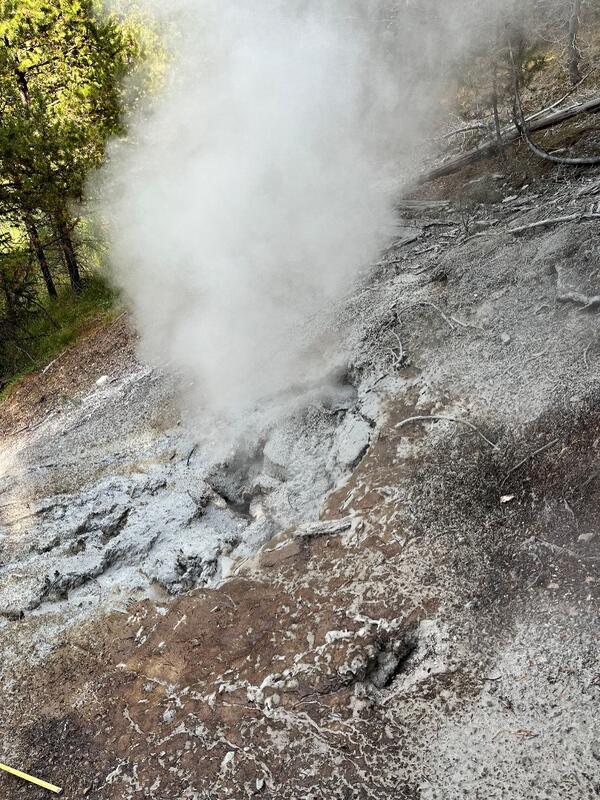
Steam vent in barren ground.  Light white silica coating dusts the surroundings.  Forested area in the background
Closeup view of hydrothermal feature that formed near Nymph Lake, Yellowstone National Park, in August 2024

Looking southeast at the hydrothermal feature that formed in August 2024 just north of Nymph Lake. Steam is emanating from a vent that is partially full of water to create the frying pan feature nestled in the newly formed vent. A thin grey layer of silica mud covers the vent area.  Photo by Jefferson Hungerford, Yellowstone National Park, August 2024.

Looking southeast at the hydrothermal feature that formed in August 2024 just north of Nymph Lake. Steam is emanating from a vent that is partially full of water to create the frying pan feature nestled in the newly formed vent. A thin grey layer of silica mud covers the vent area.  Photo by Jefferson Hungerford, Yellowstone National Park, August 2024.

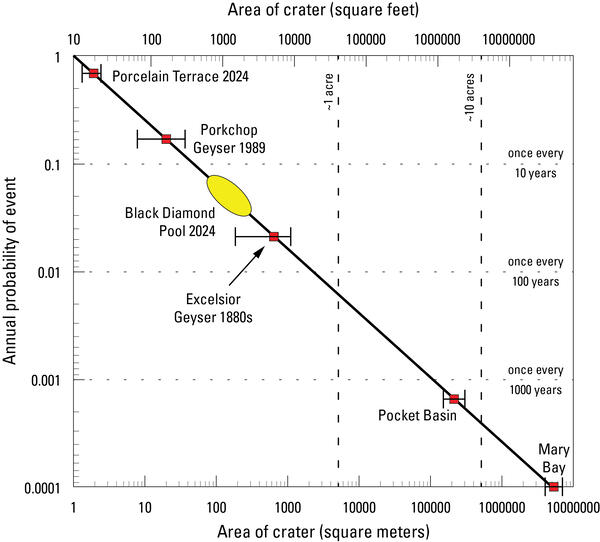
Plot of size versus annual probability for hydrothermal explosion craters in Yellowstone National Park

Plot of size versus annual probability for hydrothermal explosion craters in Yellowstone National Park. The line is a model based on the energy required to form a crater of a specific size, and it is fit to known hydrothermal explosion craters in Yellowstone National Park.

Photomicrograph showing water distribution in a quartz-hosted embayment, with greater concentrations at the embayment mouth. Includes a plot showing that the temperature in which the water circulated must have been about 500 degrees Celsius.
Water distribution in a quartz-hosted embayment from the Mesa Falls Tuff

(A) Water distribution in a quartz-hosted embayment measured with synchrotron Fourier Transform Infrared spectroscopy. Warmer colors indicate higher concentrations of water.  Dashed line shows a transect of water content that is modeled in panel (B) to indicate that the emplacement temperature of the ash flow deposit must have been about 500 °C (930 °F).

(A) Water distribution in a quartz-hosted embayment measured with synchrotron Fourier Transform Infrared spectroscopy. Warmer colors indicate higher concentrations of water.  Dashed line shows a transect of water content that is modeled in panel (B) to indicate that the emplacement temperature of the ash flow deposit must have been about 500 °C (930 °F).

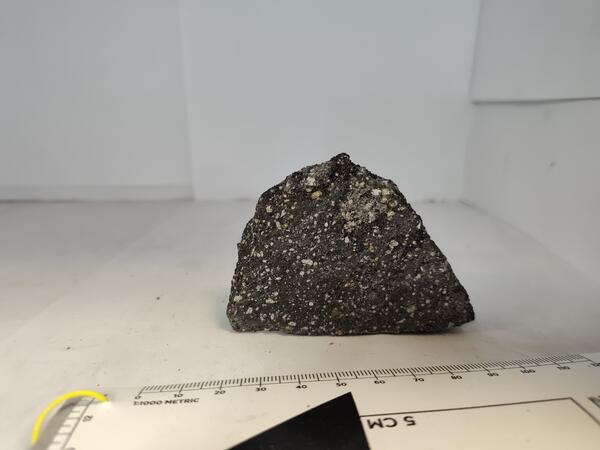
Fist sized sample of rock, black in color with white flecks
Hand sample of the Mount Jackson vitrophyre

A clean hand sample of the Mount Jackson vitrophyre. This sample has a black, glassy groundmass with large (1–3 mm, or a small fraction of an inch), white phenocrysts suspended in the glass. Photo by Liv Wheeler, Montana State University, August 2024.

A clean hand sample of the Mount Jackson vitrophyre. This sample has a black, glassy groundmass with large (1–3 mm, or a small fraction of an inch), white phenocrysts suspended in the glass. Photo by Liv Wheeler, Montana State University, August 2024.

Shaded relief location map for the East Gallatin-Reese Creek fault system in northwest Yellowstone National Park
A blue pool with an irregular edge surrounded by barren ground and yellow grass. A boardwalk is in the foreground;.
Abyss Pool, West Thumb Geyser Basin, Yellowstone National Park

Abyss Pool is about 16 m (53 ft) deep and contains alkaline-chloride hydrothermal fluids that in the summer of 2024 had a temperature of 181 °F (83 °C).

Frothy blue-green mud pots surrounded by grassy areas. Trees and Yellowstone Lake in the background under partly cloudy sky.
Mud pots in West Thumb Geyser Basin, Yellowstone National Park

Mud pots form in a few selected areas of West Thumb Geyser Basin where low-pH acidic fluids dissolve rocks and soil to produce clay-rich muds.  USGS photo by Pat Shanks, 2024.

Photomicrograph showing a quartz-hosted embayment from the Mesa Falls Tuff, accompanied by a map showing the location of the tuff in eastern Idaho.
Quartz-hosted embayment from the Mesa Falls Tuff

(A) Photomicrograph of a quartz-hosted embayment from the Mesa Falls Tuff. “MI” indicates a glassy inclusion of melt within the crystal. (B) Thickness (in centimeters) and extent of the Mesa Falls ash flow deposit (pink areas) and its source, Henrys Fork Caldera (dashed line).  Figure by Kenneth Befus, University of Texas at Austin.

(A) Photomicrograph of a quartz-hosted embayment from the Mesa Falls Tuff. “MI” indicates a glassy inclusion of melt within the crystal. (B) Thickness (in centimeters) and extent of the Mesa Falls ash flow deposit (pink areas) and its source, Henrys Fork Caldera (dashed line).  Figure by Kenneth Befus, University of Texas at Austin.

Was this page helpful?