U.S. flag

An official website of the United States government

Images

Images of Yellowstone.

Filter Total Items: 697
Morning Glory pool, before and after garbage clean out
Morning Glory Pool before and after garbage clean out, Yellowstone.

Morning Glory Pool used to be clear blue in color, as shown in the historic undated photo on the left (National Park Service photo by Rentchler).

1975 earthquake damage just south of Mammoth Hot Springs on the Mammoth-Norris highway

Photo of damage to the Mammoth-Norris highway, just south of Mammoth Hot Springs, caused by the June 30, 1975, magnitude-6 earthquake.  Haynes Inc. photo for the Deseret News.

Gibbon River in Gibbon Meadows immediate following the 1975 Yellowstone National Park earthquake

Gibbon River in Gibbon Meadows immediate following the June 30, 1975, magnitude-6 Yellowstone National Park earthquake.  The muddy color is due to increased sediment load.  NPS photo by Rick Hutchinson.

Shoshone Tukudika (Sheepeater) at Medicine Lodge Creek, Idaho, in 1871.
Shoshone Tukudika (Sheepeater) at Medicine Lodge Creek, Idaho, in 1871

Shoshone Tukudika (Sheepeater) men, women, and children at Medicine Lodge Creek, Idaho, in 1871. This photo was taken by U.S. Geological Survey employee William Henry Jackson.  Courtesy of National Park Service, Yellowstone National Park, YELL 8151.

Shoshone Tukudika (Sheepeater) men, women, and children at Medicine Lodge Creek, Idaho, in 1871. This photo was taken by U.S. Geological Survey employee William Henry Jackson.  Courtesy of National Park Service, Yellowstone National Park, YELL 8151.

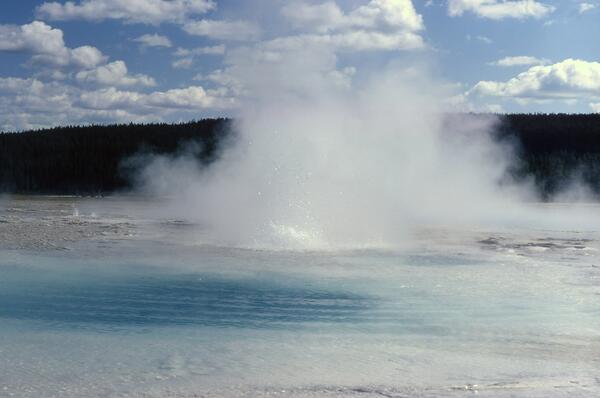
A geyser sprays water into the air. Foreground is barren with dead trees. Background is a tree-covered hill under blue sky.
Seismic geyser in Yellowstone’s Upper Geyser Basin during an eruption in 1969

Seismic geyser in Yellowstone’s Upper Geyser Basin during an eruption. Based on the study of George Marler and USGS scientist Donald E.

Eruptions from drill rods during research drilling in Yellowstone National Park, 1967–1968

Eruptions from drill rods during research drilling in Yellowstone National Park, 1967–1968. Left panel shows initial explosive eruption of water-steam mixture from open drill pipe in drill hole Y-5 (Rabbit Creek) on August 20, 1967.

Bob Fournier (left) and Don White (right) at the Y3 drilling site in Yellowstone National Park

Bob Fournier (left) and Don White (right) at the Y3 drilling site in Pocket Basin adjacent to Ojo Caliente, Lower Geyser Basin, Yellowstone National Park, in 1967.  USGS Photo.

Plot showing the solubility of amorphous silica in water as a function of temperature

The solubility of amorphous silica (solid silica with no crystal structure) in water as a function of temperature. When deep groundwater flows through hot rhyolite it can remove silica from the rhyolite (dissolve silica).

Pocket Basin orthophoto

This orthophoto of Pocket Basin, a hydrothermal explosion crater in Yellowstone National Park's Lower Geyser Basin, was created from aerial photos taken in 1965 that were corrected to have uniform scale for use in geologic mapping.

This orthophoto of Pocket Basin, a hydrothermal explosion crater in Yellowstone National Park's Lower Geyser Basin, was created from aerial photos taken in 1965 that were corrected to have uniform scale for use in geologic mapping.

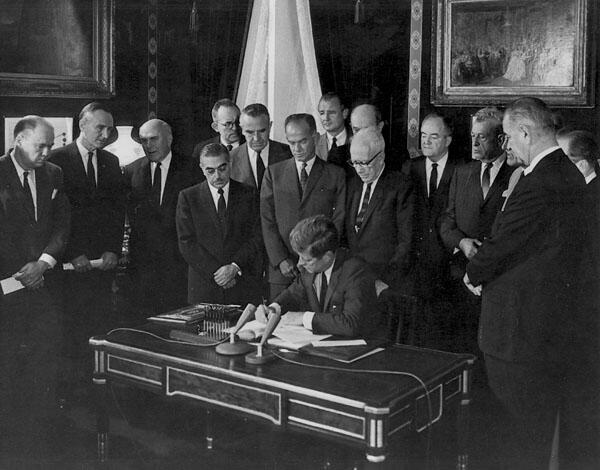
Black and white photo of President John F. Kennedy surrounded by people in suits signing a document
President Kennedy signs the nuclear test ban treaty for the United States in 1963

President Kennedy signs the nuclear test ban treaty for the United States in 1963. Photo from National Archives, Still Pictures Division, Department of State Collection 59-0, box 23 (https://nsarchive2.gwu.edu/NSAEBB/NSAEBB94/tb02.htm).

Early aerial thermal infrared images from Yellowstone National Park

Top: the first thermal infrared images of Yellowstone (1961).  Warm areas are brighter; cold areas are darker.  These images were published in: McLerran, J.H. and Morgan, J.O. (1965) Thermal mapping of Yellowstone National Park.

Top: the first thermal infrared images of Yellowstone (1961).  Warm areas are brighter; cold areas are darker.  These images were published in: McLerran, J.H. and Morgan, J.O. (1965) Thermal mapping of Yellowstone National Park.

Lower Geyser Basin from Great Fountain Geyser

View of Lower Geyser Basin. Note active thermal pools (Great Fountain Geyser) in the foreground with thermal grasslands—kept treeless by hot soils—and lodgepole pine forest in the distance. Photo by George Marler, 1959.

View of Lower Geyser Basin. Note active thermal pools (Great Fountain Geyser) in the foreground with thermal grasslands—kept treeless by hot soils—and lodgepole pine forest in the distance. Photo by George Marler, 1959.

Aerial view of Black Opal Pool, Black Diamond Pool, and part of Wall Pool, all in Biscuit Basin, Yellowstone National Park, taken in 1959

Aerial view of Black Opal Pool, Black Diamond Pool, and part of Wall Pool, all in Biscuit Basin, Yellowstone National Park, taken in 1959 sometime after the Hebgen Lake earthquake (which occurred on August 17 of that year).

Was this page helpful?