Fyke net in Wrangell St. Elias National Park. Sam Graf (NPS – LACL) adjusts a fyke net installed in a lake in Wrangell St. Elias National Park. Fyke nets are used to non-lethally capture fish.
Images
Browse images from a wide range of science topics covered by USGS. All items in this gallery are considered public domain unless otherwise noted.
Fyke net in Wrangell St. Elias National Park. Sam Graf (NPS – LACL) adjusts a fyke net installed in a lake in Wrangell St. Elias National Park. Fyke nets are used to non-lethally capture fish.
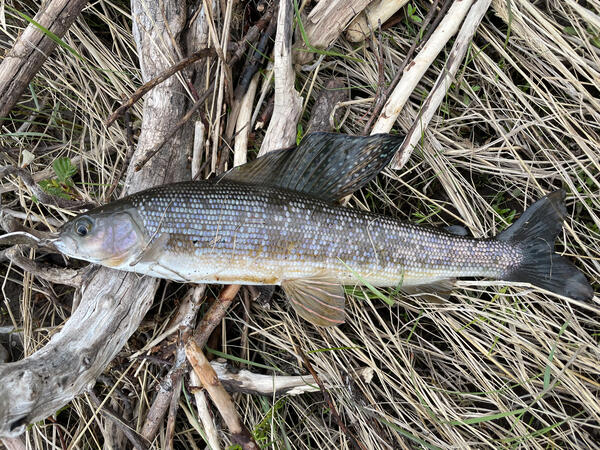
Arctic grayling in Wrangell St. Elias National Park
Arctic grayling in Wrangell St. Elias National ParkArctic grayling (Thymallus arcticus) in Wrangell St. Elias National Park. Arctic grayling were collected as part of a study examining mercury in lake food webs.
Arctic grayling in Wrangell St. Elias National Park
Arctic grayling in Wrangell St. Elias National ParkArctic grayling (Thymallus arcticus) in Wrangell St. Elias National Park. Arctic grayling were collected as part of a study examining mercury in lake food webs.
Lake trout with stomach contents in Wrangell St. Elias National Park. Dorsal muscle collection and stomach content analysis are used to evaluate biomagnification of mercury in Lake trout (Salvelinus namaycush). Stomach contents visible below the fish consist primarily of slimy sculpin (Cottus cognatus).
Collecting benthic macroinvertebrates in Wrangell St. Elias National Park
Collecting benthic macroinvertebrates in Wrangell St. Elias National ParkSam Graf (NPS – LACL) collects benthic macroinvertebrates using an Eckman grab in Wrangell St. Elias National Park as part of a study examining mercury in lake food webs. Disclaimer statement: Any use of trade, firm, or product names is for descriptive purposes only and does not imply endorsement by the U.S. Government.
Collecting benthic macroinvertebrates in Wrangell St. Elias National Park
Collecting benthic macroinvertebrates in Wrangell St. Elias National ParkSam Graf (NPS – LACL) collects benthic macroinvertebrates using an Eckman grab in Wrangell St. Elias National Park as part of a study examining mercury in lake food webs. Disclaimer statement: Any use of trade, firm, or product names is for descriptive purposes only and does not imply endorsement by the U.S. Government.
Collecting benthic macroinvertebrates in Wrangell St. Elias National Park. Sarah Laske (USGS – ASC) collects benthic macroinvertebrates using a kick net in a lake in Wrangell St. Elias National Park, Alaska, as part of a study examining mercury in lake food webs.
Collecting zooplankton in Wrangell St. Elias National Park
Collecting zooplankton in Wrangell St. Elias National ParkSarah Laske (USGS - ASC) collects zooplankton from a lake using a plankton net in Wrangell St. Elias National Park as part of a study examining mercury in lake food webs. Sam Graf (NPS - LACL) angles.
Collecting zooplankton in Wrangell St. Elias National Park
Collecting zooplankton in Wrangell St. Elias National ParkSarah Laske (USGS - ASC) collects zooplankton from a lake using a plankton net in Wrangell St. Elias National Park as part of a study examining mercury in lake food webs. Sam Graf (NPS - LACL) angles.
Example of a screen capture of machine learning assisted image processing with OtterChecker9000 from the USFWS aerial survey for sea otters in Southeast AK.
Tributary of Agashashok River, Noatak National Park and Preserve, Alaska
Tributary of Agashashok River, Noatak National Park and Preserve, AlaskaTributary of Agashashok River located in the Noatak National Park and Preserve, Alaska. Recent observations from Arctic Alaska indicate that waters draining permafrost landscapes may be susceptible to iron and carbon mobilization following thaw.
Tributary of Agashashok River, Noatak National Park and Preserve, Alaska
Tributary of Agashashok River, Noatak National Park and Preserve, AlaskaTributary of Agashashok River located in the Noatak National Park and Preserve, Alaska. Recent observations from Arctic Alaska indicate that waters draining permafrost landscapes may be susceptible to iron and carbon mobilization following thaw.
Three marine mammal trainers measure a healthy female walrus
Three marine mammal trainers measure a healthy female walrusSea World Orlando marine mammal trainers, Kelly Trotto, Josh Boepple and Matt Oddi, measure a healthy mature female walrus in support of a USGS study that seeks to develop methods to monitor walrus body condition from survey drones flown high above walruses where they rest on shore. With this new tool, USGS intends to examine the environmental factors that affe
Three marine mammal trainers measure a healthy female walrus
Three marine mammal trainers measure a healthy female walrusSea World Orlando marine mammal trainers, Kelly Trotto, Josh Boepple and Matt Oddi, measure a healthy mature female walrus in support of a USGS study that seeks to develop methods to monitor walrus body condition from survey drones flown high above walruses where they rest on shore. With this new tool, USGS intends to examine the environmental factors that affe
Laura Geissinger watching sea otters through a spotting scope
Laura Geissinger watching sea otters through a spotting scopeGraduate student Laura Geissinger looks through a spotting scope. The student is watching sea otters in Kachemak Bay forage. USGS researchers spend hundreds of hours annually observing sea otter foraging behavior to document prey composition and energy recovery rates.
Laura Geissinger watching sea otters through a spotting scope
Laura Geissinger watching sea otters through a spotting scopeGraduate student Laura Geissinger looks through a spotting scope. The student is watching sea otters in Kachemak Bay forage. USGS researchers spend hundreds of hours annually observing sea otter foraging behavior to document prey composition and energy recovery rates.
Walrus at SeaWorld Orlando, Florida as part of USGS research
Walrus at SeaWorld Orlando, Florida as part of USGS researchAn adult female walrus being positioned by marine mammal trainers at SeaWorld Orlando, Florida for measurement using aerial photographs (see camera at the top of the image). These images were taken as part of a USGS study in collaboration with zoos and aquaria in the United States and western Europe for validating aerial imagery as a method for monitoring the b
Walrus at SeaWorld Orlando, Florida as part of USGS research
Walrus at SeaWorld Orlando, Florida as part of USGS researchAn adult female walrus being positioned by marine mammal trainers at SeaWorld Orlando, Florida for measurement using aerial photographs (see camera at the top of the image). These images were taken as part of a USGS study in collaboration with zoos and aquaria in the United States and western Europe for validating aerial imagery as a method for monitoring the b
Image depicting the new camera system USGS, FWS, and NPS are using to conduct photo-based aerial surveys for sea otters.
Study site locations for waterbird and Arctic lake ecosystem research on the Arctic Coastal Plain of Alaska
Study site locations for waterbird and Arctic lake ecosystem research on the Arctic Coastal Plain of AlaskaThe Teshekpuk Lake region was designated as a Special Area in 1977 by the Secretary of the Interior, Cecil Andrus. The map shows the approximate boundary of the Special Area in 2008, 2013, and 2020.
Study site locations for waterbird and Arctic lake ecosystem research on the Arctic Coastal Plain of Alaska
Study site locations for waterbird and Arctic lake ecosystem research on the Arctic Coastal Plain of AlaskaThe Teshekpuk Lake region was designated as a Special Area in 1977 by the Secretary of the Interior, Cecil Andrus. The map shows the approximate boundary of the Special Area in 2008, 2013, and 2020.
Marine mammal trainers measure a healthy female walrus
Marine mammal trainers measure a healthy female walrusIndianapolis Zoo marine mammal trainers, Erika Allen and Sydney Pitts, measure a healthy female walrus in support of a USGS study that seeks to develop methods to monitor walrus body condition from survey drones flown high above walruses where they rest on shore. With this new tool, USGS intends to examine the environmental factors that affect walrus body condi
Marine mammal trainers measure a healthy female walrus
Marine mammal trainers measure a healthy female walrusIndianapolis Zoo marine mammal trainers, Erika Allen and Sydney Pitts, measure a healthy female walrus in support of a USGS study that seeks to develop methods to monitor walrus body condition from survey drones flown high above walruses where they rest on shore. With this new tool, USGS intends to examine the environmental factors that affect walrus body condi
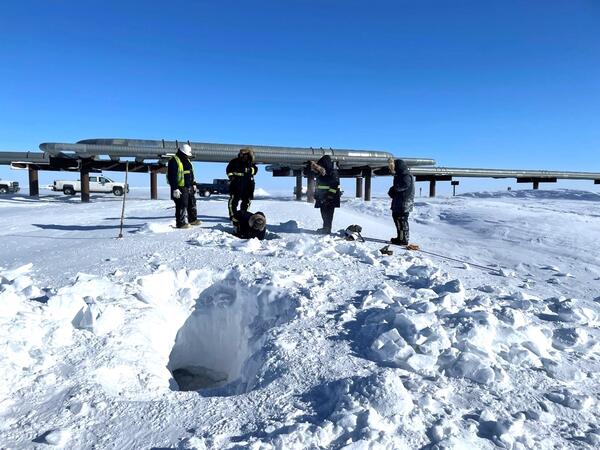
Sagavanirktok River Winter Streamflow Measurement at USGS Station 15908000
Sagavanirktok River Winter Streamflow Measurement at USGS Station 15908000Sagavanirktok River Winter Streamflow Measurement at USGS Station 15908000. Ice augers are used to drill through river ice in order to measure ice thickness, water depth, and water velocity under the ice. The total streamflow under the ice is computed with these measurements from 25 holes across the channel.
Sagavanirktok River Winter Streamflow Measurement at USGS Station 15908000
Sagavanirktok River Winter Streamflow Measurement at USGS Station 15908000Sagavanirktok River Winter Streamflow Measurement at USGS Station 15908000. Ice augers are used to drill through river ice in order to measure ice thickness, water depth, and water velocity under the ice. The total streamflow under the ice is computed with these measurements from 25 holes across the channel.
Intern designs graphic showing how USGS collects and releases bird species checklist data to the public
Intern designs graphic showing how USGS collects and releases bird species checklist data to the publicThis is a graphical abstract depicting the process that the USGS Alaska Science Center uses for compiling and releasing bird species checklist data to the public via USGS and eBird. Scientists from the USGS Alaska Science Center regularly work in remote field camps, often for days or weeks at a time.
Intern designs graphic showing how USGS collects and releases bird species checklist data to the public
Intern designs graphic showing how USGS collects and releases bird species checklist data to the publicThis is a graphical abstract depicting the process that the USGS Alaska Science Center uses for compiling and releasing bird species checklist data to the public via USGS and eBird. Scientists from the USGS Alaska Science Center regularly work in remote field camps, often for days or weeks at a time.
USGS Alaska Science Center scientists and industry collaborators examine features of a vacated maternal polar bear den near the Alyeska oil pipeline in northern Alaska to determine how to more reliably locate dens that occur near industrial activities.
Cross section of a lake trout (Salvelinus namaycush) otolith collected from a fish in Lake Clark National Park. Otoliths, also known as 'earstones' are hard, calcium carbonate structures located directly behind the brain of bony fishes.
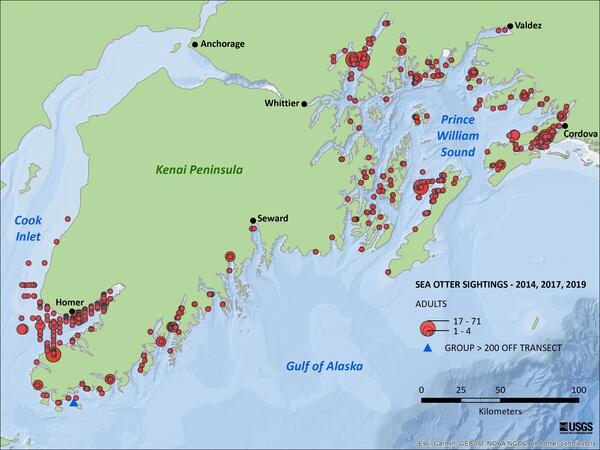
Distribution map of sea otters in southcentral Alaska
Distribution map of sea otters in southcentral AlaskaDistribution map of sea otters in southcentral Alaska from aerial surveys flown in 2014, 2017, and 2019.
Distribution map of sea otters in southcentral Alaska
Distribution map of sea otters in southcentral AlaskaDistribution map of sea otters in southcentral Alaska from aerial surveys flown in 2014, 2017, and 2019.
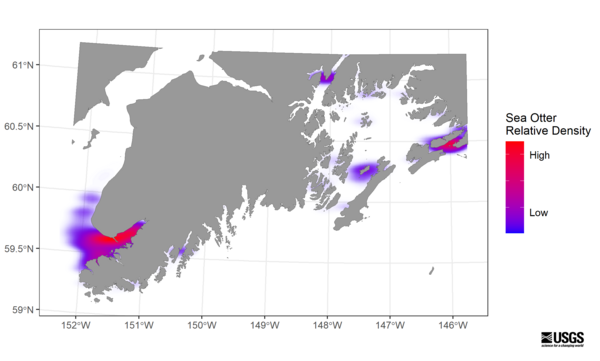
Density estimate of sea otters in southcentral Alaska
Density estimate of sea otters in southcentral AlaskaDensity estimate of sea otters in southcentral Alaska from aerial surveys flown in 2014, 2017, and 2019. Sea otters in southcentral Alaska are the northernmost stock of sea otters and a keystone predator because they are known for structuring nearshore marine ecosystems through their feeding habits. Biologists with the USGS and USFWS conducted aerial
Density estimate of sea otters in southcentral Alaska
Density estimate of sea otters in southcentral AlaskaDensity estimate of sea otters in southcentral Alaska from aerial surveys flown in 2014, 2017, and 2019. Sea otters in southcentral Alaska are the northernmost stock of sea otters and a keystone predator because they are known for structuring nearshore marine ecosystems through their feeding habits. Biologists with the USGS and USFWS conducted aerial
USGS Alaska Science Center scientists, Danielle Gerik, Bronwen Wang, and Anchorage School District student volunteer, Gabe Gray count and identify birds for the 2021 Anchorage Christmas Bird Count at Prospect Heights, Anchorage, Alaska.