



The Turnagain Heights landslide in Anchorage occurred along a steep bluff fronting Knik Arm of Cook Inlet. Its length, which was parallel to the bluff, was about one and half miles; its width was about a quarter to half a mile. This landslide reduced to rubble many of the finer homes of the city of Anchorage.
Images
Browse images from a wide range of science topics covered by USGS. All items in this gallery are considered public domain unless otherwise noted.
Filter Total Items: 1611

Turnagain Heights landslide, Anchorage
The Turnagain Heights landslide in Anchorage occurred along a steep bluff fronting Knik Arm of Cook Inlet. Its length, which was parallel to the bluff, was about one and half miles; its width was about a quarter to half a mile. This landslide reduced to rubble many of the finer homes of the city of Anchorage.

Turnagain Heights landslide damage, Anchorage
Close-up of damaged homes at Turnagain Heights landslide, Anchorage from 1964 earthquake.
Close-up of damaged homes at Turnagain Heights landslide, Anchorage from 1964 earthquake.
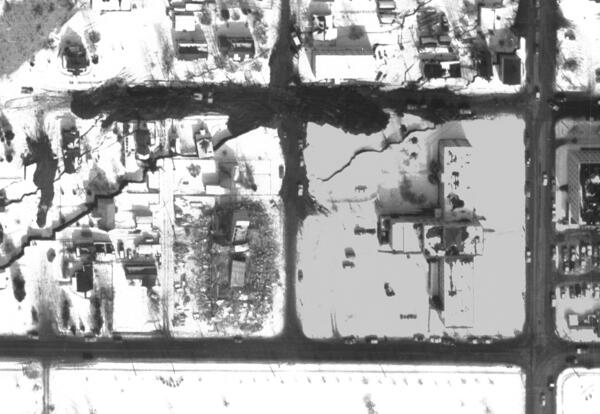
St. Mary's Residence - Old Providence Hospital
1964 aerial photograph of St. Mary's Residence and the nearby Four Seasons Apartment Building (#25 on map), Anchorage, Alaska. copyright: Air Photo Tech - NV5 Geospatial
1964 aerial photograph of St. Mary's Residence and the nearby Four Seasons Apartment Building (#25 on map), Anchorage, Alaska. copyright: Air Photo Tech - NV5 Geospatial

Fourth Avenue near C Street collapse
Collapse of Fourth Avenue near C Street, Anchorage, due to a landslide caused by earthquake. Anchorage, Anchorage District, Cook Inlet Region, Alaska. (Photo by U.S. Army). Published as Figure 45 in U.S. Geological Survey. Professional Paper 541. 1966.
Collapse of Fourth Avenue near C Street, Anchorage, due to a landslide caused by earthquake. Anchorage, Anchorage District, Cook Inlet Region, Alaska. (Photo by U.S. Army). Published as Figure 45 in U.S. Geological Survey. Professional Paper 541. 1966.

Anchorage municipal wharf area
Anchorage municipal wharf area shortly after the earthquake at low tide. The main dock was only slightly damaged, but the older Army dock (upper left) was ruined. Vibration and ground fractures damaged some structures in the port area, including the petroleum tank (lower right). Photo by U.S. Army.
Anchorage municipal wharf area shortly after the earthquake at low tide. The main dock was only slightly damaged, but the older Army dock (upper left) was ruined. Vibration and ground fractures damaged some structures in the port area, including the petroleum tank (lower right). Photo by U.S. Army.

Ruptured fuel tank, Alaska Native Hospital
Close-up of the compressional buckle, the ruptured fuel tank, and the revetment at the foot of the landslide near the Alaska Native Hospital in Anchorage.
Close-up of the compressional buckle, the ruptured fuel tank, and the revetment at the foot of the landslide near the Alaska Native Hospital in Anchorage.

Wreckage of J.C. Penney Department Store at Fifth Avenue and D Street
Wreckage of J.C. Penney Department Store at Fifth Avenue and D StreetAlbum caption: Wreckage of the J.C. Penney's Department Store at Fifth Avenue and D Street. Building failed after sustained seismic shaking. Most of rubble has been cleared from the streets. Anchorage, Anchorage District, Cook Inlet Region, Alaska, 1964. (Photo by George Plafker). Published as Figure 5 in U.S. Geological Survey. Professional Paper 542-A. 1965.
Wreckage of J.C. Penney Department Store at Fifth Avenue and D Street
Wreckage of J.C. Penney Department Store at Fifth Avenue and D StreetAlbum caption: Wreckage of the J.C. Penney's Department Store at Fifth Avenue and D Street. Building failed after sustained seismic shaking. Most of rubble has been cleared from the streets. Anchorage, Anchorage District, Cook Inlet Region, Alaska, 1964. (Photo by George Plafker). Published as Figure 5 in U.S. Geological Survey. Professional Paper 542-A. 1965.

The 1200 L Street Building
The 1200 "L" Street Building in Anchorage, a fourteen-story reinforced concrete apartment building, was severely damaged during the earthquake. One the main exterior piers (the white bearing walls without windows)shown in this slide, failed at the second floor, exposing the steel reinforced bars within the concrete.
The 1200 "L" Street Building in Anchorage, a fourteen-story reinforced concrete apartment building, was severely damaged during the earthquake. One the main exterior piers (the white bearing walls without windows)shown in this slide, failed at the second floor, exposing the steel reinforced bars within the concrete.

Turnagain Heights landslide, Anchorage
Part of the Turnagain Heights landslide in Anchorage shortly after the earthquake.
Anchorage, Anchorage District, Cook Inlet Region, Alaska, 1964.
Photo by W.R. Hansen, 1964.
Published in Frontispiece, U.S. Geological Survey Professional paper 541, 1966.
Part of the Turnagain Heights landslide in Anchorage shortly after the earthquake.
Anchorage, Anchorage District, Cook Inlet Region, Alaska, 1964.
Photo by W.R. Hansen, 1964.
Published in Frontispiece, U.S. Geological Survey Professional paper 541, 1966.

Damage to houses from landslides in Turnagain Heights
Damage to houses from landslides in Turnagain HeightsAlaska Earthquake March 27, 1964. Damage to houses from landslides in Turnagain Heights in Anchorage. Photo by R.A. Page.
Pages 24-25, Earthquake Information Bulletin, v.12, no.1.
Damage to houses from landslides in Turnagain Heights
Damage to houses from landslides in Turnagain HeightsAlaska Earthquake March 27, 1964. Damage to houses from landslides in Turnagain Heights in Anchorage. Photo by R.A. Page.
Pages 24-25, Earthquake Information Bulletin, v.12, no.1.

Denali Theater, Fourth Avenue landslide
The marquee of the Denali Theater, which was in the graben of the Fourth Avenue landslide in Anchorage, subsided until it came to rest on the sidewalk in front of the theater, which was on ground not involved in the landslide.
The marquee of the Denali Theater, which was in the graben of the Fourth Avenue landslide in Anchorage, subsided until it came to rest on the sidewalk in front of the theater, which was on ground not involved in the landslide.

Fourth Avenue landslide scarp, Anchorage, Alaska. 1964.
Fourth Avenue landslide scarp, Anchorage, Alaska. 1964.Alaska Earthquake March 27, 1964.

" L" Street landslide, Anchorage, Alaska
A subsidence trough (or graben) formed at the head of the L Street landslide in Anchorage during the earthquake. The slide block, which is virtually unbroken ground to the left of the graben, moved to the left. The subsidence trough sank 7 to 10 feet in response to 11 feet of horizontal movement of the slide block.
A subsidence trough (or graben) formed at the head of the L Street landslide in Anchorage during the earthquake. The slide block, which is virtually unbroken ground to the left of the graben, moved to the left. The subsidence trough sank 7 to 10 feet in response to 11 feet of horizontal movement of the slide block.

The Fifth Avenue Chrysler Center
Damage to building from seismic vibration. The Fifth Avenue Chrysler Center in Anchorage was constructed of pre-cast, pre-stressed concrete roof T's which rested on concrete block walls in most parts of the building. However, in the showroom area the roof T's rested on reinforced concrete columns.
Damage to building from seismic vibration. The Fifth Avenue Chrysler Center in Anchorage was constructed of pre-cast, pre-stressed concrete roof T's which rested on concrete block walls in most parts of the building. However, in the showroom area the roof T's rested on reinforced concrete columns.

The Alaska Sales and Service building
Damage to building from seismic vibrations. The Alaska Sales and Service building in Anchorage, which was under construction, partially collapsed during the earthquake. The building was constructed of pre-cast and pre-stressed concrete roof "T"s which rested on pre-cast reinforced-concrete T-columns, and it had pre-cast reinforced-concrete walls.
Damage to building from seismic vibrations. The Alaska Sales and Service building in Anchorage, which was under construction, partially collapsed during the earthquake. The building was constructed of pre-cast and pre-stressed concrete roof "T"s which rested on pre-cast reinforced-concrete T-columns, and it had pre-cast reinforced-concrete walls.

The Four Seasons Apartments, Anchorage, Alaska
The Four Seasons Apartments in Anchorage was a six-story lift-slab reinforced concrete building which crashed to the ground during the earthquake. The building was under construction, but structurally completed, at the time of the earthquake.
The Four Seasons Apartments in Anchorage was a six-story lift-slab reinforced concrete building which crashed to the ground during the earthquake. The building was under construction, but structurally completed, at the time of the earthquake.

Anchorage International Airport Tower
The control tower at Anchorage International Airport fell to the ground during the earthquake. It was a split-level structure that was seven stories high on one side and built of reinforced concrete.
The control tower at Anchorage International Airport fell to the ground during the earthquake. It was a split-level structure that was seven stories high on one side and built of reinforced concrete.

L street slide annotated
Annotated photo of ake00346. Album caption: A subsidence trough (or graben) formed at the head of the "L" Street landslide in Anchorage during the earthquake. The slide block, which is the virtually unbroken ground tot he left of graben, moved to the left. The subsidence trough sank 7 to 10 feet in response to 11 feet of horizontal movement of the slide block.
Annotated photo of ake00346. Album caption: A subsidence trough (or graben) formed at the head of the "L" Street landslide in Anchorage during the earthquake. The slide block, which is the virtually unbroken ground tot he left of graben, moved to the left. The subsidence trough sank 7 to 10 feet in response to 11 feet of horizontal movement of the slide block.

Pre-1964 Landslide Scarp
Arc-shaped bluff that many interpret to be evidence of landsliding during a pre-1964 earthquake of unknown age. The Frank and Maxine Reed Family Staircase at this stop was built to accommodate pedestrian traffic over a steep bluff along West Twelfth Avenue which is made discontinuous by the bluff. There was no sliding on this feature in 1964.
Arc-shaped bluff that many interpret to be evidence of landsliding during a pre-1964 earthquake of unknown age. The Frank and Maxine Reed Family Staircase at this stop was built to accommodate pedestrian traffic over a steep bluff along West Twelfth Avenue which is made discontinuous by the bluff. There was no sliding on this feature in 1964.
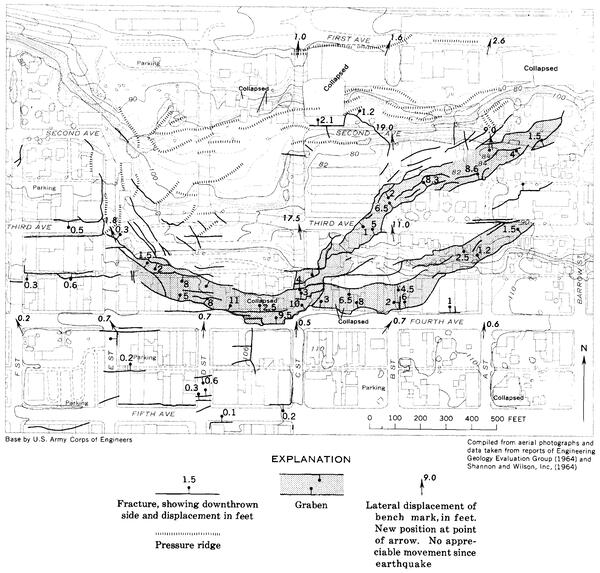
Buttress Park
This map shows the extent of ground disrupted by the Fourth Avenue Slide and some of the measured displacements. Much of this area north of Third Avenue has since been re-graded and reinforced. The North-facing slope dropping into Ship Creek has been reinforced at its toe with a buried gravel buttress, giving the park its name.
This map shows the extent of ground disrupted by the Fourth Avenue Slide and some of the measured displacements. Much of this area north of Third Avenue has since been re-graded and reinforced. The North-facing slope dropping into Ship Creek has been reinforced at its toe with a buried gravel buttress, giving the park its name.

Annotated Native Hospital landslide in Anchorage District, Cook Inlet Region, Alaska
Annotated Native Hospital landslide in Anchorage District, Cook Inlet Region, AlaskaNative Hospital landslide in Anchorage, showing graben and pressure ridge. The scar of an older landslide is transected by the slide of March 27. Photo lables the hospital and two areas of the main scarp on the 1964 landslide.
Annotated Native Hospital landslide in Anchorage District, Cook Inlet Region, Alaska
Annotated Native Hospital landslide in Anchorage District, Cook Inlet Region, AlaskaNative Hospital landslide in Anchorage, showing graben and pressure ridge. The scar of an older landslide is transected by the slide of March 27. Photo lables the hospital and two areas of the main scarp on the 1964 landslide.